

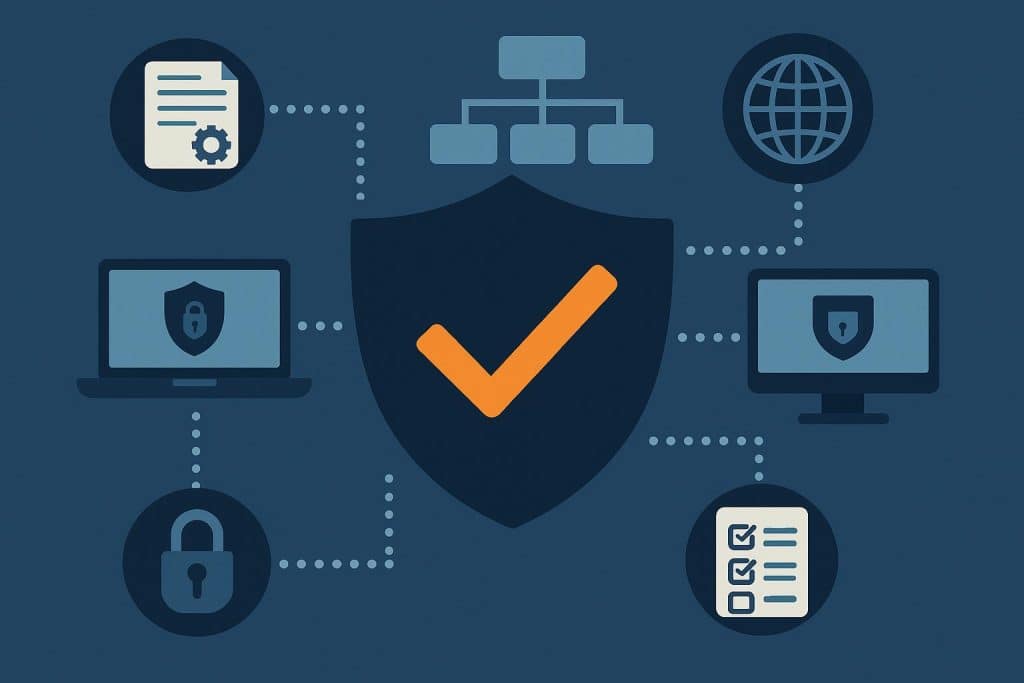
As more companies move to remote settings, employees rely on multiple endpoints, laptops, tablets, and smartphones, to access corporate data. These devices remain untracked and vulnerable to cybersecurity attacks.
IT and security teams face constant pressure to maintain consistent device controls across a dispersed workforce.
Companies are required to follow regulatory standards such as ISO (International Standard Organization) and CIS (Center for Internet Security). This allows IT teams to keep every endpoint properly inventoried, configured, and protected under consistent governance.
In this article, we’ll share how you can map your device policy architecture to meet ISO 27001 and CIS standards.
Core Documents for Device Policy Architecture
The first step in developing a device policy architecture is setting strong IT policies and procedures for accountability and behavior. This helps everyone understand their role in keeping company devices and data safe.
Here’s a complete breakdown of documents you need to establish for your policy planning:
Acceptable Use Policy (AUP)
An Acceptable Use Policy (AUP) defines how employees can use company devices and data. It explains the proper way to handle corporate resources and encourages responsible behavior that reduces security risks.
The AUP lists allowed and prohibited activities, such as installing software, sharing credentials, or connecting to unsafe networks.
Laptop Agreements
A laptop agreement outlines an employee’s responsibilities when using company-issued devices. It covers how devices are handled, stored, and returned, helping build accountability from the start.
These agreements often include rules for encryption, remote wipe consent, and software updates.
Exception Handling
Exception handling defines how to manage situations where a device or user needs to operate outside standard policy. This could include using unsupported software or accessing restricted systems for specific tasks.
Each exception should be documented, approved, and reviewed regularly to avoid long-term risk.
Bring Your Own Device (BYOD) Policy
A BYOD policy defines how employees can securely use their personal devices to access company data. It outlines what types of devices are allowed, the security settings required, and how company information is separated from personal data.
According to a report, 82% of organizations have implemented the BYOD model, while 90% of employees use both personal and company devices during work.
Implementing a strict BYOD documentation protects corporate assets while maintaining employee privacy. It may include rules for data encryption, app-based access, and remote wipe permissions.
Mapping Device Policies with Global Security Frameworks
Mapping is the process of linking your organization’s internal device policies to external security standards. It shows how each rule supports a specific compliance requirement. This connection helps teams prove that their security practices are both intentional and measurable.
Most organizations use ISO 27001 for governance and the CIS Baselines for technical configurations. Here’s an example of how these global security frameworks fit your IT policies:
ISO 27001 Annex A Controls
ISO 27001 is an international standard that guides how organizations manage information security. Its Annex A lists best-practice controls for protecting systems, data, and devices. These cover access management, encryption, software installation, and incident response.
When you map device policies to these controls, you’re linking your internal rules with the standard’s requirements. For example, a laptop encryption rule connects to Annex A 8.24 on cryptography. Access permissions relate to Annex A 5.15 on access control, and limits on software installation tie to Annex A 8.19.
This process helps confirm that your policies align with global security expectations and makes audits easy. It also shows that your controls are built on a trusted framework recognized by partners and regulators.
CIS Baselines for Windows and Other Platforms
The Center for Internet Security (CIS) Baselines provide detailed configuration guidelines for securing different systems such as Windows, macOS, iOS, and Android.
ISO 27001 focuses on what security controls an organization should have, while CIS tells you how to apply them in practice. Each baseline offers step-by-step settings to secure devices. This includes password rules, encryption, system logging, and software management.
For example, the CIS Controls include practical safeguards such as:
- Secure Configuration of Enterprise Assets (Control 4): Secure device settings to reduce attack surfaces.
- Account Management (Control 5): Keep user access limited and up to date.
- Continuous Vulnerability Management (Control 7): Make sure systems are scanned and patched regularly.
- Audit Log Management (Control 8): Keep activity logs centralized for visibility.
- Malware Defenses (Control 10): Use modern endpoint protection tools across all platforms.
These technical baselines help organizations translate ISO 27001’s broad requirements into measurable device actions.
Mapping ISO 27001 to CIS gives companies both strategic and operational alignment. This helps you create a consistent device policy architecture that’s easier to audit. It also makes maintenance simpler across different operating systems and remote devices.
Maintaining and Proving Compliance
Compliance frameworks like ISO 27001 and the CIS Controls expect organizations to define policies and show proof of compliance. You must provide clear ownership, verifiable evidence, and a review cadence.
- Ownership is handled by control owners who are responsible for each security control in practice, including those tied to remote asset management.
- Evidence is the record that proves a policy is active. This can include screenshots from MDM tools, audit reports, or access review logs.
- Cadence is how often controls are reviewed to maintain compliance. These can be regular monthly, quarterly, or annual checks.
These three elements make compliance part of everyday operations. They help organizations show that security controls are consistently managed and proven over time.
Bottom Line
A well-structured device policy architecture connects people, processes, and technology through a clear framework. When policies are mapped to ISO 27001 and CIS standards, it helps IT teams track compliance across every device remotely.
Ultimately, this supports transparency during audits, strengthens accountability, and helps teams respond to cyberthreats without rebuilding their entire system.