

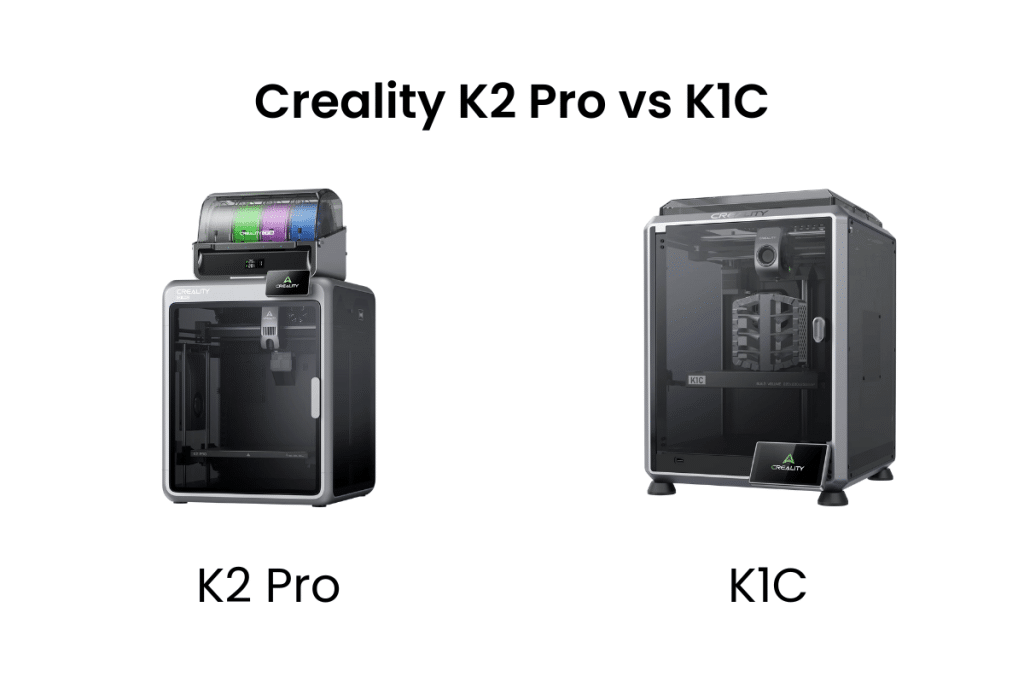
Creality continues to evolve its professional lineup, and two models excel for anyone planning to upgrade or begin serious business in 3D printing: the K2 Pro and the K1C. The two machines bring high-speed performance, accurate control, and reliable extrusion. However, they are designed with separate goals in mind. One stands out in extensive multicolor creativity, while the other concentrates on carbon-fiber strength and quick, daily production. Today’s guide compares both printers centered on print volume, workflow, and filament support for a clear picture of which tool matches your project needs.
A Quick Overview of Both Printers
K2 Pro / Combo: Built for Creative and Professional Workflows
The K2 Pro Combo – eventual creative powerhouse is engineered for those who want a comprehensive range in scale, color, and material. Printer’s 16-color multi-material printing capacity via the CFS system eliminates the requirement for manual swaps.
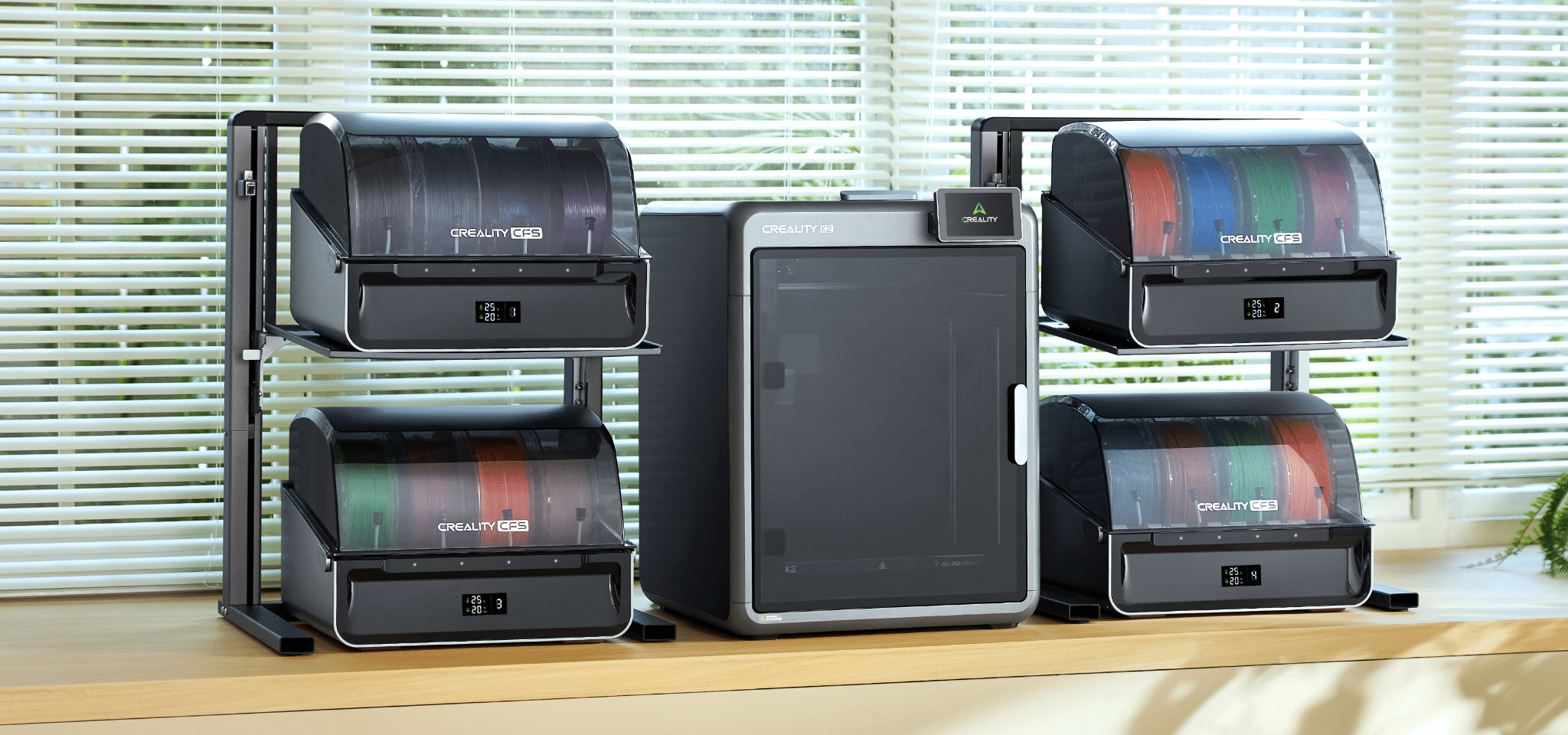
This is why it is a powerful choice for product designers, set builders, and artists creating detailed parts. A 300 × 300 × 300 mm build volume makes space for cosplay work, helmets, and multifaceted batches in a single run.
Moreover, it features chamber heating and precision step-servo motors, making it suitable for ASA, ABS, and other performance filaments.
K1C: Fast, Compact, and Carbon-Fiber Focused
The K1C aims for strength, speed, and quick assembly. The layout of the printer facilitates carbon-fiber-filled filaments, which are best for mechanical elements, drone parts, and practical engineering pieces.
Additionally, it delivers 600 mm/s performance, quick restarts, and a plug-and-print system for effortless everyday usage. The printer suits hobbyists, creators, or small labs that need powerful components without intricate multi-material work.
Flexible upkeep, quiet operation, and one-tap calibration increase its appeal as a trustworthy workhorse.
| Feature | K2 Pro/Combo | K1C |
| Key Strength | Multi-material 16-color printing with CFS | Carbon-fiber reinforced printing + speed |
| Build Volume | 300 × 300 × 300 mm | Standard, built for performance, not volume |
| Print Focus | Large-format + professional-grade multi-material prints | Speed + durability prints with carbon fiber |
| Special Tech | Dual AI cameras, chamber heating, auto leveling, 4-bay CFS | A1 camera, clog-free extrusion, quick-swap tri-metal nozzle |
| Best For | Pro creators, batch production, cosplay, engineered materials | Fast prototypes, carbon-fiber functional parts, and everyday prints |
Print Size and Build Volume: How Big Can You Print?
The K2 Pro presents a massive workspace with a 300 × 300 × 300 mm build volume, offering users the freedom to handle any task, small or big. You can print RC bodies, props, full-size helmets, and internal assemblies without slicing models into little fragments.
This durable king-size powerhouse is best for creators who deal with big creative builds or operate multi-file production batches. Also, size is instrumental when the target is to print big or print several at once.
The K1 C, on the other hand, has a smaller footprint, with a build volume of 220 x 220 x 250 mm, making it well-suited to compact work settings. It tackles brackets, gears, tools, and repetitive active parts better, specifically when printing strong carbon-fiber filament.
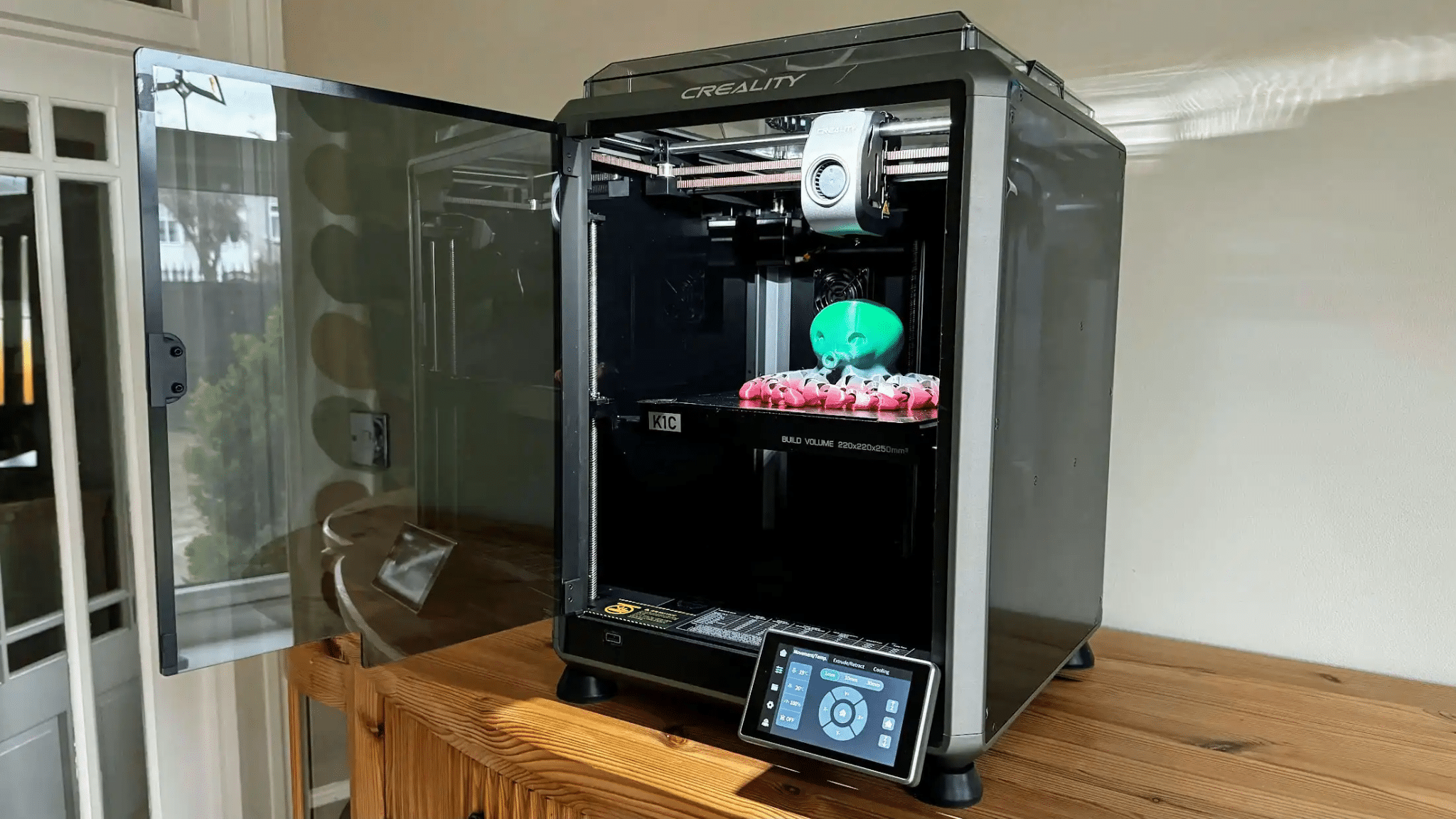
This 3D printer is ideal for users who work with rapid prototyping or mechanical components, where size is not the first priority.
Multicolor Printing: A Feature Only One Can Do
Among the sharp differences between the two models is the multicolor capability. The K2 Pro supports up to 16 colors utilizing the CFS multi-material units.
This system automates filament exchanges while printing, permitting makers to generate multi-shade gradients, thorough character models, brand-marked items, and themed supports without physical switching.
Additionally, its smart filament handling, such as auto-feeding, software, and hardware, is smoothly combined to offer an innovative multicolor printing experience. This is a significant benefit for designers and artists who want refined final parts directly from the build plate.
The K1C does not carry multicolor assistance and concentrates rather on single-filament output. It prints sturdy and fast, however is not designed for gradual changes, striped layers, or multi-color cosmetic work. This produces an easy decision point for many buyers:
When the diversity of color or stylized display prototypes is included in your workflow, the K2 Pro provides much more variety. When your needs are based on toughness and routine printer activity, the K1C stays the sensible choice.
Speed and Motion Accuracy: Both Are Fast, But in Different Ways
Both printers hit blazing 600 mm/s print speeds, but they address motion performance distinctly. The K2 Pro is boosted by step-servo motors on the X, Y, and extruder axes to balance flow during fast acceleration.
This motor setup enhances surface precision and helps the nozzle keep a constant extrusion at maximum velocity. Layer details remain even when operating on large-format elements or time-dependent batches.
The K1 C receives an active CoreXY motion path that supports easy movement and fast direction shifts. It offers swift returns for prototypes, mechanical prints, and repeated components.
Those who need quick outcomes with minimum tuning love this printer, particularly in environments where print pace directly impacts productivity. Briefly, the two printers are fast; however, their strengths among accuracy and agility.
Smart Monitoring and Ease of Use
Ease of use plays a crucial role in differentiating the two systems. The K2 Pro involves two AI cameras, one within the chamber and one focused on the nozzle. The cameras monitor print progress live, locate problems such as spaghetti or detachment, and assist in keeping long tasks operating effortlessly.
Moreover, the printer uses area-based auto leveling, which estimates the active print zone rather than the whole bed to enhance initial-layer accuracy.
The K1C follows a more simplified method. It contains one observation camera and a one-tap self-calibration sequence for fast startup. Beginners can unbox, switch on, and start printing with basic configuration.
The K1C functions better as routine equipment for creators who want clean output without modifications or advanced tracking.
For regulated production, the K2 Pro provides further control and fine-tuning. For user-friendliness, the K1C holds the advantage.
Noise, Comfort & Work Environment
Workplace ease matters, particularly for house and office frameworks. The K2 Pro runs with steady fans and servo-based motion, which lowers harsh vibration sound. It complements workshop corners, shared zones, and classrooms where continual printing might go throughout the day.
The K1C gives an even noiseless choice with a ≤45 dB silent mode. This feature delivers quiet levels like a normal atmosphere, appropriate for bedrooms, studios, and small workstations.
Moreover, it contains air purification, which purifies particles produced during printing and supports healthier activity in closed rooms.
Who Should Choose Which Printer?
Select K2 Pro if your preferences involve:
- Heavy builds, such as props or helmets
- Multicolor printing and artistic detail
- Industrial-grade prototyping
- Modern filament works with ASA, ABS, and PPA-CF
The K2 Pro is best for engineers, creators, and businesses that require visual impression and multi-material flexibility.
Select K1C if your workflow requires:
- Quick installation and instant print readiness
- Powerful mechanical components with carbon fiber strength
- Compact operation in office or house settings
- Reliable performance for everyday tasks
The K1C is a good match for hobby printers, functional part creators, and confined workspaces.
Conclusion
The K2 Pro and K1C stand as two strong choices in the Creality lineup, each designed with a separate user in mind. The two tools print quickly, offer constant quality, and assist innovative workflows, yet their advantages lead in different directions. Selecting the correct model comes down to the way to print, size, and color, or strength and simplicity.