

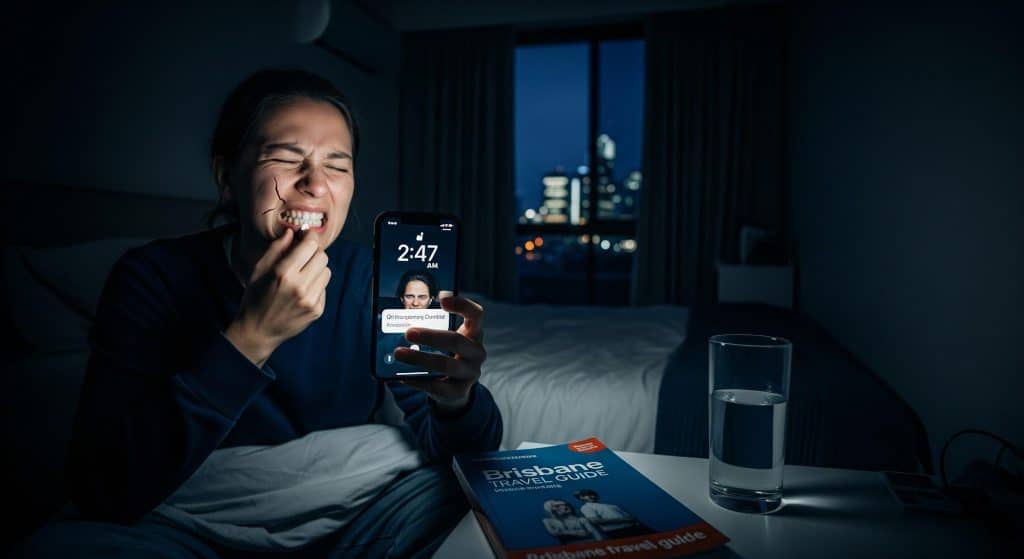
Cracking a tooth at night is one of those issues with terrible timing. It is late, the majority of clinics are closed, and all of a sudden you are left wondering if you should endure it until tomorrow morning or consider it an actual emergency.
The good news: even when the situation feels stressful, it is possible to manage it temporarily, as long as you know what to follow next to manage safely at home. Here is a step-by-step guide that will assist you to save the tooth, alleviate pain, and make intelligent decisions about when (and how quickly) to seek care in Brisbane.
First: remain calm and make a self-examination.
Do not do anything without first checking what has really happened. A crack may be as small as a hairline fracture or a chunk of it may fall off.
Ask yourself:
- Does it not stop bleeding even after 10 minutes of mild pressure?
- Does the pain feel sharp, aching, or spreading to your ear/jaw?
- Do you have any swelling in your face or gum?
- Do you have a bad taste, signs of infection, or a fever?
- Is the tooth loose or forced out of place?
If the answer to any of these is yes, consider it urgent, and plan to see a dentist immediately—tonight, not tomorrow.
What you ought to do immediately (the first 15 minutes)
When you crack a tooth, you want to save the area and not worsen it during the first few minutes.
- Rinse with warm salt water.
Combine a teaspoon of salt and 1/2 cup of warm water, and stir. This assists in cleaning the area without scratching it. - In case there is bleeding, apply pressure.
Apply clean gauze or folded tissue and press it firmly for 10 minutes. Do not keep checking—repeatedly lifting the gauze will reopen the wound. - Cut down the swelling externally.
Use a cold pack on the cheek on a 10-10 schedule. Do not apply ice directly to the tooth. - Save any fragment (if you can).
In case one of the fragments fell off, rinse it with water and put it into a clean container. In certain instances, it aids the dentist to determine what went wrong.
Safe (and unsafe) pain relief.
The pain in cracked teeth is due to the exposure of nerve-sensitive inner layers by the crack, or to the fact that biting pressure flexes the tooth and irritates the nerve.
Typically the following are popular:
- Non-prescription pain medication (take as advised)
Ibuprofen or paracetamol is taken by many people, according to their personal ability and medical history. In case you do not know which one is safe (ulcers, kidney problems, blood thinners, pregnancy, etc.), consult a pharmacist. - Avoid chewing on that side
Even if the tooth only hurts when you bite, it is an indication that the crack is under pressure. Turn over to the other side. - Stick to soft foods
Yoghurt, soup (not too hot), scrambled eggs, mashed stuff—anything that does not need to be crunchy.
There are some things to avoid, as they may increase cracking or inflammation:
- Also, do not chew ice, nuts, hard candy, or crusty bread.
- Do not use toothpicks to test the crack.
- Do not rub aspirin on the gum or the tooth (this can cause chemical burns to the soft tissue).
- Don’t even think of doing it yourself using household glues.
Temporary care of the tooth overnight.
In case the crack has left a sharp edge, it may cut your tongue or cheek. You can reduce irritation until you are seen.
Try:
- Dental wax (from a pharmacy)
This is the easiest option. Dry the tooth with a tissue, then apply the wax over the sharp end. - In a pinch: Sugar-free chewing gum.
Not perfect, but it can be used as a kind of temporary wax. Do not chew with it; use it as a covering.
In case the tooth is sensitive to air or cold, avoid breathing through your mouth and drink room temperature water in sips.
In case of an after-hours emergency in a cracked tooth.
Waiting until you get up in the morning is tempting, particularly when the pain is manageable. Certain situations of the cracked tooth are time-sensitive.
Urgent after-hours medical attention is required when:
- Pain is becoming severe rapidly particularly accompanied by heat or throbbing during rest.
- Your gum, cheek, or jaw is swollen.
- You have signs of infection (bad taste, pus, fever, swollen glands).
- The crack occurred due to trauma (sports injury, fall, accident).
- The tooth is loose, or your bite is suddenly different.
- Even proper pain relief does not enable you to sleep.
In Brisbane, when you fall in that category, it would only be normal to seek emergency dental Brisbane services so that you can be examined, stabilized, and treated before the complications worsen overnight.
What the dentist can do to a broken tooth (so you know what to expect)
Individuals usually fear that they will automatically require extraction. As a matter of fact, treatment varies with the direction and depth of the crack, the involvement of the nerve, and the restorability of the tooth.
Ordinary dental strategies are:
- Bonding or smoothing out a small chip.
In case it is a small chip, the dentist can polish sharp edges or apply a tooth-coloured resin. - To cover and guard the tooth, a crown.
In case the tooth structure is undermined, a crown can support it and prevent further division. - Root canal therapy in case the nerve has been inflamed or infected.
In the event that the crack has extended to the pulp (nerve), the tooth may require a root canal prior to being crowned. - Extraction in case the crack is below the gum line in an irreversible manner.
This is predominant in vertical root fractures or deep fractures that undermine stability.
There is no need to panic, in case you do not know the severity of yours, as cracks are not always noticeable. Dentists are able to assess using bite tests, magnification, X-rays (but the cracks do not always appear), and in some cases, special dye or imaging.
The way to get the appointment smoother (even at night)

As you are stressed and in pain you tend to forget some information that will help a dentist treat you faster. Write down the following before you call or book:
- The time when the crack occurred and the cause of the crack (hard food, grinding, trauma)
- Whether a piece broke off
- Where the pain comes from (biting, cold, heat, air)
- Swelling, fever, bad taste
- Your medications, allergies, and other pertinent health conditions
- Last ate (of note if sedation can be taken into consideration)
In other clinics, a patient management system is utilized where you can complete the form, describe the symptoms, and confirm the information digitally; this can save time so time in the waiting room is minimized, in particular when you come to the clinic after hours.
In case you are not able to book a dental appointment right now.
In some cases, there are restrictions on after-hours appointments. When you cannot be seen immediately, work on damage control during the next eight to twelve hours.
- Maintain the area neat by use of mild salt-water baths.
- Add cold packs in case of swelling.
- Sleep with your head elevated.
- Hot drinks are to be avoided when heat exacerbates pain.
- Do not bite down on the tooth to check if it still hurts.
In case of an aggravation of your symptoms, particularly swelling, fever, or acute pain, do not wait. The nighttime increase is an indicator that you require critical evaluation.
It is painful having a cracked tooth after hours, yet you are not helpless. By keeping the area clean, not chewing on the tooth, safely managing pain, and being familiar with the red flags, you will be able to maintain the health of your tooth and your health until you are evaluated.