

I used to treat SEO tools like dashboards in a car: lots of gauges, not many decisions. I’d check a domain score, skim a backlink chart, screenshot a keyword table, and still end the session with the same feeling—“Okay… now what?”
What changed for me wasn’t finding another metric. It was letting AI sit between the metrics and my next move.
These days, my workflow is basically: pull the data fast, then ask for a plain-English explanation and a concrete plan. I’ve been doing that with Domain Rank App (https://domainrank.app), and it’s been the first setup that feels like an assistant rather than a spreadsheet generator.
If you want to see the exact tools I use most:
- Domain Rank Checker: domainrank.app/dr
- Keyword Difficulty Checker: domainrank.app/keyword-difficulty
- URL Rating Checker: domainrank.app/url-rating
I’ll walk you through how I use them with an “AI-first” mindset—meaning the AI isn’t there to sound smart; it’s there to shorten the distance between “interesting data” and “clear action.”
The real problem: SEO data is easy, decisions are hard
Most SEO platforms can tell you what happened:
- DR went up or down.
- This URL has X backlinks.
- That keyword has Y volume.
But the parts that actually cost time are the follow-ups:
- Why did DR change?
- Which links matter versus noise?
- Is this SERP hard because the domains are strong, or because the pages are strong?
- What should I do next week?
That’s where AI becomes practical. Not “write my blog post” AI—more like “help me interpret the situation” AI.
In Domain Rank App, the AI insights are built into the analysis flow (and they stream as they generate), so I’m not copying tables into ChatGPT and hoping I didn’t miss a key context.
Step 1: Domain Rank Checker, but AI turns it into a narrative
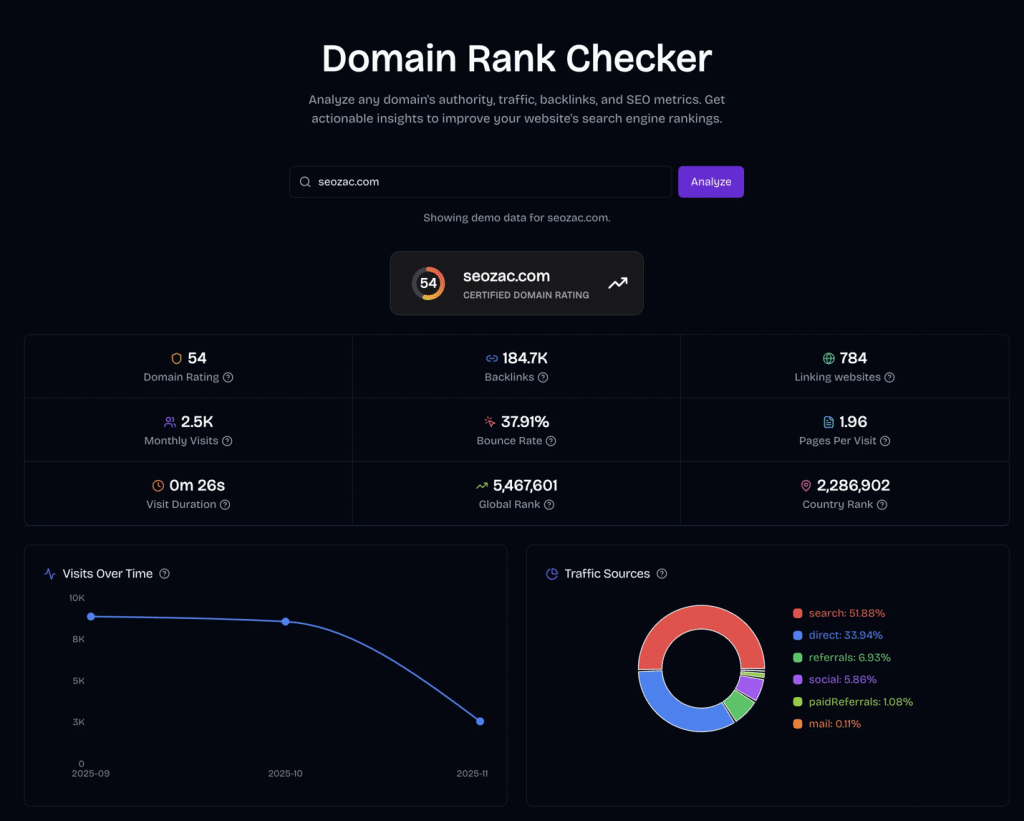
I start with the Domain Rank Checker:
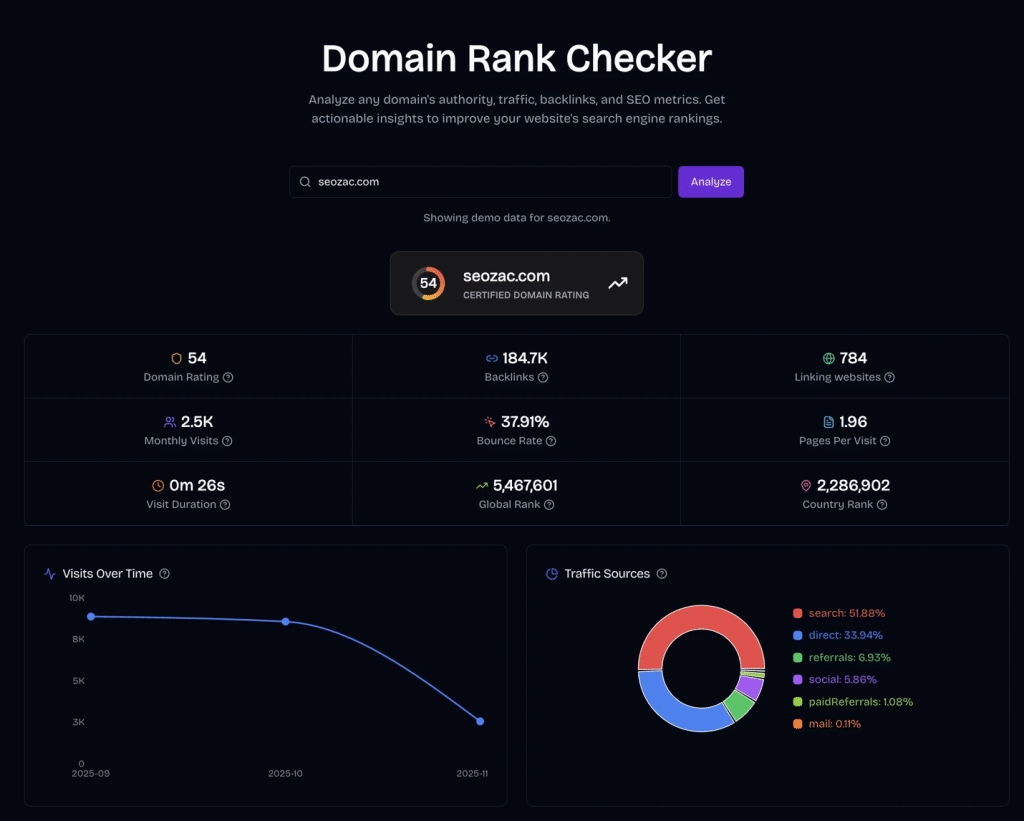
I’ll run my site plus 3–5 competitors. The raw metrics are useful (DR, backlinks, referring domains, traffic, rankings), but what I actually want is an explanation like:
- “This competitor’s DR is higher, but their traffic is concentrated in one country.”
- “Their backlinks are broad, but the top pages driving traffic are a narrow content cluster.”
- “Your domain is weaker overall, but you have an advantage in [topic] based on ranking keywords.”
That kind of summary sounds simple, but it’s huge psychologically. It stops me from overreacting to a single number and helps me form a story: who’s winning, how, and where I can realistically compete.
The streaming AI insights are especially helpful when I’m doing quick competitor research. Instead of taking notes manually, I end up with:
- key takeaways,
- likely reasons they rank,
- and suggestions for what to target next.
It feels like having someone in the room who’s seen a thousand similar SEO profiles and can say, “Here’s what matters.”
Step 2: URL Rating is where AI saves me from false confidence
Domain-level metrics can be misleading. A strong domain doesn’t mean every page is strong.
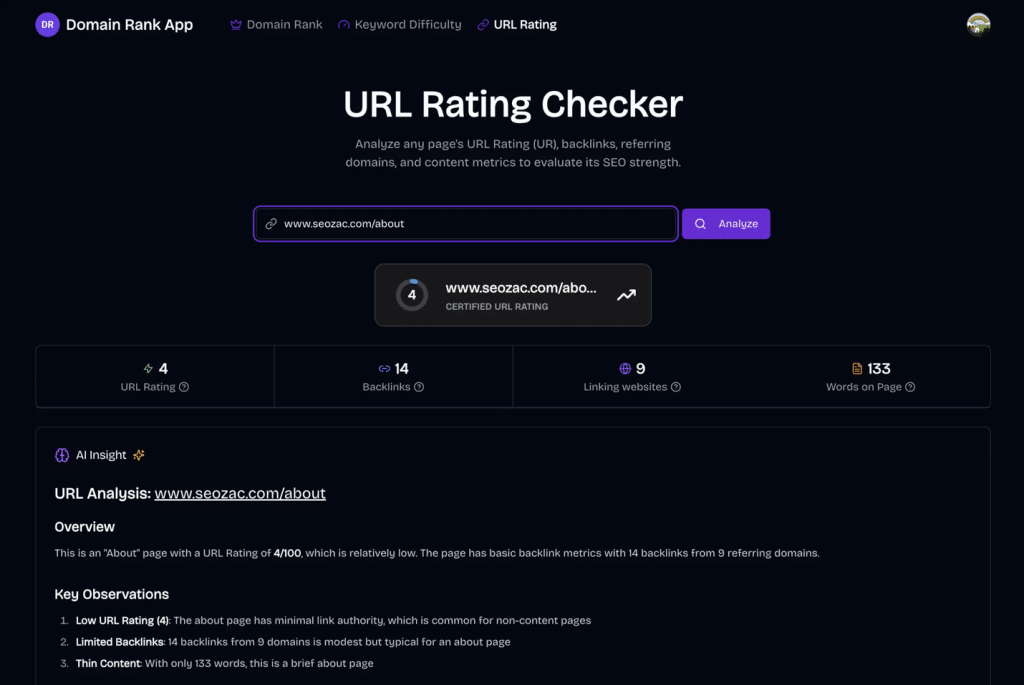
So I almost always follow up with the URL Rating Checker: domainrank.app/url-rating
I’ll paste:
- the exact competitor page ranking,
- my page (if it exists),
- or a page I plan to build internal links from.
The URL view gives me UR, backlinks/referring domains for that page, and content-length signals. But again, the AI part is where the time savings come from. I use it to answer questions like:
- “Is this page ranking because it’s genuinely strong, or because the domain is strong?”
- “What’s the simplest way to close the gap—content depth, internal linking, or external links?”
- “If I can only do one thing this week, what moves the needle for this URL?”
This is the moment where I often change plans. Sometimes I realize the “scary competitor” is ranking with a surprisingly weak page. That’s my cue to ship quickly and win with better coverage and structure.
Other times the page is clearly supported—links pointing directly to it, strong UR, and a content format that matches intent perfectly. If AI tells me, in plain English, “You’re not losing on content, you’re losing on authority for this specific URL,” that’s a different strategy. I either pick a softer keyword variation or plan link support instead of rewriting headings for the tenth time.
Step 3: Keyword difficulty, but AI helps me choose an angle
Then I jump into the Keyword Difficulty Checker:
I check difficulty, volume (local and global), clicks/CTR, CPC, and traffic potential. But the “AI flavor” I care about isn’t a generic paragraph. It’s angle selection.
What I’ll do is run 10–20 keyword variations, then use the AI insights to help answer:
- “Which variant is easiest to win with my current authority?”
- “What intent does this keyword imply—definition, comparison, tool, template, list?”
- “What subtopics do top pages consistently cover that I shouldn’t miss?”
- “What’s a realistic content outline that could outperform what’s ranking?”
In practice, this saves me from two common traps:
- Choosing a keyword that looks good in a vacuum but has a SERP full of monster pages.
- Picking a keyword I can win, but writing the wrong style of content for the intent.
If the AI summary says something like, “Top results are tool pages and calculators, not long-form guides,” that’s a sign to change format—not just add more words.
My weekly “AI-first” SEO routine
This is the loop I repeat because it’s simple and it keeps me honest:
- Check my baseline in Domain rank app.
- Compare 3–5 competitor domains and skim the AI insights
- Inspect the actual ranking pages in
- Validate keyword variants in
- Let AI help me pick the most winnable angle + outline
- Publish, then reinforce with internal links and a small outreach list
The key is that AI is doing the interpretation and prioritization—not replacing my judgment, just reducing the “blank page” time between analysis and action.
A bonus: I like AI when it’s honest about uncertainty
One reason I’m picky about AI in SEO tools is that a lot of it feels like confident nonsense. The useful kind of AI is the kind that says:
- “Based on this backlink profile, the page likely ranks because of X.”
- “Your best leverage is internal links because external links are scarce for this URL.”
- “This keyword is probably tough unless you have topical authority or a unique format.”
That’s the tone I actually need. SEO has too many variables for certainty. What I want is a clear bet, with reasoning.
If you want to try this approach today
Run this quick exercise:
- Put your domain into domainrank.app and read the AI insights like a diagnosis.
- Paste one target competitor URL into domainrank.app/url-rating and ask: “What’s the shortest path to compete?”
- Test one keyword idea in domainrank.app/keyword-difficulty and use AI to pick the right content angle.
If you do just that, you’ll usually discover which bottleneck you’re really dealing with:
- domain authority,
- page-level authority,
- or intent mismatch.