

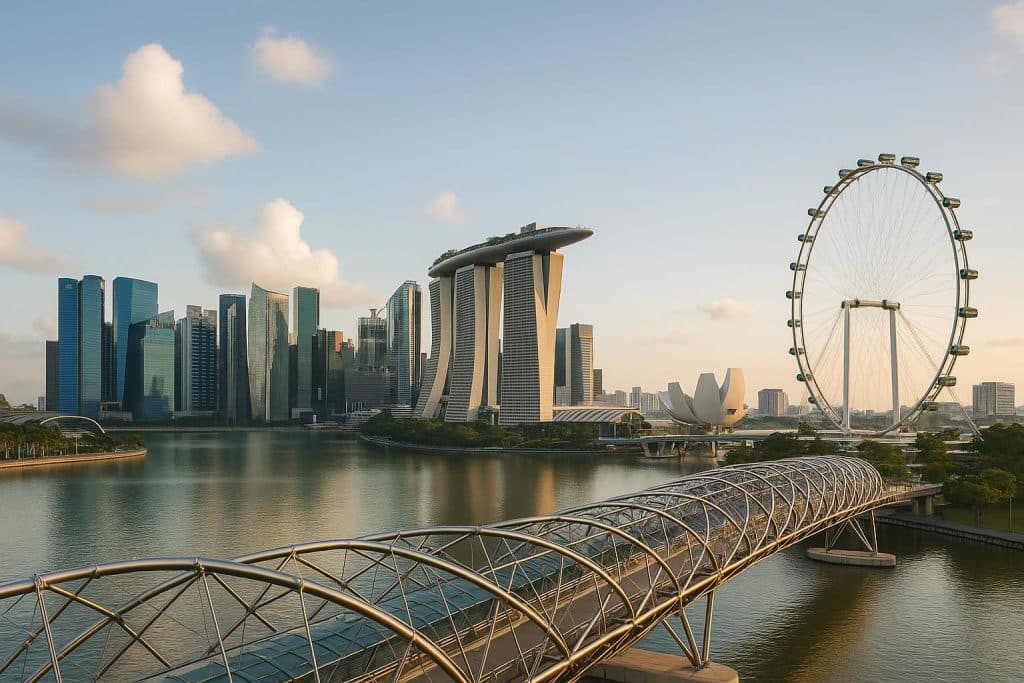
Singapore has grown rapidly over the years into the biggest business hub in Asia. What lies behind its rise? Being one of the ASEAN founder members, Singapore has been recognized worldwide for its political stability and business-friendly atmosphere, in addition to its strong economy.
Singapore is a preferred location for various companies looking to establish their regional headquarters and head offices that look to tap into the Asia Pacific. As of 2023, Singapore reportedly had 4,200 multinational companies with regional headquarters here. Let us understand the key reasons for its growth as Asia’s predominant business hub.
Key Reasons Behind Singapore’s Business Dominance in Asia
Singapore dominates the headlines in Asia as far as business is concerned, be it the setting up of RHQs (regional headquarters), head offices, and multiple other sectoral clusters. Here are some of the main reasons behind the same.
- Ease of doing and starting businesses– Singapore is globally ranked as number one in the EIU (Economic Intelligence Unit) business environment rankings for several years in succession. It is one of the easiest places globally to set up and do business, particularly for its low corruption levels, smooth and stringent administration, and efficient regulatory frameworks. There are multiple Singapore EDB (Economic Development Board) initiatives and concessionary tax rates that attract more companies to the region.
- Better tax and trade frameworks– The Singapore Government maintains an open and free environment to enable a better flow of goods. The city’s status as a leading trade hub makes it a huge magnet for business in Asia. It also has multiple FTAs with leading partners like the UK, China, Middle Eastern countries, and more. Singapore has one of the lowest rates of corporate tax and multiple incentives on offer.
- Excellent location– Singapore benefits immensely from its highly strategic location, particularly throughout the ASEAN region. The Changi Airport is one of the world’s best airports, connecting to 130+ global cities. The position of Singapore along key shipping routes is another advantage, while the upcoming Johor-Singapore SEZ is another hub that will boost business here.
- Top-class infrastructure– The city boasts some of the best infrastructure for doing business in Asia. Business travelers can access a variety of corporate-serviced accommodation in Singapore, each equipped with state-of-the-art conferencing and networking facilities. High-speed connectivity and logistics are a major advantage, with full 5G coverage and Smart Nation initiatives. Singapore also has Digital Economy Agreements with multiple countries, while offering high-capacity freight and cargo handling capacity as well.
- Stringent legal frameworks– Singapore is known for its stringent laws and regulations, with an efficient judiciary, and proper frameworks to cover IPs, IAs, and more. It is also a safe city with some of the world’s most rigorous laws against drunken behavior, jaywalking, late-night noise, and even chewing gum.
- Global talent pool– Singapore attracts multiple businesses due to its highly skilled workforce. English is the primary language in Singapore, while there are multiple kinds of employment visas available. There are also Government initiatives like SkillsFuture, which enable continuous upskilling to meet the demands of various industries.
Some Other Factors behind Singapore’s Steady Rise as a Business Hub
Singapore benefits from its core strengths, including financial services, technology, logistics, and more. There is also an emphasis on growing sectors like robotics, AI, and debt structuring, to name a few. Tourism is also a major growth driver in Singapore, and the authorities are planning to scale up tourism receipts from its record $29.8 billion figure in 2024 to a whopping $50 billion over a period of 15 years.
Singapore has a Tourism 2040 strategy that will focus on scaling up demand from various groups, including stopover travelers and business travelers. There is more focus on tripling tourism receipts from the MICE (meetings, incentives, conventions, and exhibitions) sector, with world-class infrastructure already existing for business travelers. A new MICE hub is being planned for the downtown area in Singapore, while a mega Herbalife Extravaganza event is slated for 2026, which is expected to attract 25,000+ visitors.
Terminal 5 of the Changi Airport should be completed by the 2030s, scaling up passenger capacity to 140 million people annually. There will also be a focus on offering top-class attractions, with the Singapore Oceanarium in the works, along with a Porsche Experience Center and a Science Center in the year 2027. The city is also looking at promoting various cruises, including the Disney Cruise Line’s Disney Adventure and the Ritz-Carlton Yacht Collection’s Luminara. Wellness tourism is another future growth segment, along with the concert economy and major sporting events. A new theater is planned at the Gardens by the Bay, along with an arena at Marina Bay Sands.
Business Travel to Pick Up in Singapore
Going by soaring demand for serviced apartments, it is clear that business travel in Singapore has only been picking up in the city over the last few years. Top-class accommodation choices, cutting-edge infrastructure, work-friendly environments, stringent regulations, and a robust economy contribute to making Singapore the leading business hub in Asia. It is poised to witness rapid growth in its business travel volumes in the years to come.