


Reading the Quran in Arabic represents a profound spiritual connection for Muslims worldwide. This comprehensive guide shows how children and adults can begin this sacred journey using modern learning methods available in 2026, with a special focus on how to learn Quran online effectively.
The Enduring Importance of Quranic Literacy
For over 1,400 years, Muslims have transmitted the tradition of Quran recitation from generation to generation, beginning with Prophet Muhammad ﷺ in 7th-century Arabia. The hadith teaches: “The best of you are those who learn the Qur’an and teach it” (Sahih al-Bukhari). This practice offers both spiritual merit and tangible advantages—improved concentration during prayer, self-assurance in recitation, and strengthened family bonds through shared learning.
Today’s technology has revolutionized Quranic education. Adults worldwide now access structured programs to begin or resume their studies. Whether you heard Quran recitation growing up without learning to read yourself, or you’re a new Muslim encountering the Quran for the first time, systematic approaches make this goal attainable.
Beginning Your Quranic Reading Journey
New learners typically start with foundational programs such as Noorani Qaida or Noor Al Bayan rather than jumping directly to the Mushaf.
Initial Phase: Learning Arabic Letters
Begin by recognizing Arabic letters from alif to ya in their various forms. Educational materials demonstrate how letter shapes change based on word position—whether appearing at the beginning, middle, end, or standing alone.
Following Phase: Vowel Marks and Connections
Progress to short vowels (fatha, kasra, damma) along with sukoon, tanween, and shaddah. Watch as letters connect to create simple words. Arabic transforms from unfamiliar symbols into readable sounds.
Creating Daily Habits
Dedicating merely 15 minutes each day produces remarkable results. Connect this practice to your existing schedule—after morning prayer or before evening prayer works well for many. Daily 15-minute sessions typically yield faster advancement than weekly two-hour marathons.
Setting Achievable Targets
Consider this reasonable first goal: reading simple Quranic words from Juz’ Amma after 3–4 months of regular study. This timeframe works for most committed beginners following structured guidance.
Guiding Children in Quran Reading
Most children begin learning between ages 4–6, though individual readiness outweighs specific age targets. Each child develops differently—some excel at 4, others benefit from starting at 6 or 7.
Optimal Lesson Format
Plan frequent, brief sessions—10 to 20 minutes each—happening three to five times per week instead of lengthy occasional meetings. Young minds engage better with short, regular exposure that keeps Quran study enjoyable.
Family Participation
Parents amplify learning by monitoring home practice, listening to their children recite, and providing encouragement based on instructor guidance. Children whose parents demonstrate authentic interest recognize Quran study as a family value.
Expected Development
Children practicing consistently often recite Surah Al-Ikhlas, Al-Falaq, and An-Nas fluently after 6–9 months. These initial achievements create momentum for continued growth.
Choosing Online Quran classes for Children
When selecting digital Quran instruction, evaluate these elements:
- Instructor Qualifications: Seek tutors holding ijazah in Hafs recitation or credentials from established institutions
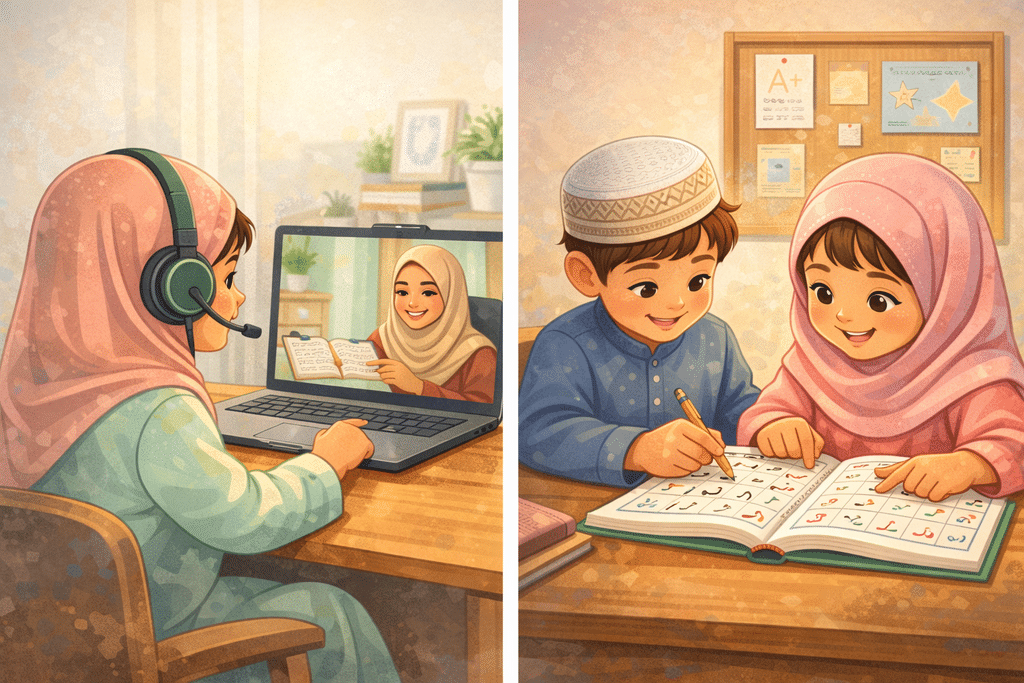
- Personalized Instruction: One-on-one video sessions provide customized feedback and appropriate advancement
- Digital Tools: Instructors should display Mushaf or Qaida pages on screen during teaching
- Timing Adaptability: Services with instructors in various time zones accommodate families in the UK, USA, or Canada around school schedules
- Sample Classes: Respected providers offer trial sessions to evaluate instructor demeanor, connection with your child, and teaching approach
- Security Protocols: Verify secure meeting platforms and explore options for session recordings allowing parental monitoring
Adults Can Begin at Any Age
People in their 40s, 50s, 60s and beyond complete Quran reading programs successfully each year. Contemporary platforms and adaptable online courses make this increasingly realistic.
How Adults Progress
Adult students generally follow similar paths as children yet frequently advance more rapidly thanks to enhanced concentration and self-discipline. The sequence starts with Arabic alphabet fundamentals, continues through elementary tajweed, progresses to brief surahs from Juz’ Amma, and ultimately addresses extended passages. Many adults integrate translation and introductory tafsir with their reading practice.
Addressing Adult-Specific Obstacles
Adults encounter distinct hurdles: anxiety about errors, constrained time from professional and family demands, and occasionally difficult prior learning experiences. Well-designed online instruction resolves these through adjustable scheduling, selection of instructors matching learning preferences, and supportive atmospheres.
Measuring Development
Adults gain from establishing monthly targets:
- First Month: Accurately recognize and pronounce every Arabic letter and vowel mark
- Second Month: Read basic words and brief phrases applying fundamental rules
- Third Month: Independently recite five short surahs from the Mushaf incorporating tajweed
A Seven-Part Plan for Adult Learners
Part One: Perfect Letter Recognition
Invest two to four weeks confirming you identify each letter in all forms and pronounce each from its proper articulation point (makhraj). Employ flashcards, applications, or worksheets for systematic practice.
Part Two: Introduce Tajweed Gradually
Begin with core principles: rules governing noon sakinah and tanween (izhaar, idghaam, iqlaab, ikhfa), meem sakinah, madd, and qalqalah. Implement rules upon encountering them instead of attempting complete memorization initially.
Part Three: Practice Short Surahs from Juz’ Amma
Start with surahs you recognize by ear, such as Al-Fatiha and Al-Ikhlas. Recognizing familiar words connects auditory memory with visual reading. Concentrate on these for two weeks applying tajweed before moving forward.
Part Four: Build Regular Practice Routines
Dedicate 15–20 minutes to recitation daily, supplemented by 5 minutes hearing skilled reciters like Al-Minshawi, Abdul Basit, or Mishary Al-Afasy while following along in the Mushaf.
Part Five: Work with Expert Instructors
Just one weekly session where an instructor hears your recitation and identifies mistakes generates substantial progress. Effective tutors spot pronunciation issues, modify lesson content, and maintain your commitment.
Part Six: Imitate Expert Reciters
Hear a verse, pause, then replicate it. This “echo method” conditions your hearing and speech to reproduce sounds precisely. Ten daily minutes of imitation markedly speeds advancement.
Part Seven: Unite Reading with Understanding
Connect recitation with tafsir and translation. Comprehending your recitation strengthens motivation and memory. Even basic English translation consulted after reading develops deeper engagement with verses.
Typical Learning Stages
Structured programs generally follow defined phases:
Phase 1: Fundamentals (2–6 months)
Through primers like Noorani Qaida or Noor Al Bayan, acquire Arabic letters, vowel notation, sukoon, tanween, shaddah, and elementary letter connections. Timeline depends on age, background, and practice consistency.
Phase 2: Elementary Recitation (3–6 months)
Access short surahs in Juz’ Amma, beginning from Surah An-Nas progressing toward Surah Al-Duha. Emphasize deliberate, precise reading with attention to articulation and fundamental tajweed principles.
Phase 3: Intermediate Level (6–12 months)
Approach extended surahs including Yaseen, Al-Rahman, or Al-Mulk. Fluency grows, enabling 15–30 minute recitation periods. Many students investigate elementary grammar and common Quranic vocabulary.
Phase 4: Advanced Study (Continuous)
Achieve complete khatmah with tajweed. Some advance to memorizing selected surahs or the full Quran. In-depth tafsir study gains prominence, and recitation evolves toward refined tarteel with contemplative reflection.
Comparing Online and Traditional Learning
Both approaches prove effective. Your optimal selection depends on personal circumstances.
Digital Learning Benefits: Access to qualified instructors globally, adaptable scheduling spanning time zones, home-based learning convenience, session recordings for later review
Traditional Learning Benefits: Direct viewing of mouth positioning for challenging letters, communal environment, dedicated classroom setting minimizing household interruptions
Weigh commute duration, regional instructor availability, privacy considerations, and expense variations. For numerous Muslims residing where qualified teachers are scarce, online learning offers the sole viable route to proper tajweed instruction.
Assessing Quran Education Services
Prior to enrollment, confirm:
- Instructor credentials, ijazah certification, and applicable experience
- Focus on accurate pronunciation from initial lessons
- Session structure (individual vs. group), length, and recommended weekly frequency
- Genuine testimonials from comparable student backgrounds
- Organized curriculum featuring advancement tracking
- Introductory session availability
- Rescheduling flexibility and provided educational materials
Maintaining Momentum Despite Difficulties
Typical challenges include distinguishing similar letters (س versus ص versus ث, or ض versus ظ), frustration with gradual progress, and scheduling complications.
Effective approaches: Establish modest daily objectives, utilize flashcards for problematic letters, record yourself weekly to detect improvement, obtain consistent instructor feedback, and acknowledge achievements like completing Qaida or finishing your initial surah.
The hadith assures us that learners who struggle during recitation earn double rewards. Your earnest commitment carries significance independent of advancement rate.
Common Questions Answered
What’s the typical learning duration? Committed beginners studying 3–5 times weekly generally require 6–12 months progressing from no Arabic knowledge to independently reading short surahs. Children might need additional time, while certain adults advance quicker through daily practice.
Must I know Arabic beforehand? No. Quran reading instruction begins with the alphabet. Complete language mastery isn’t necessary to start recitation.
Which comes first—memorization or reading? Most students should initially develop accurate reading with tajweed. Once reading confidently, memorization becomes simpler through reinforcing proper pronunciation.
Do apps substitute for instructors? Apps enhance learning but cannot completely replace qualified instructors who correct pronunciation immediately. Even single weekly instructor sessions combined with app practice substantially outperform independent study.
What if I begin later in life with pronunciation difficulties? Numerous students commence in their 40s, 50s, or beyond and attain excellent outcomes. Address one challenging sound at a time, practice deliberately, and record yourself. Those struggling during recitation still earn double rewards.
Take Your First Step Now
Embarking on your Quran reading journey connects you with centuries of tradition unifying Muslims globally. Whether enrolling your child or pursuing a personal aspiration, the path is straightforward: learn fundamentals, practice regularly, study with qualified instructors, and remain patient with the process.
Begin with 15 minutes today. In sha Allah, you’ll look back with gratitude.