

Enterprise applications store a huge amount of business data. This involves reports, emails, tickets, internal knowledge, and documents. In such a case, it might not be easy to locate the correct information at the correct time as it ought to be.
A majority of enterprise search engines are based on simple keyword matching. This results in partial, outdated, or irrelevant findings. Due to the adoption of AI in businesses, they are now seeking smarter methods for searching internal data.
This is where Retrieval Augmented Generation, or RAG, becomes relevant.
What Is Enterprise Search and Why It Is Hard
Enterprise search is the ability to search within the internal business systems through one interface. This can involve content in databases, cloud software, file systems, and collaboration platforms.
Enterprise search might be difficult due to a few reasons:
- Information is distributed among numerous systems.
- A lot of the information is not organized.
- All users have different access permissions.
- Contextual and intentional searching fail with traditional search.
These issues become more evident with the increase in data volume. Employees waste their time searching and have less time working on significant activities.
What Is Retrieval Augmented Generation (RAG)
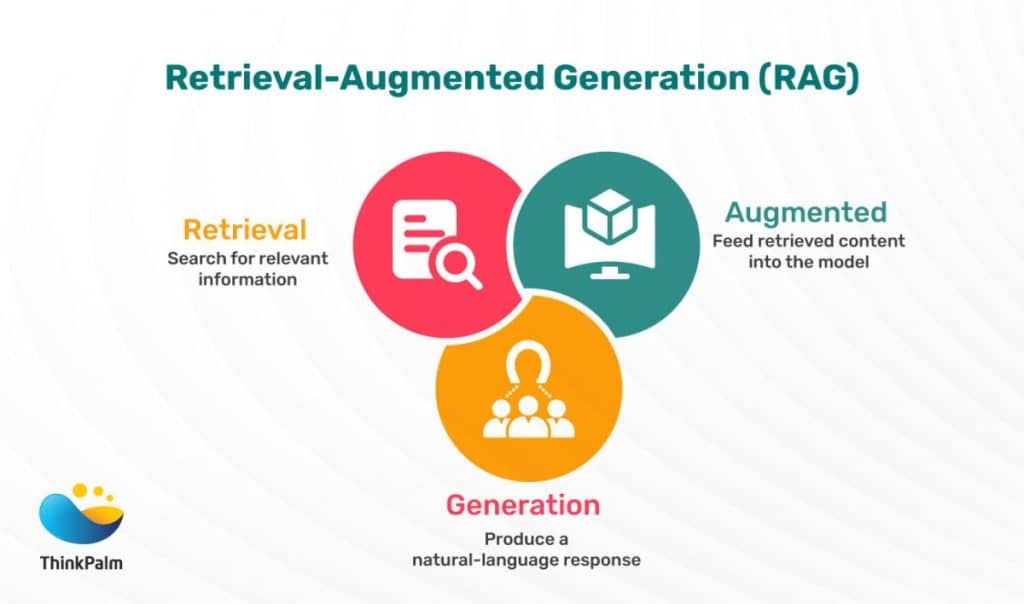
Retrieval augmented generation is an AI technique that involves using large language models in conjunction with information retrieval. As opposed to the generation of answers using only known information within a model, RAG initially extracts pertinent information through credible data sources. It then uses that information and comes up with the correct and contextual response.
This renders retrieval augmented generation to be particularly convenient in the case of enterprise setting, where solutions are required to be found on both internal and more recent information. RAG, unlike traditional search, is able to comprehend natural language queries and provide an answer in comprehensible, human-written text.
How RAG Improves Search Inside Enterprise Applications
RAG alters the way that enterprise search operates. It does not present a list of links but gives direct answers supported with internal data.
RAG enhances enterprise search through a number of means:
- Knows the intent of users, not only keywords.
- Pulls internal sources of information.
- Use the latest and most up-to-date information.
- Gives precise, summarized answers.
This enables the user to pose questions using normal language and get valuable answers without having to search through various documents.
Key Benefits of Using RAG for Enterprise Search
Enterprise search using RAG provides actual business value.
Some key benefits include:
- Quick access to the right information.
- Better production among employees.
- Make superior decisions using reliable data.
- Less reliance on manual search and support teams.
RAG also helps organizations make better use of their existing data, turning scattered information into actionable insights.
Best Practices for Implementing RAG in Enterprise Applications
A successful RAG implementation requires careful planning. Simply adding AI is not enough.
Best practices include:
- Start with high-impact use cases like internal knowledge search
- Ensure data is clean, well-structured, and updated
- Apply strong access control and security policies
- Monitor performance and improve results over time
Many organizations work with experienced partners offering software development services in UK markets to build secure and scalable RAG-based enterprise solutions.
Final Thoughts
Enterprise search is no longer limited to locating documents. It is about finding answers. Retrieval augmented generation offers a practical and effective way to improve how employees interact with internal data.
By combining intelligent retrieval with generative AI, RAG makes enterprise applications smarter, faster, and more useful. As businesses continue to grow their data ecosystems, RAG-powered search will become a key part of modern enterprise software.