

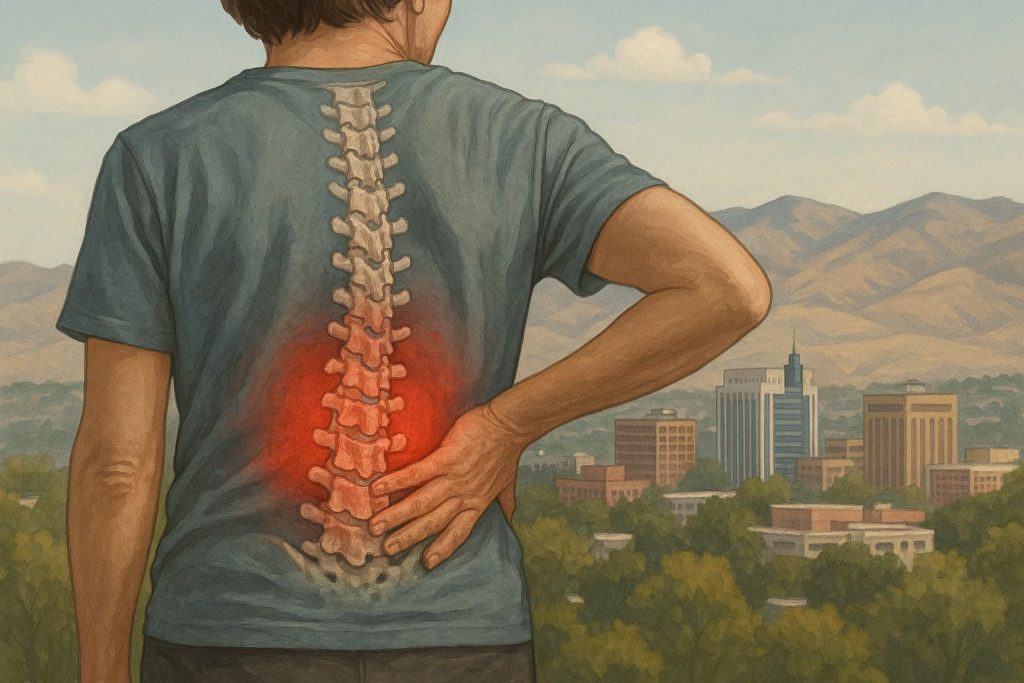
Living in the Treasure Valley comes with an unspoken agreement: we stay active. Whether it’s spending Saturday mornings hiking the Foothills, fly-fishing on the Boise River, or simply keeping up with the grandkids at Julia Davis Park, movement is the currency of life here. But for thousands of Idahoans, that movement is slowly being taxed by a persistent, grinding ache that doesn’t go away with a couple of ibuprofen or a night’s rest.
When back or neck pain stops being an occasional nuisance and starts dictating your schedule, you aren’t just dealing with “getting older.” You might be dealing with spine arthritis. It’s a diagnosis that sounds heavy—and it is—but understanding it is the first step toward reclaiming the lifestyle that makes living in Boise so special.
What Does Spine Arthritis Actually Feel Like?
If you ask ten different people what their arthritis feels like, you’ll get ten different answers. For some, it’s a localized stiffness—that “Tin Man” feeling when you first wake up and have to slowly find your range of motion. For others, it’s a sharp, electric protest from the lower back when reaching for a bag of groceries.
Technically known as osteoarthritis of the spine, this condition occurs when the cartilage that cushions the facet joints (the hinges of your vertebrae) begins to wear thin. Without that padding, bone rubs against bone. The body, in a misguided attempt to heal itself, often creates bone spurs (osteophytes). These spurs can crowd the spinal canal, pinching nerves and leading to that tell-tale numbness, tingling, or weakness in the legs.
But beyond the clinical definition, spine arthritis is a thief. It steals your confidence in your own body. It makes you second-guess a trip to the Farmers Market because you aren’t sure if there will be enough benches to sit on when the ache flares up. It turns a simple drive up to McCall into an endurance test of discomfort.
The Emotional Landscape of Chronic Pain
We don’t talk enough about the mental toll of spinal issues. When your back is constantly “on your mind,” it drains your battery. Chronic pain creates a feedback loop of stress and exhaustion. You want to be present at the dinner table, but a portion of your brain is constantly monitoring your posture, looking for a way to sit that doesn’t hurt.
In a community as outdoorsy as ours, there’s also a sense of “FOMO” (fear of missing out) that accompanies spinal degeneration. Seeing others enjoy the Greenbelt while you’re stuck on the heating pad can feel isolating. This is why finding a specialist isn’t just about fixing a joint; it’s about restoring your connection to the community and your sense of self.
Why Boise? The Local Context of Care
Idahoans are a unique breed. We tend to be self-reliant, often waiting until a problem is “unbearable” before seeking help. However, the Boise medical landscape has grown significantly, offering specialized care that understands this “high-desert” lifestyle. We aren’t just looking for a doctor who can read an MRI; we want someone who knows that “rest” isn’t a long-term solution for someone who wants to be out in the woods.
When searching for a spine arthritis surgeon in the Boise area, you are looking for a partner in your long-term mobility. You need someone who recognizes that your goal isn’t just to “sit without pain,” but to return to a high level of function.
When Is It Time to See a Specialist?
Many people wait far too long to seek help. They assume that surgery is the only outcome, and because surgery feels scary, they choose to “tough it out.” This “toughing it out” often leads to secondary problems, like weight gain from inactivity, depression from chronic pain, or hip and knee issues from walking with an altered gait.
The time to seek a professional opinion is when the “good days” are being outnumbered by the “bad days.” If you are avoiding social invitations because of your back, or if you find that you can no longer walk more than a block without needing to lean over a shopping cart for relief, it’s time to look at more definitive solutions.
The Path Forward: From Conservative Care to Surgical Precision
The good news is that “spine surgery” has changed dramatically over the last decade. Modern neurosurgery isn’t about the massive, life-altering procedures of the past; it’s about precision, preservation, and personalized recovery.
For many patients in Boise, the journey starts with conservative management. This might include:
- Targeted Physical Therapy: Strengthening the “core” isn’t just for athletes; it’s about creating a natural corset of muscle to support the spine.
- Anti-Inflammatory Protocols: Managing the chemistry of the joint to reduce the “fire” of arthritis.
- Injections: Using guided imaging to deliver relief exactly where the inflammation is centered, often providing a window of time to pursue physical therapy more effectively.
However, when these measures fail to provide lasting relief, surgery becomes a powerful and necessary tool. In the hands of a specialist, the goal of surgery for spine arthritis is decompression and stability. By removing the bone spurs or thickened ligaments that are crowding the nerves, a surgeon can often alleviate the radiating pain and weakness that makes daily life a struggle.
Why the “Human Touch” Matters in Neurosurgery
Choosing to undergo spine surgery is a deeply personal decision. You aren’t just a chart or an MRI image; you’re a person with specific goals. Maybe your goal is to walk your daughter down the aisle, or maybe it’s just to be able to garden without being bedridden the next day.
This is where the choice of a surgeon becomes critical. In a place like Boise, we value neighborly care. We want a doctor who listens—who understands that a 70-year-old in Idaho has different physical expectations than a 70-year-old elsewhere.
Neurosurgery is as much about communication as it is about technical skill. It’s about explaining the why behind the procedure and being a partner in the recovery process. When you visit a spine arthritis surgeon, you should feel like your lifestyle goals are the primary metric of success.
Anatomy 101: Understanding the Wear and Tear
To truly manage spine arthritis, it helps to understand what’s happening “under the hood.” Our spines are marvelous pieces of engineering, but they are subject to the laws of physics. Over decades, the discs between our vertebrae lose hydration (disc degeneration), which puts more pressure on the facet joints at the back of the spine.
This shift in weight distribution is what triggers the arthritic process. As the joints rub together, the resulting inflammation causes the surrounding tissues to thicken. If you’ve heard the term “spinal stenosis,” that’s often the result of this thickening. It’s essentially a “clogged pipe” where the nerves are the water trying to flow through. Surgery effectively “clears the pipe,” allowing the nerves to function without interference.
Recovery and the “New Normal”
One of the biggest myths about spine arthritis surgery is that you’ll never be the same again. In reality, the goal is to get you back to being yourself.
Recovery in the Treasure Valley often looks like gradual returns to the things we love. It starts with short walks on flat ground—perhaps a lap around the neighborhood—and progresses as the body heals. With modern, minimally invasive techniques, the downtime is often significantly less than patients expect.
The “new normal” after treatment shouldn’t be “pain-free perfection”—that’s a tall order for any human body—but it should be a life where pain is no longer the protagonist of your story. It’s about getting back to the point where you can look at Table Rock and think about the view from the top, rather than the ache in your back.
Taking the First Step
If you’re reading this and nodding along because your back has become your primary concern, know that you aren’t alone. Spine arthritis is a common Chapter Two for many of us, but it doesn’t have to be the final chapter.
Boise is a city of resilience and movement. We have access to world-class neurological care right here in our backyard. Whether your path involves new therapeutic exercises or a surgical intervention to clear the way for your nerves, the objective is the same: getting you back out there.
Don’t let the “grind” of arthritis wear down your spirit. Reach out to a professional, ask the hard questions, and start the journey back to the active Idaho life you love. Your spine supports you every day; it might be time to return the favor.