

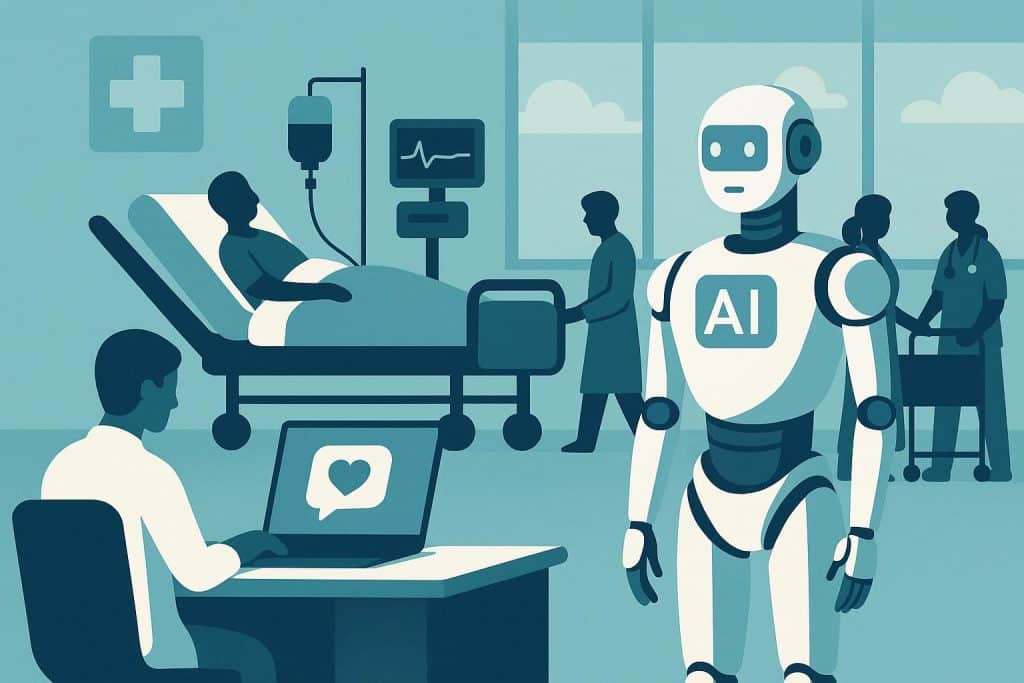
Staff shortages, rising costs, and increasing documentation requirements are shaping everyday life in hospitals. As a result, medical professionals are often stretched to their limits and spend significantly less time with patients. Many hospitals are therefore looking for new solutions and are increasingly turning to AI-powered assistants. This article explores how such systems can positively impact both clinical staff and patients while helping hospitals reduce operational costs.
AI for Hospitals as a Response to Structural Challenges
Many hospitals are facing significant structural challenges. Staff shortages among physicians, nursing staff, and administrative personnel, combined with a high administrative workload, increasingly strain day-to-day hospital operations and limit the time available for actual patient care.
Documentation requirements, billing processes, appointment scheduling, and patient communication consume valuable resources that are urgently needed elsewhere. At the same time, expectations regarding efficiency, quality, and economic sustainability in hospital operations continue to rise.
Against this backdrop, many hospitals are turning to digital support solutions. Artificial intelligence is increasingly proving to be a valuable asset. Specialized AI for hospitals can take over administrative and organizational tasks, significantly relieving physicians, nurses, and administrative staff.
Within coordinated systems, multiple AI functions can be bundled and interconnected. Documentation, coding, and patient services seamlessly share and transfer collected data without delay. This simplifies processes, reduces fragmentation, and enables more efficient workflows throughout the hospital.
Digital Assistant Systems in Day-to-Day Hospital Operations
One of the biggest time-consuming tasks for physicians and nurses is documentation. After treatment, reports must be created and recorded as completely as possible. This often requires manually researching or assigning billing and procedure codes. The result is a significant time investment that is usually not reflected in the reimbursement of medical services. As a consequence, less time remains for direct patient interactions. In addition, documentation and coding are highly error-prone, as time pressure and heavy workloads can easily lead to inaccuracies or incomplete records.
The use of AI systems has brought about a noticeable shift. These systems capture all relevant information during or immediately after treatment and generate structured documentation from it. At the same time, appropriate billing and procedure codes are automatically suggested or assigned, eliminating the need for manual research by medical staff.
Automated processing increases the consistency and completeness of data. Sources of error are reduced and follow-up work is minimized. As a result, physicians and nurses gain significantly more time for their primary responsibility: caring for patients.
Digital Patient Support and Service Assistants in Hospitals
Artificial intelligence can also make a significant difference in direct patient communication. Traditionally, hospitals operate staffed information desks at entrances and often on individual wards. These provide guidance on directions, procedures, waiting times, and organizational matters.
However, this level of service comes at a cost for medical institutions—costs that may not always be fully accounted for in budget planning. In addition, hospitals are increasingly struggling to recruit and retain service personnel, particularly for shift work. Digital reception and service assistants can offer a viable solution.
They welcome patients via terminals or apps, assist with check-in procedures, and direct them to the appropriate departments. Digital service assistants can also support appointment management and organizational tasks by automating recurring processes.
For example, they handle appointment bookings, send reminders, and provide information on necessary preparations. At the same time, they can answer frequently asked patient questions, even in multiple languages. This helps reduce waiting times and makes processes more transparent and efficient for both hospitals and patients.
If individual questions or more complex concerns arise, an AI assistant can forward them to the appropriate medical or administrative staff. This ensures that personal interaction remains available when needed, while standardized service tasks continue to run efficiently in the background through digital systems.
AI Doctors: Is This the Future of Patient Care?
Many patients—particularly older ones—remain uncertain and are often hesitant to accept AI-based solutions in their medical interactions. This hesitation is largely due to their more limited exposure to technology and digital media in general. Among younger patients, however, acceptance is significantly higher, as they grow up with social media platforms such as Instagram and Facebook, as well as modern digital and assistive technologies.
An example from China illustrates how hospitals could one day be operated largely by artificial intelligence. Recently, the world’s first so-called Agent Hospital was launched there. Its distinctive feature is that virtual “AI doctors” are primarily responsible for treating more than 300 different diseases. Their “training” was based on hundreds of thousands of simulated patient cases, enabling them to achieve a diagnostic accuracy of over 93 percent. For human physicians, reaching a comparable level of expertise would require many years—if not decades—of experience.
In this hospital, however, AI-based professionals do not operate in isolation. Instead, they function within a coordinated network that brings together multiple clinical disciplines and incorporates continuous feedback from human doctors. At present, this model is still regarded primarily as a pilot project, but it may soon set a precedent for similar approaches in other countries.