

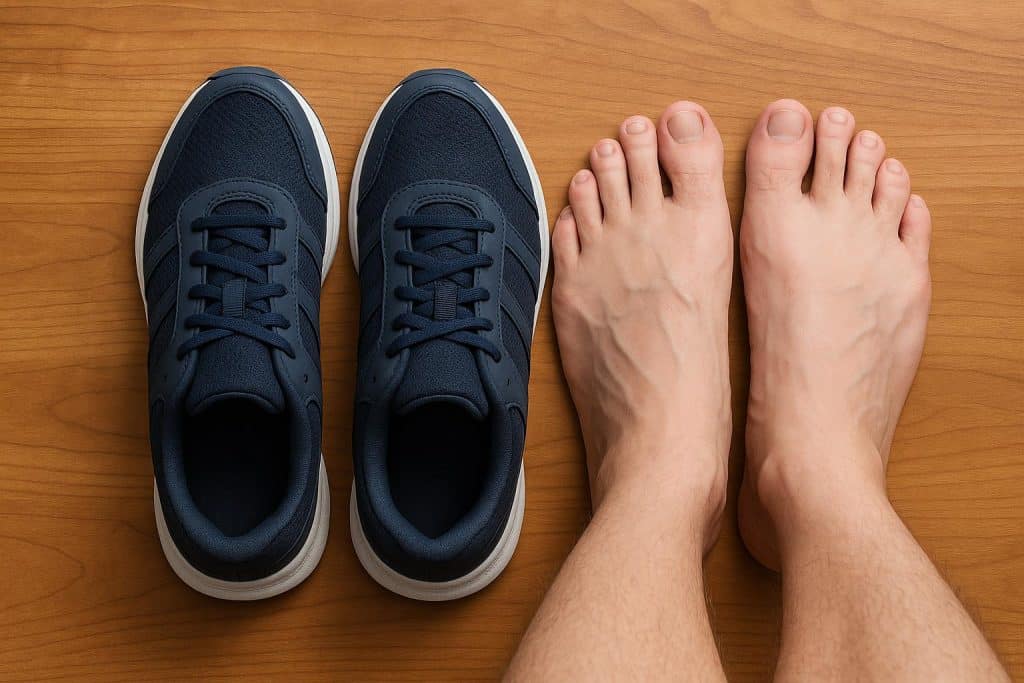
If you possess wider feet, you have likely encountered the same recommendation repeatedly: “Simply invest in supportive footwear.”
The issue lies in the fact that “support” ranks among the most frequently utilized and poorly defined terms in the realm of footwear. Brands apply it to a wide range of products, from flexible foam sneakers to rigid motion-control footwear. Salespeople often resort to this phrase when they find themselves at a loss for words. Even well-intentioned friends employ it as a broad term for “these are pleasant.”
However, when it comes to wider feet, the concept of “support” takes on a distinct role. It must provide stability for your foot without constricting it, direct your stride without imposing restrictions, and prevent pressure from accumulating in inappropriate areas. Above all, it must enhance the experience of walking, ensuring it feels more liberating rather than constraining.
This guide elucidates the true essence of support for men with wider feet, clarifies misconceptions, and provides insights on selecting footwear that ensures stability and comfort in everyday situations.
For men with wide feet, “support” encompasses a stable base, a secure heel, controlled flex, and a fit that allows the forefoot to spread naturally without encroaching on the midsole. It does not imply “rigid,” “constrained,” or “firm beneath the arch.” Optimal walking shoes for wider feet feature various width selections, a spacious toe box, a sturdy heel counter, a well-balanced midsole, and a reliable outsole, all while ensuring comfort from the initial wear.
Why wide feet change the support conversation
Wide feet are more than simply “larger feet.” They frequently feature an expanded forefoot, increased volume, an altered pressure distribution, and occasionally a heel that is narrower than the front.
This combination results in prevalent issues:
- Your foot extends beyond the confines of the midsole when the base lacks sufficient width.
- The sidewalls experience friction due to the upper contending with your width.
- You untie the laces for a moment of relief, only to feel your heel slide out.
- You extend in length to achieve width, then you advance and secure your position with your toes.
In this context, “support” does not involve coercing the foot into position. It involves providing your foot with the optimal surface for landing.
What “support” actually means for wide feet
Support encompasses more than just a single feature. This constitutes a system. Envision it as a cohesive framework of four integral components collaborating seamlessly.
1) A stable base that matches your footprint
If you have a wide forefoot, it is essential to select a shoe designed with a wide platform, rather than one that merely features a flexible upper atop a narrow sole.
When the foundation is excessively narrow, your foot tends to extend beyond the perimeter. This results in fatigue and pressure in the ball of the foot. As time progresses, it may diminish your stride’s confidence, particularly on irregular surfaces.
A shoe designed for wide feet typically features an expanded midsole and outsole footprint, particularly in the forefoot area.
2) A heel that feels held, not floating
Heel support is often overlooked for those with wide feet, as the emphasis tends to be on the space for the toes. Heel control is essential for preventing sliding, rubbing, and that sense of instability during turns.
A well-structured heel typically originates from:
- A robust heel counter, the architectural element at the rear of the shoe.
- A collar that embraces without causing discomfort.
- Lacing designed to secure the midfoot while maintaining comfort in the forefoot.
When the heel is firmly in place, you can afford to have a more spacious front in the shoe while maintaining optimal control.
3) Controlled flex in the right spot
Support should not equate to a rigid, unyielding structure.
An optimal walking shoe flexes at the ball of the foot, aligning with the natural push-off of your toes. A shoe that bends in the center may exhibit a lack of precision and support. If it exhibits minimal flexibility, it can alter your gait and cause discomfort in the knees or hips.
For individuals with wider feet, the importance of controlled flex cannot be overstated, as it provides essential stability while allowing for a seamless natural rollover.
4) Pressure distribution that feels even
Individuals with wide feet typically distribute force over a broader surface area. That is excellent. The issue arises when a narrow shoe directs that pressure into a limited number of sensitive areas.
Genuine support effectively disperses pressure across the midsole, preventing any concentrated discomfort under the ball of the foot, pinching at the pinky toe, or irritation in the bunion region.
When pressure is balanced, walking becomes a seamless experience.
What “support” does not mean (and why it backfires)
This is a domain where financial resources are squandered.
“Support” does not mean “tight”
A snug shoe may provide a sense of “security” for a brief period. Subsequently, your foot becomes warm, experiences a slight swelling, and the pressure evolves into discomfort. The increase in tightness subsequently elevates friction levels.
If you have wide feet, constriction does not equate to support. This serves as a cautionary notice.
“Support” does not mean “hard arch pressure”
Some shoes attempt to provide “support” by forcefully pressing into the arch. For specific individuals utilizing particular orthotics, that can be effective. For numerous men with wider feet, it often presents as a mere protrusion beneath the foot.
True arch support should provide a sense of fullness in the area, rather than pressing uncomfortably upwards.
A sharp arch pressure point indicates inadequate support. The shape is not aligned correctly.
“Support” does not mean “stiffer is always better”
A shoe can provide support while maintaining a flexible feel. While stiffness can occasionally enhance stability, excessive stiffness may render your stride mechanical and transfer stress to higher areas.
Support ought to provide a sense of stability without imposing limitations.
“Support” does not mean “more cushioning”
Cushioning pertains to the comfort experienced upon impact. Support involves mastery and synchronization.
A shoe may provide ample cushioning yet remain unstable if it is excessively soft or narrow beneath the foot. That is why some individuals slip into a luxurious shoe and instantly sense a lack of stability.
Gentle does not equate to providing support.
The “support equation” for wide-footed men
For a straightforward approach, consider this equation:
Support is defined by the combination of fit, stability, and pressure management.
If any one of those elements is absent, the shoe may provide comfort for brief periods, but it will not perform well during extended walks, hectic days, or on challenging surfaces.
This is also why numerous men find themselves specifically seeking the finest shoes designed for wide feet when they come to the realization that conventional “supportive” shoes cater to a different foot shape. For those prioritizing walking comfort and reliable daily wear, an excellent approach is to explore a collection dedicated to walking, such as the best shoes for wide feet men, and then refine your selection based on authentic fit and stability indicators.
How to spot real support in a shoe, in plain language
There is no requirement for complex terminology. It is essential to have straightforward assessments that can be performed in the comfort of your own home.
Check the heel counter
Grip the shoe firmly and apply pressure to the rear section of the heel.
- If it collapses effortlessly, the heel might exhibit a lack of stability.
- A structured feel typically enhances heel control.
You are not seeking rigid plastic. You seek a robust and reliable cup.
Look at the outsole width
Flip the shoe over.
Does the outsole provide sufficient width under the forefoot to accommodate your foot’s dimensions? Or does it constrict sharply?
A shoe with a narrow outsole will frequently feel unstable if your foot is wide, regardless of the softness of the upper.
Twist test for torsional stability
Grip the shoe firmly with both hands and carefully rotate it.
An effective walking shoe typically exhibits a degree of resistance to twisting. If it contorts like a towel, it may exhibit instability on irregular terrain.
Flex test for the right bend point
Bend the shoe.
It ought to flex around the ball of the foot. If it bends at the center, you may experience the sensation of the arch giving way. If it exhibits minimal flexibility, it may come across as rigid and exhausting.
Step-in feel should be calm, not dramatic
The most effective support frequently comes across as “subtle.” Your foot makes contact and remains precisely in position. Absolutely stable. There should be no intense pressure. No lateral compression.
If the shoe exhibits excessive tension in the arch or constriction at the sides, it typically indicates an improper fit.
Wide feet also need the right upper, not just the right sole
Many shoes do not accommodate wide feet effectively, as the upper design conflicts with the natural shape of the foot.
Uppers designed for wide feet typically provide:
- A toe box that offers genuine spaciousness, rather than mere height.
- Substances that maintain form without compression.
- Customization via laces or straps.
- Sufficient capacity for accommodating swelling or bulkier socks.
While stretchy uppers can enhance comfort, a narrow platform beneath may lead to your foot spilling outward more readily.
The objective is spacious yet organized.
“Support” for common wide-foot scenarios
Not all wide feet are identical. Here are several patterns and the corresponding sensations of support for each.
Wide forefoot, narrow heel
It is essential to have ample forefoot space while ensuring there is no heel slip.
This typically indicates a more spacious toe area, various width selections, and a heel that secures firmly in place.
Addressing forefoot tightness by opting for a larger size frequently exacerbates heel slip. Prioritize width initially, then refine heel hold through lacing adjustments.
Wide feet with bunions
It is essential to have sidewall comfort and a toe box that provides ample space without constriction.
Support in this context refers to the even distribution of pressure and minimized friction, rather than pronounced arch protrusions. A solid foundation prevents pressure on the bunion region with each stride.
Wide feet with overpronation
Certain individuals with broader feet tend to exhibit a greater tendency to roll inward.
Support here signifies a steady presence that directs without imposing. You seek a shoe that maintains your stride with precision while providing ample space for your forefoot.
The risk lies in purchasing a narrow stability shoe that claims to “support” your pronation while constricting your width.
Wide feet with swelling
Swelling alterations occur by the afternoon.
Support encompasses flexibility, ample space in the forefoot, and fabrics that provide comfort without constriction. A shoe that feels impeccably fitted in the morning may transform into a source of discomfort as the day progresses.
The daily fit checklist that proves whether a shoe is supportive
If you’re seeking a straightforward assessment, proceed with this.
Wear the shoes with the socks you typically choose.
Stand up.
Walk for ten minutes indoors.
Then check:
- Your toes ought to move freely without any friction against the sides.
- Your forefoot must remain comfortably spacious.
- Your heel must remain firmly in place.
- It is essential to maintain a sense of stability while executing turns.
- A sharp pressure point should not be felt under the arch.
- Upon removing the shoe, there should be no prominent red marks visible along the sides.
If any of those aspects fall short, the shoe lacks the necessary support for your foot, regardless of what the marketing claims.
Socks and lacing matter more than most men realize
Support encompasses much more than just the shoe. It is equally about the manner in which you don it.
While thicker socks enhance comfort, they may also encroach upon available width space.
Streamlined socks minimize bulk, yet they could elevate friction if the shoe creates any rubbing.
A refined strategy involves ensuring that socks remain smooth and breathable, allowing the shoe to deliver the necessary structure.
The significance of lacing cannot be overlooked. Exerting excessive force on the laces canlead to undue pressure on the upper foot, thereby limiting its natural mobility.
Support should provide a sense of security without any constriction.
How to shop smarter without getting lost in labels
For those with wider feet, the focus should be on practicality and proper fit, rather than trendy terms.
- Explore the various width options available.
- Seek a platform that offers ample width beneath your feet.
- Seek a robust and steady heel.
- Seek a toe box design that aligns perfectly with the contours of your foot.
- Subsequently, validate through actual walking assessments.
This is the method to break free from the pattern of purchasing “supportive” shoes that continue to cause discomfort.
For those seeking a shopping lane that prioritizes consistent daily comfort, exploring walking-oriented choices such as the best shoes for wide feet men can serve as an effective starting point. Utilizing the fit checklist above will ensure that the support truly meets your needs.
FAQs
What does “support” mean in walking shoes?
Support in walking shoes entails a robust foundation, regulated flexibility, a firmly secured heel, and balanced pressure distribution. It provides stability and minimizes discomfort during extended use.
Are wide shoes automatically supportive?
Not always. Certain wide shoes provide ample room yet may compromise stability, particularly when the midsole is overly soft or the outsole is too narrow. Support necessitates both space and framework.
Is cushioning the same as support?
No. Impact is absorbed by cushioning. Support facilitates movement and ensures your foot remains stable. One can exist independently of the other.
Why do my feet hurt even when the shoe length is correct?
Often it is width or volume. When the forefoot is constricted or the platform is excessively narrow, discomfort may arise even if your toes are not making contact with the front.
Should supportive shoes feel tight at first?
They should feel secure, not tight. Constrictive conditions often result in friction and strain, particularly for individuals with broader feet.
How can I tell if a shoe is stable enough for walking?
Examine the outsole width, assess the firmness of the heel counter, and evaluate the twist resistance. Proceed to walk and assess whether you feel grounded while executing turns and halts.
Final takeaway
For men with wider feet, genuine support transcends mere marketing rhetoric. The interplay of openness and steadiness creates a serene walking experience.
- Support means your foot fits naturally.
- Support means the base matches your width.
- Support means your heel is held.
- Support means pressure feels even.
Support should not equate to tightness, excessive arch pressure, or rigidity without purpose.
When you begin evaluating shoes based on these straightforward principles, you move beyond the pursuit of “true size” and begin selecting shoes that genuinely suit your feet.