


Did You Know?
70% to 85% of AI and machine learning projects never deliver meaningful results. Many assume these failures stem from complex algorithms or a lack of technical expertise. The real reason? Fragmented data architecture.
This data confusion stems from different data management tools, overlapping systems, and a lack of consistent governance. This situation results in what is known as integration debt.
Moreover, today, all the data-driven enterprises have these fragmented silos that keep agentic AI stuck in proof-of-concept mode, unable to reason in real-time or act autonomously across the enterprise’s workflows.
That’s where Converged Data Management Platforms (CDMPs) come in as the solution agentic AI needs: unified, AI-ready data that reduces complexity, enables true agility, and eliminates fragmentation. But
What’s Killing Agentic AI in 2026?
1. Data Silos Starve Full Context
You’ve seen AI accurately identify overstock, but it stumbles without the complete view like pricing from Azure, logistics from GCP, or sales from Snowflake. Years of building in silos have left agentic AI without the context it needs to understand the real business situation.
2. Tool Sprawl Buries Integration Debt
Many overlapping tools, like ETL, catalogs, and governance, trap engineers in endless connections instead of fostering AI breakthroughs. This tech debt we’ve built up hinders the quick delivery of data for agentic models.
3. Trust & Readiness Gaps Block Autonomy
Fragmented metadata obscures data trustworthiness. Executives will not trust AI without complete visibility and real-time readiness. 56% of leaders realize they need to simplify their tech stacks, but sprawl prevents governed AI data from flowing at scale.
These 3 blockers aren’t isolated problems-they’re symptoms of a fragmented data architecture. What agentic AI needs is a unified foundation that addresses all these challenges simultaneously and here comes the converged data platform.
What is a Converged Data Platform?
Converged Data Management Platforms (CDMPs) unify your entire data stack-storage, integration pipelines, transformation workflows, governance, lineage, and AI/ML-into one seamless architecture that eliminates silos and accelerates AI-ready insights, providing core data management capabilities well-integrated through a platform approach. CDP adoption is expected to grow at a 14% CAGR from 2025 to 2032.
With 1Platform by Polestar Analytics, you can bring converged data management and intelligence platform together to eliminate these blockers killing your agentic AI initiatives.
It brings all business data together into one reliable, managed foundation, eliminating data silos and excess tools. Our platform combines data preparation with AI-driven decision-making and autonomous agents in one interface. It provides predictive insights and automated choices.
With a modular design, 1Platform works well with Microsoft, Databricks, Snowflake, GCP, and AWS.
The result is fast delivery of AI-ready data, allowing your systems to succeed.
The platform is composed of numerous purpose-built modules, broadly organized into two layers:
Two Essential Layers are:
Data Solutions: brings together and manages enterprise data. It removes silos and builds a reliable base for AI.
Decision Solutions: uses AI agents to transform data into predictive insights, automated decisions, and smart actions.
Together, these solutions speed up the transition from scattered data to clear business results without added complexity.
Here’s how these layers connect:
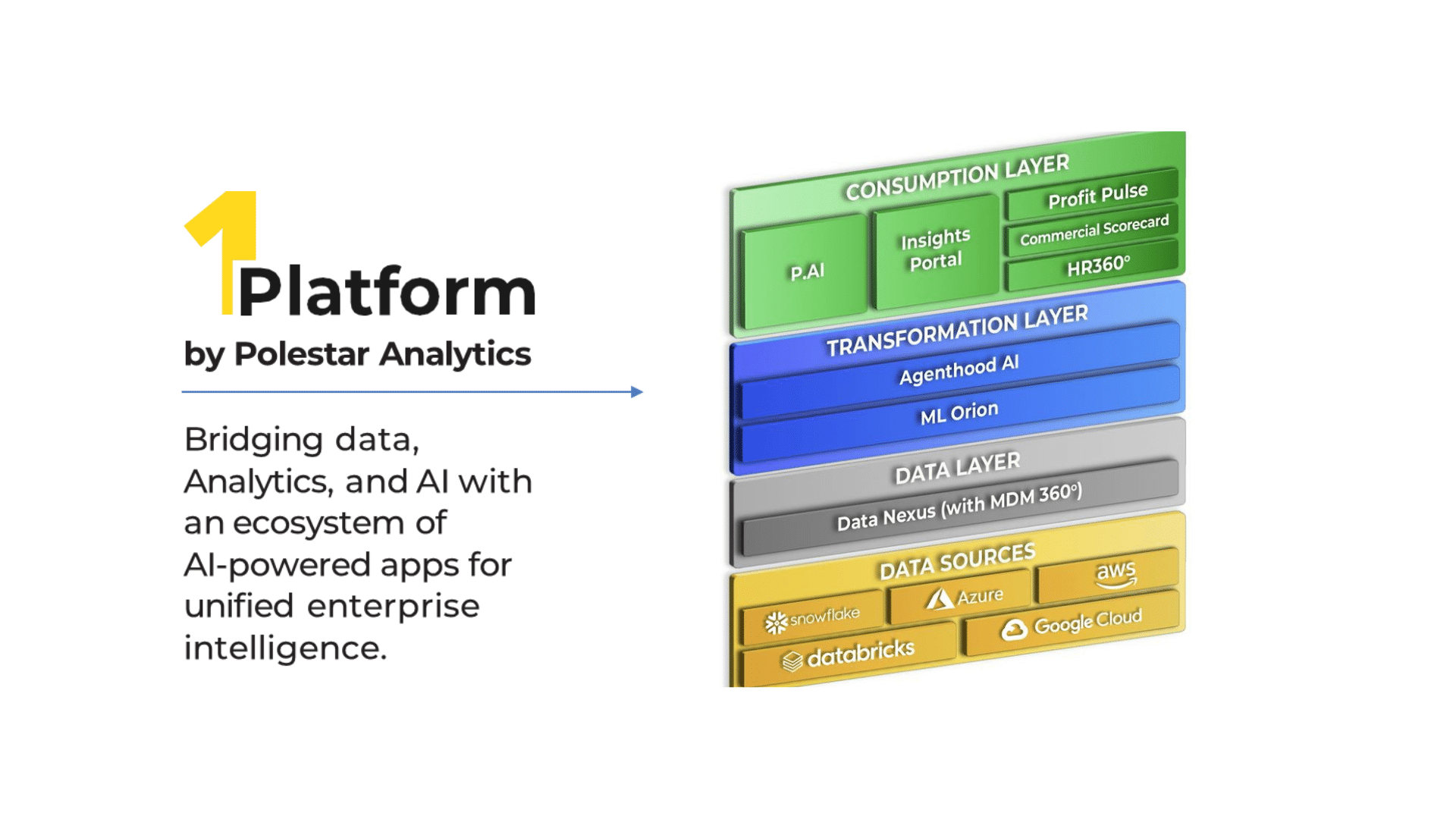
These modules create a full intelligence ecosystem.
Now that we’ve examined the structure, let’s look at how this unified approach tackles the challenges of agentic AI.
How Do Converged Data Platforms Empower Agentic AI?
61% of organizations are reshaping their D&A operating model to support AI (Gartner). For agentic AI to function end-to-end, it needs complete, semantically consistent, real-time data with proper governance. CDPs provide this controlled foundation, enabling AI agents to generate outcomes reflecting full business truth, not fragments.
Key enablers:
- Unified infrastructure: Consolidated monitoring, standardized CI/CD pipelines, and native integrations ensure AI agents execute tasks without friction
- Real-time access: Dramatically reduced retrieval time enables AI to transition from identifying issues to taking immediate action
- Innovation focus: Teams shift from maintaining integrations to building scalable data products and AI programs
Human-AI collaboration: Convergence elevates humans. Business users review AI recommendations that previously took weeks to create, providing strategic oversight while AI handles operational execution.
But data readiness is only half the equation. To truly see agentic AI, you need an execution layer that can act on this foundation.
How Does Agenthood AI Turn Data into Autonomous Action?
While CDPs eliminate data silos and deliver AI-ready data, Agenthood AI serves as the agentic engine within 1Platform that converts this data into automated outcomes.
It addresses the enterprise challenge of automating cross-functional workflows through multi-agent orchestration, where specialized agents collaborate across SAP, Salesforce, Databricks, and your entire tech stack. Business users design these workflows in minutes using conversational interfaces, no coding required.
Key capabilities include cross-departmental orchestration, enterprise-scale deployment processing thousands of tasks simultaneously, specialized agent architecture, Agent FinOps for cost visibility, and API-first integrations with real-time tracking.
Integrated with Microsoft Azure, Fabric, and Databricks, everything is controlled via natural language, enabling anyone to schedule or modify workflows by simply prompting their needs.
Together, CDPs and Agenthood AI complete the agentic AI stack: trusted data foundation and autonomous intelligent execution.
Conclusion: Converged Platforms are the AI Foundation
Agentic AI’s promise is autonomous agents that reason, decide, and act across complex business processes that cannot be realized on a fragmented data infrastructure. The 70-85% failure rate isn’t about algorithms or talent. It’s about data architecture.
Converged Data Platforms provide the unified, governed, real-time foundation that agentic AI needs. By removing data silos, cutting down on too many tools, and creating consistent governance, CDPs change AI from basic assistants that spot problems into independent agents that offer full solutions.