

As data volumes grow and applications become more search-driven, scanning entire datasets to answer simple questions quickly becomes impractical. Whether you’re debugging logs, powering search features, or retrieving context for AI applications, performance hinges on one core capability: finding relevant records fast.
This is where the inverted index comes in. Originally popularized by search engines, inverted indexes have become a foundational building block in modern databases, analytics platforms, and observability systems.
What Is an Inverted Index?
An inverted index is a data structure that maps terms to the records in which they appear, rather than storing data in a purely row-oriented or column-oriented format.
In a traditional forward structure, each document or row points to its content. With an inverted index, the relationship is reversed: each term points to a list of document IDs (or row numbers) where it occurs.
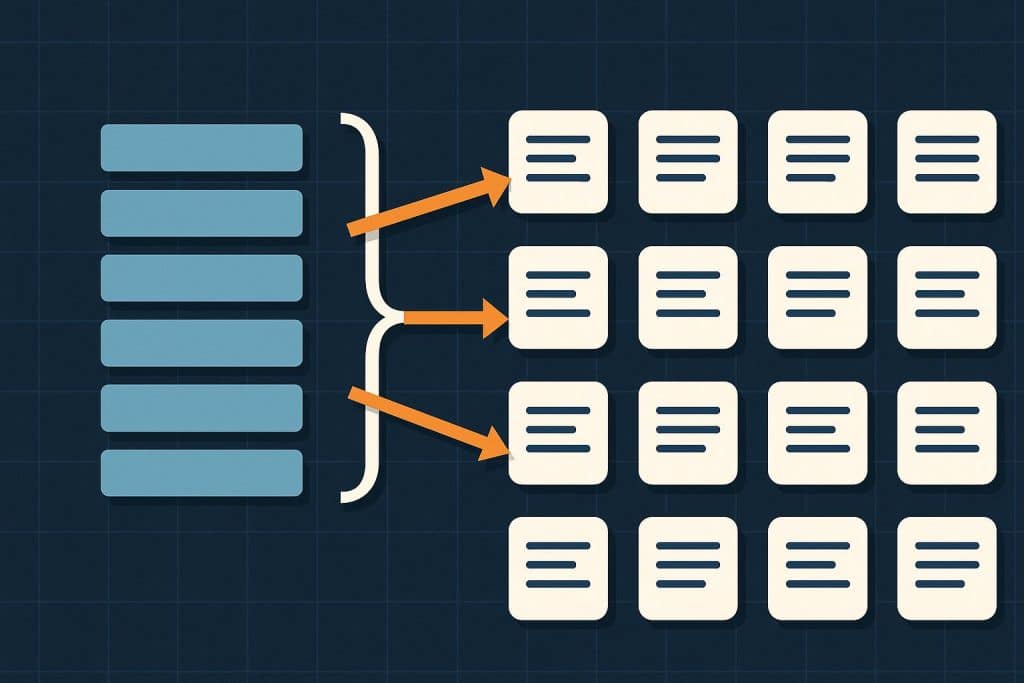
This simple inversion has a powerful effect. Instead of scanning every row to check whether it contains a keyword, the system can jump directly to the relevant subset of data using a dictionary lookup. As datasets scale to millions or billions of rows, this difference becomes the deciding factor between seconds and milliseconds.
Why Use Inverted Indexes?
Inverted indexes exist because full scans do not scale for text-heavy or filter-heavy workloads.
In practice, teams encounter several recurring problems that inverted indexes solve well:
Fast Keyword and Phrase Search
Inverted indexes excel at exact and phrase-based matching. Searching for specific error messages, identifiers, or text fragments becomes nearly instantaneous, even across massive datasets.
Efficient Filtering Before Analytics
Many real-world queries start with a filter—find records that mention X—before running aggregations. Inverted indexes dramatically reduce the amount of data that needs to be scanned downstream.
Real-World Performance Gains
In production systems, inverted indexes routinely deliver orders-of-magnitude speedups. Queries that take seconds without indexing often drop to sub-second latency once an inverted index is in place, making them usable in interactive and real-time scenarios.
A Natural Fit for Logs and AI Retrieval
Log analytics, incident debugging, and retrieval-augmented generation (RAG) all depend on fast text-based filtering. In these workloads, inverted indexes are not an optimization—they are a requirement.
Where Inverted Indexes Fall Short
Despite their strengths, inverted indexes are not a universal solution. Understanding their limitations is critical to using them effectively.
Storage Overhead
Maintaining posting lists and term positions increases storage usage, especially for large text fields. Depending on configuration, index size can add significant overhead.
Update and Delete Costs
Frequent in-place updates or deletions can be expensive. Inverted indexes typically perform best on append-heavy data rather than constantly mutating datasets.
Limited Use for Pure Aggregations
If queries involve only numerical aggregation without text filtering, columnar storage and column-level indexes are usually more efficient.
Not Designed for Semantic Similarity
Inverted indexes are optimized for exact term matching, not semantic similarity. For use cases where meaning matters more than keywords, vector search is often a better fit.
In practice, the most effective systems combine inverted indexes with other indexing strategies, rather than relying on them in isolation.
How Inverted Indexes Are Used in Modern Systems
Modern databases and analytics platforms integrate inverted indexes in different ways, depending on workload requirements.
Text Search and Log Analytics
Inverted indexes are widely used to search logs, traces, and event data by message content, error codes, or identifiers. This enables engineers to investigate issues interactively instead of waiting for batch jobs.
Hybrid Search and Analytics
Increasingly, teams want to filter data using text predicates and then aggregate results using SQL. Inverted indexes act as the first-stage filter, while analytical engines handle grouping, counting, and time-based analysis.
AI and Retrieval Pipelines
In RAG workflows, inverted indexes are often used alongside vector search. Keyword filtering narrows down candidates, while vector similarity refines relevance. This hybrid approach improves both performance and accuracy.
Operational Dashboards
User-facing dashboards frequently rely on fast filtering across high-cardinality dimensions. Inverted indexes make these interactive experiences feasible at scale.
How VeloDB Applies Inverted Index in Practice
In many production environments, search and analytics are handled by separate systems. A common pattern is to use a search engine for filtering and an analytical database for aggregation. While functional, this architecture introduces operational friction: duplicated data, synchronization delays, and complex pipelines.
VeloDB takes a different approach. Instead of treating search as an external capability, inverted indexes are integrated directly into VeloDB’s analytical engine. This allows keyword filtering and analytical queries to run on the same data, within a single system.
In practice, this design enables workflows such as:
- Filtering logs by message or error code, then aggregating by time, service, or region
- Combining text predicates with SQL analytics without ETL
- Analyzing fresh, high-volume event data in real time
The goal is not to replace dedicated search engines for advanced relevance ranking, but to cover the most common production use cases—where fast filtering and analytics need to work together without operational overhead.
By unifying inverted index–based search and analytical processing, VeloDB helps teams simplify their data architecture while maintaining the performance required for modern observability and AI-driven applications.
Final Thoughts
Inverted indexes remain one of the most effective tools for enabling fast search at scale. They shine in keyword-driven workloads, significantly reduce query latency, and unlock interactive exploration of large datasets.
At the same time, they are most powerful when used as part of a broader system—combined with columnar storage, analytical execution, and, increasingly, vector search. Platforms that integrate these capabilities can support a wider range of real-world workloads without forcing teams to stitch together multiple systems.
Understanding where inverted indexes fit—and how they’re applied in practice—is essential for building scalable, responsive data systems in today’s search- and AI-driven landscape.