

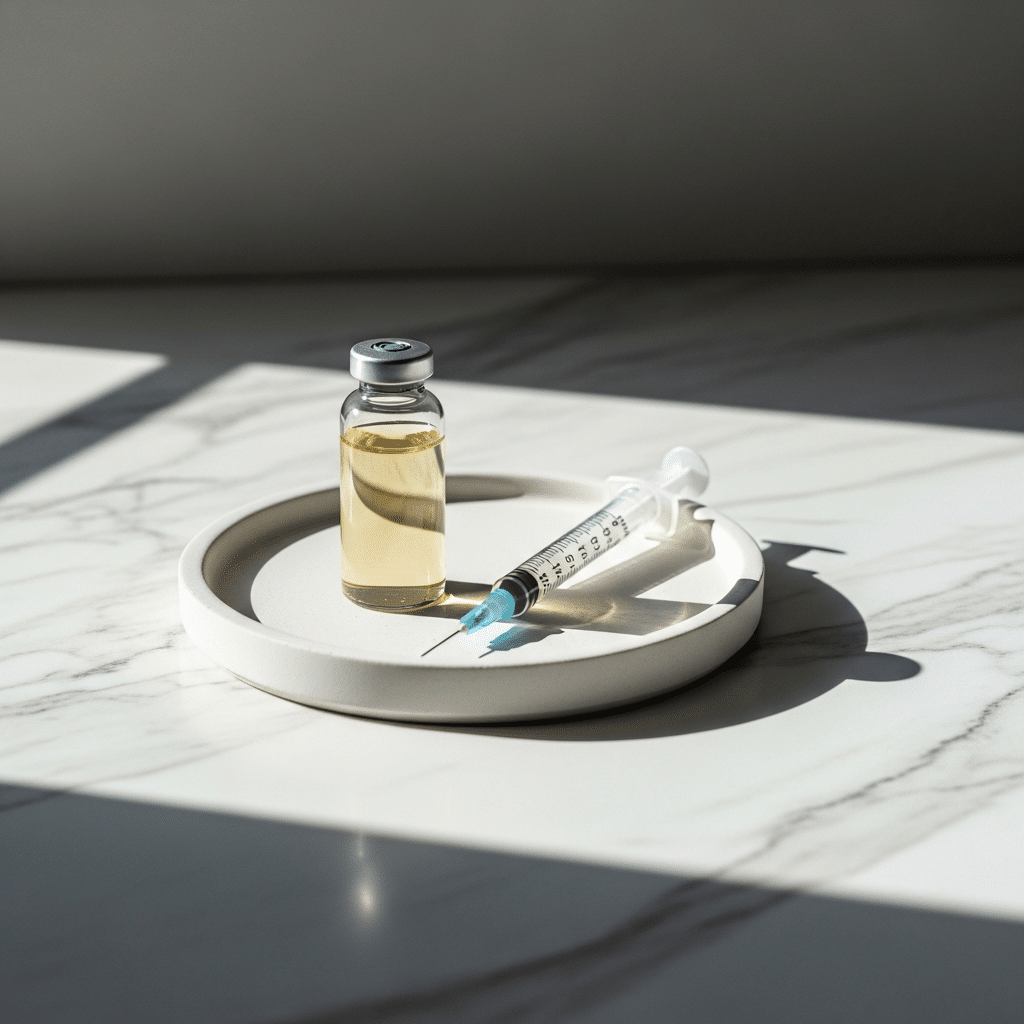
I used to treat my aesthetic appointments like pit stops in a Formula 1 race. I wanted to rush in, get my maintenance done, and rush back to my laptop before my Slack status turned to “away.” It worked for a while. The dermal fillers did their job of smoothing out the exhaustion, and I looked rested even when I wasn’t. But recently, I noticed something shifting. The volume was there, but the “vibe” was off. My face looked structured, yet the skin sitting on top of that structure looked tired. That is when my dermatologist introduced me to the concept of “treatment stacking,” a methodology borrowed from biohacking circles that suggests dermal fillers for volume restoration are only half the equation. If you want the kind of results that look expensive rather than just “done,” you need to pair the structural work of fillers with the biological repair work of peptides.
The “Tent Pole” Analogy
To understand why this combination is non-negotiable for the modern high-performer, you have to visualize a camping tent. The dermal fillers act as the tent poles. They provide the necessary lift, the shape, and the architectural support that keeps everything upright against the pull of gravity. However, the tent poles are useless if the canvas stretched over them is wrinkled, thin, or weather-beaten.
In this scenario, your skin is the canvas. If you place high-quality filler underneath skin that has lost its elasticity and thickness, the result can often look disjointed. You get the volume, but you don’t get the youthful bounce. This is where many people get it wrong. They chase more volume to fix a texture problem. Insights into how smart injections are rewriting Toronto women’s morning routines suggest that the most natural results come not from adding more filler, but from improving the quality of the skin that creates the envelope for that filler.
The Biological Architects: Why Peptides Matter
Enter peptide therapy. If fillers are the construction crew adding new beams to the house, peptides are the project managers sending signals to the workers. Peptides are short chains of amino acids that act as messengers, telling your cells to perform specific functions like “produce more collagen” or “reduce inflammation.”
When you stack these treatments, you create a synergy that is impossible to achieve with needles alone. Specifically, peptides like GHK-Cu (Copper Peptide) work to densify the dermis. They thicken the “canvas” of the tent. When you inject filler beneath skin that has been primed with a solid peptide protocol, the product integrates more seamlessly. It doesn’t just sit there; it becomes part of a healthier ecosystem.
The Investment Portfolio Approach
Think of your face like an investment portfolio. Fillers are your high-yield bonds; they give you an immediate, visible return. Peptides are your index funds; they provide slow, compounding growth that secures your long-term position. Relying on just one is a risky strategy.
Leading beauty authorities like Allure Magazine have noted that the future of injectables is hybridization, where the goal is not just to fill a void but to regenerate the tissue itself. By using peptides to ramp up your skin’s natural regenerative engine, you actually extend the life of your aesthetic investments. You might find you need less filler over time because your skin is doing more of the heavy lifting.
Actionable Stacking Protocols
So, how do you execute this without turning your bathroom into a chemistry lab?
- The Pre-Game: Start a topical or injectable peptide protocol (consult your provider about GHK-Cu) two weeks before your filler appointment. This reduces inflammation and primes the skin to heal faster.
- The Event: Get your structural work done. Focus on the cheeks or jawline where you need support.
- The Maintenance: Continue peptide therapy to maintain the collagen matrix.
Stop asking your provider to simply “fill the gap.” Start asking how you can treat the structure and the surface simultaneously. That is the difference between looking filled and looking finished.