

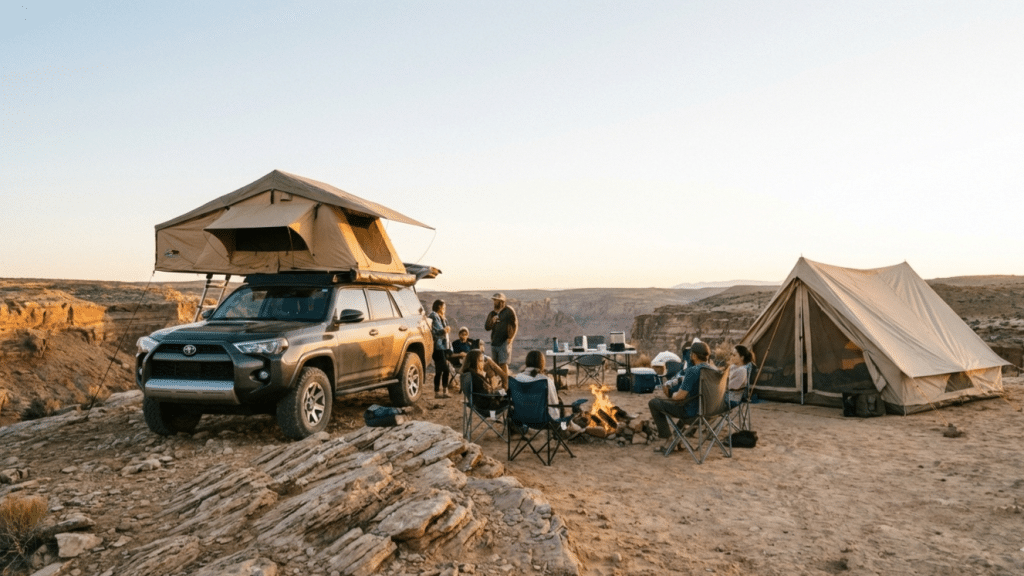
Rooftop tents (RTTs) have rapidly become a defining piece of modern overlanding culture. From social media feeds to remote trailheads, they are often presented as a premium upgrade over traditional ground tents. But are they genuinely worth the investment, or simply a lifestyle trend?
To answer that question objectively, this article compares rooftop tents and ground tents across five practical dimensions that directly affect real-world camping experiences.
Key Comparison Points (Quick Overview)
- Setup speed and daily convenience
- Sleep comfort and moisture control
- Safety and privacy in real camping conditions
- Terrain adaptability and campsite flexibility
- Long-term cost, resale value, and overall utility
1. Setup Efficiency: Time Matters More Than You Think
Ground tents typically require site preparation, leveling, and full pitching. Even experienced campers usually spend 15–30 minutes per setup, longer in poor weather or low light.
Rooftop tents, especially hard-shell designs, deploy in just 60s. This speed reduces fatigue at the end of the day and encourages spontaneous overnight stops.
2. Sleep Quality: Elevation Changes Everything
Sleeping on the ground introduces two common problems: moisture from below and condensation inside the tent. Even high-quality sleeping pads cannot fully eliminate damp mornings.
RTTs avoid ground moisture entirely and benefit from improved airflow due to elevated positioning. Most rooftop tents also include integrated high-density foam mattresses, providing consistent comfort without additional setup.
3. Safety and Privacy: Off the Ground Has Advantages
Ground-level camping increases exposure to small wildlife, flash flooding, and foot traffic in crowded campgrounds.
Rooftop tents add a physical buffer. Elevation discourages most animals, reduces flood risk, and improves privacy—particularly valuable in busy or shared camping areas.
4. Terrain Adaptability: Camp Where Ground Tents Can’t
Ground tents require flat, dry, and obstacle-free surfaces. Finding suitable sites can be difficult in rocky, muddy, or sloped environments.
RTTs shift the requirement from ground conditions to vehicle positioning. As long as the vehicle is parked safely, the sleeping platform remains level and usable—whether on rocky coastlines, uneven trails, or even urban overnight parking.
5. Long-Term Value: Cost vs. Utility
Rooftop tents clearly demand a higher upfront investment. However, they consolidate multiple components—tent, mattress, and platform—into one system and typically retain resale value far better than ground tents.
When factoring in time saved, increased trip frequency, and consistent comfort, the value calculation extends beyond simple cost per night.
3-Year Cost Comparison (Table Unchanged)
| Cost Category Ground | Tent System (High-End Setup) | Rooftop Tent System ( e.g., Topoak) | Notes Key Difference |
|---|---|---|---|
| Initial Shelter Cost | $400 – $800 | $2,000 – $3,500 | RTT is a complete sleep system (includes mattress) |
| Sleep System | $300 – $600 | $0 (Included) | Ground tent requires separate pad, bag, & pillow |
| Vehicle Requirements | $0 | $300 – $800 | RTT requires a suitable roof rack or platform |
| Estimated Resale Value | 30-40% of original | 60-70% of original | Premium RTT brands hold value significantly better |
| 3-Year Total Cost | $900 – $1,900 | $2,800 – $5,800 | Higher upfront investment for RTT |
| Cost per Night (60 nights) | $15 – $32/night | $47 – $97/night | Based on net cost only |
Who Should Choose What?
- Choose a ground tent if:
You camp only a few times per year
You prioritize low upfront cost
You need gear suitable for backpacking
- Choose a rooftop tent if:
You camp monthly or more
You value speed, comfort, and consistency
You camp in varied terrain or poor weather
In the end, rooftop tents are not a replacement for ground tents—they are a different tool. For frequent campers and overlanders, the convenience, comfort, and flexibility of an RTT often justify the investment.