

Warehouses across the USA face considerable pressure to deliver goods in shorter periods, hold diverse product assortments, and support the rapidly widening distribution networks. Customer expectations have moved from just receiving orders effectively to focusing on speed, accuracy, and consistency of service across numerous sales channels.
Every operation has to be conducted with space, labour, and cost constraints. Conventional storage layouts that were built to match the expected volumes and low SKU variety have been unable to fulfil changing order requirements. This led to slower picking, excessive space usage, and limited inventory visibility.
The appropriate warehouse storage solution typically involves optimising layout, storage systems, and material flow in order to achieve operational goals, increase throughput and accuracy, and accommodate future growth. Smart storage design enables automation, helping warehouses overcome labour shortages. This way, they can maintain high service levels across expanding fulfilment networks.
Market Forces Reshaping Warehouse Storage Needs
Due to exponential growth in e-commerce and the growth of DTC business models, high volumes of orders have emerged, and service delivery timeframes are becoming increasingly restricted. Warehouses must become capable of handling an increased SKU diversity, demanding flexible storage set-ups that can be adapted quickly. Most of the urban fulfilment centres are definitely working in cramped spaces, thereby making the horizontal and vertical storage utilisation much more crucial.
Smooth picking and replenishing processes are required for high-speed cycle times. Meanwhile, growing distribution networks require a system that is capable of scaling without interruptions in operation. That is really why warehouses have to rethink their storage strategies. They need to think about a warehouse storage solution that enables speed, flexibility, and operational efficiency in the long term.
Technology Landscape for Modern Storage Systems
Storage environments today leverage automation, modular infrastructure, and software-driven control. Automated storage and retrieval systems support highly dense storage. It also provides quick access to inventory. Shuttle systems and modular racking make it easy to tweak layouts so that they can meet the business's actual needs. Slotting software assigns products based on demand patterns, which minimises picker travel time and ensures smoother operations.
Real-time integration with warehouse management solutions guarantees accurate inventory tracking and efficient task coordination. These things also work in alignment with robotic picking and material handling systems to enable more seamless workflows across storage, retrieval, picking, and order consolidation processes.
Key Functional Components of Advanced Storage Solutions
• Intelligent slotting algorithms that reduce picking distance
• Real-time inventory visibility through system integration
• Dynamic replenishment workflows based on demand patterns
• Configurable racking and bin structures for flexible layouts
• Compatibility with both automated and manual processes
These features ensure storage systems remain responsive, accurate, and scalable. Strong warehouse management solutions also support faster decision-making and better coordination across fulfilment operations.
Operational Challenges Solved by the Right Storage Design
In pick areas, poor storage layouts often lead to congestion. This can result in delays in fulfilment operations. Inefficient use of available space increases the costs of the facility and holds back expansion. Misplacement promptly leads to order delays and errors. Additionally, weak replenishment processes could cause stockouts at fast-moving zones.
A structured warehouse storage solution would enable smooth material flow, faster picking, and more precise inventory placement. Without such a solution, it will be difficult for any warehouse in the USA to meet its service targets while controlling operational complexity.
Decision Framework for Selecting a Storage Solution
Warehouses must evaluate order profiles to understand the storage density requirements. High-velocity SKUs must have easy access. On the other hand, slower movers can be set aside in compact zones. Slotting strategies based on turnover improve efficiency.
Compatibility with warehouse management solutions ensures smooth integration. Facility infrastructure, like ceiling height and floor load-bearing capacity, can affect the storage design. Scalability for long-term and readiness for automation should influence the investment decisions.
Implementation Considerations for Storage Optimisation
Phased deployment minimises disruption to daily operations. The layout redesign must align with material flow paths so that bottlenecks can be avoided. System configuration helps ensure inventory accuracy and task visibility through warehouse management solutions.
Adequate workforce training prepares staff for new procedures as well as the technologies. Constant performance monitoring makes it easier to figure out opportunities for improvement. It also helps maintain operational efficiency over time.
Performance Impact of Optimised Storage Systems
Structured storage not only ensures faster picking speed and improved order accuracy but also enhances productivity by reducing travel distance. Better utilisation of space reduces real estate costs. Faster replenishment results in smoother order processing and fulfilment.
A strong warehouse storage solution offers improved visibility on inventory and facilitates stock control and planning. These benefits ensure more reliable fulfilment while fueling future growth.
Addverb’s Approach to Intelligent Warehouse Storage
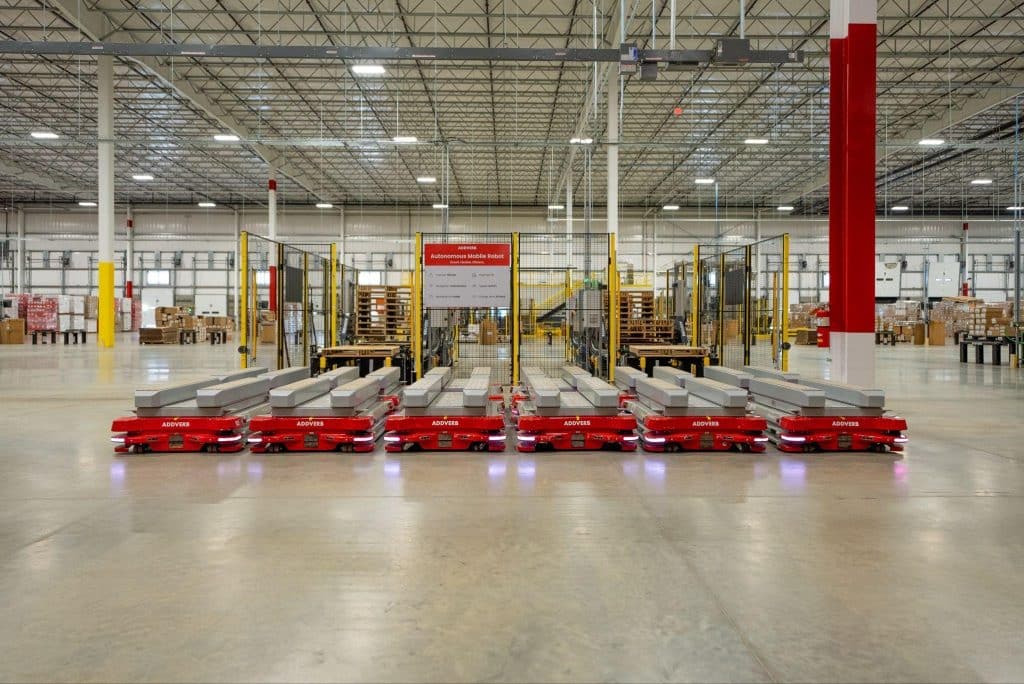
Addverb develops storage solutions designed for high-density and high-throughput warehouse operations. Their systems integrate with warehouse execution software to provide real-time control over inventory movement, order processing, and material flow. These solutions include advanced carton storage systems, efficient pallet handling and automated crane-based storage and retrieval systems to support diverse warehouse needs.
Modular storage configurations are designed to facilitate scaling storage capacity without any great disruption to layouts. Such solutions specifically align with robotic warehouse strategies and advanced warehousing management solutions that support automated picking, retrieval, and transport. Automated cranes enable precise, high-speed movement and storage of cartons and pallets within these systems. All focus stays geared toward the operational stability, system uptime, and long-term efficiency.
Conclusion
The key to efficient and scalable order processing in the USA lies in the proper warehouse storage solution. Since automation and digital workflows are now becoming an integral part of warehouse operations, storage systems need to evolve further to support speed, accuracy, and cost control.
The integration of a software-enabled design powered by strong warehouse management solutions enhances the visibility and flexibility of the fulfilment process. Addverb supports businesses in building smart storage environments, meeting the demands of modern fulfilment and supporting long-term supply chain performance by enabling automation-ready infrastructure.