

This article is presented by Sharon Vernick, a Pittsburgh-based product and services leader with extensive experience in global marketing and business development. In her role as director of global marketing at Westinghouse, she works closely with international stakeholders, technology partners, and large-scale infrastructure clients, building an analytical perspective on how major destinations and complex operations are structured. Sharon Vernick has collaborated with organizations across North America and central and eastern Europe, gaining insight into how large, multi-use properties balance innovation, logistics, and visitor experience. Her professional background includes senior sales and marketing leadership roles in the energy and financial sectors, as well as earlier experience in human resources and business analysis. This breadth of experience provides a practical lens for examining Disney World’s four major theme parks, which combine entertainment, transportation, hospitality, and long-term planning into a single integrated destination.
Disney World’s Four Major Theme Parks
Located in Orlando, Florida, Walt Disney World opened its doors to the public in October 1971, following several decades of The Walt Disney Company establishing itself as a major player in the film and television industry. Studio owner Walt Disney had long maintained an interest in amusement parks and officially entered the theme park industry by opening Disneyland in 1955. While the Anaheim, California, park proved successful and remains in operation today, Disney believed he needed more room to fully realize his vision for a theme park that catered to both children and adults.
Disneyland quickly grew in popularity on America’s West Coast, so the studio looked to the East Coast for a second, larger park. Ownership settled on a 28,000-acre parcel of land near Orlando, allowing Disney World to operate both as a theme park and vacation resort with multiple hotels, restaurants, and campgrounds, in addition to the amusement rides and attractions.
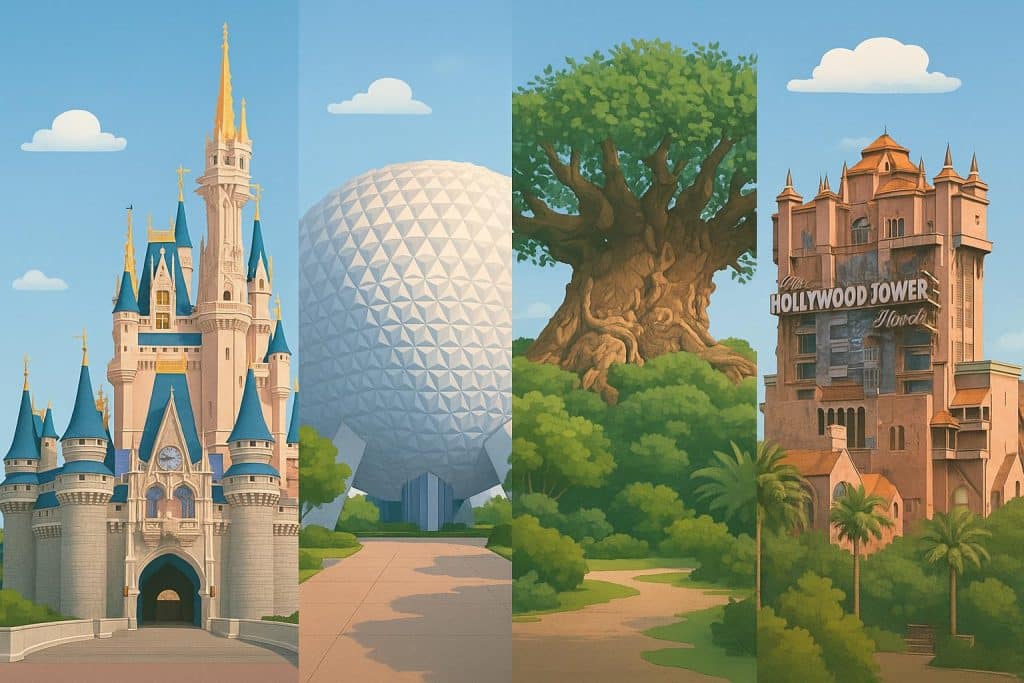
When Disney World opened in 1971, it consisted of a single theme park: Magic Kingdom. The park consists of six distinct areas: Main Street, USA, Adventureland, Frontierland, Liberty Square, Fantasyland, and Tomorrowland. These areas consist of numerous iconic theme park rides, such as Big Thunder Mountain, The Haunted Mansion, and Space Mountain. Several Magic Kingdom rides have spawned film adaptations; the Pirates of the Caribbean, for example, has spawned five films that have generated global box office returns exceeding $4.5 billion.
Individuals and families staying at the Magic Kingdom can select from several popular hotels situated near the park. Options include Disney’s Grand Floridian Resort and Spa, Disney’s Wilderness Lodge, and Disney’s Port Orleans Resort.
Disney World expanded for the first time in 1982 with the opening of EPCOT Center. The company shortened the name to EPCOT in 1996. EPCOT represents one of Walt Disney’s last great ambitions, a planned community that blended the most advanced trends and technologies in urban planning. The company ultimately scaled back these plans and opened it as a new amusement park instead. EPCOT, however, still featured a highly advanced transportation network. The park highlights a combination of future technologies and world cultures. Notable attractions include the World Showcase, the Living Seas, and Spaceship Earth.
Seven years later, Disney World unveiled its third major park: Disney-MGM Studios, later renamed Disney’s Hollywood Studios, a park inspired by show business. While the park features various rollercoasters and thrill rides, it is perhaps best known for its Backlot Tour, a unique attraction that takes visitors through various stages of a Hollywood production, providing in-depth looks at a costume department, classic film sets, and a special effects show, among other points of interest.
Disney World opened its fourth major park, Disney’s Animal Kingdom, in 1998. The park opened on Earth Day and consists of many animal-focused attractions, including the Kilimanjaro Safari. While Animal Kingdom represents Disney World’s last major park, visitors can see many other attractions, such as the waterparks Typhoon Lagoon and Blizzard Beach.
Today, Disney World functions as a crucial part of Florida’s economy, drawing more than 50 million tourists each year. Visitors to the park generate upwards of $40 billion in impact for the local economy, including approximately 250,000 jobs.
About Sharon Vernick
Sharon Vernick is a director of global marketing at Westinghouse, where she supports sales efforts for large nuclear power plants, small modular reactors, and energy storage technologies. Based in Pittsburgh, she has developed international relationships that promote energy security and zero-emissions strategies. Her career includes leadership roles at Peoples Natural Gas and experience in human resources at First Commonwealth Bank. Sharon Vernick holds an MBA in marketing from Ashford University and is a member of the American Marketing Association.