

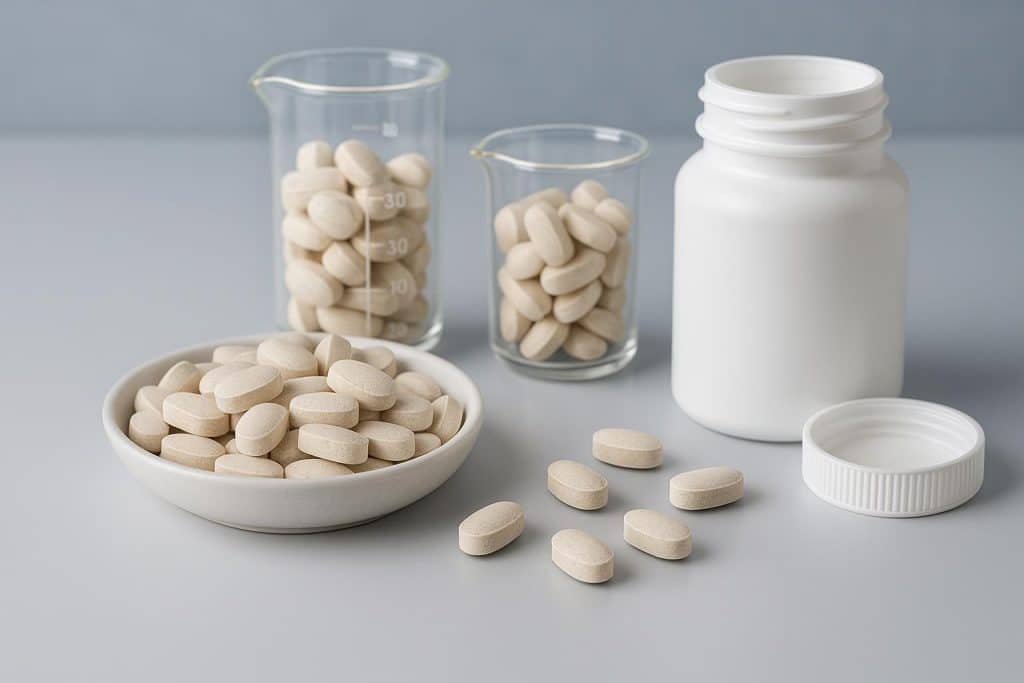
The Tablet Manufacturing Process
The tablet manufacturing process consists of the compression of powdered raw ingredients into solid dosage forms using specialized machinery. Tablets can be created using numerous different active ingredients and excipients, such as vitamins, minerals, herbs, and more. Tablet manufacturers have to be simple, shelf-stable, and consistent within a batch of tablets, making sure to meet the same weight, hardness, and dissolution qualities as the rest of the batch.
Click here to read more about Custom Tablet Manufacturing – Prosafe Nutritionals
Why Tablets Are An Important Form of Supplement Customization
Custom tablet manufacturing gives brands the right to create differentiated products that fill gaps in the market. Tablets can be customized to serve unique health concerns and can be tailored toward age, gender, or delivery preferences to a specific target demographic. Brands can create exclusive formulations with the right manufacturers to fill gaps in the market and make their products stand out from the rest of the competition
View Custom Tablet Manufacturing – Prosafe Nutritionals for More Details
Brief Overview of The Tablet Manufacturing Process
There are five manual steps to the production of tablets to be manufactured: blending, granulation, compression, coating, and packaging. Each one of these steps has to be done with specific parameters in mind. Granulation promotes compressibility and powder flow, compression of the tablets has to be done at quantitatively controlled pressure, and coating can be done to enhance the appearance, mask the taste, or provide controlled release functions. Types of Tablets and Their Applications
Nutraceutical Tablets
Nutraceutical tablets provide solid forms of ingredients that may promote good health. They can help with various health objectives; some help with heart health, bone health, the immune system, and brain health. Tablets have precise dosages, can last for a longer period of time, and are cheaper than other health supplement forms.
Chewable Tablets
Chewable tablets are great for those who have a hard time swallowing normal pills. They can also include great flavors to appeal to even more people. A couple of good examples of chewable tablets are kids’ vitamins, antacids, and calcium supplements.
Types of Custom Tablets
Manufacturers can create a wide variety of tablets with different consumer needs in mind. Some examples are standard compressed, effervescent, sublingual, and enteric-coated. There are also sustained-release tablets that can extend the delivery of active ingredients. Customers can also get multi-layer tablets that can release ingredients at different times. Knowing the different options can help brands make the best choice.
Choosing a Tablet Manufacturer
Key Qualities of a Good Tablet Manufacturer
When searching for good manufacturers, you can test their reliability by seeing their ability to produce their tablet designs, adhere to regulations, and their communication skills. Good partners have better technology, staff, and quality more than other partners. Good manufacturers are also open about what they can and can’t do.
Assessing the Capabilities of a Manufacturer
Production equipment, capacity, and technical specializations should be evaluated on an individual basis, considering the different types of tablet presses, coating equipment, and packaging machinery. Some manufacturers are more suited for specific applications, such as high-potency formulation and/or controlled-release tech, and/or organic certifications. Aligning a manufacturer’s strengths with a customer’s product requirements will lead to a more successful outcome and maintain a high-quality output.
Understanding the Options for Contract Manufacturing
There are different types of contract manufacturing arrangements based on the scope and the complexity of the manufacturer’s processes. Some manufacturers offer fully integrated services from formulation through fulfillment, while others only offer production services to customers with fully developed formulas. Understanding these models will assist a brand in finding an appropriate solution based on its internal capabilities, as well as its goals.
Developing Custom Tablets
How Formulation Plays a Role in Tablet Manufacturing
Every successful tablet manufacturing operation begins with a great formulation. Scientifically based, it provides the proper active ingredients, excipients, appropriate binders, and disintegrants. Each formulation will affect different attributes of the tablet, such as stability, bioavailability, and manufacturability. The developmental phase of a formulation involves prototype production, stability testing, and scale-up verification. Great formulators will foresee design challenges and be able to modify the design to overcome them.
Private Label Tablet Manufacturing
Offering a private label service to customers will provide manufacturers with the opportunity to enter new markets. The manufacturers will provide developed formulas for them to brand. Some of the most requested private label services are multivitamins, B-complex, calcium, and herbal/botanical formulas. Adopting this strategy allows manufacturers to provide their clients with fully developed, market-driven products while quickly establishing their brand.
Meeting Your Manufacturing Needs
Meeting a wide range of client expectations is a hallmark of great manufacturers. Flexible partners make changes to batch sizes, packaging, and deliveries. Avoiding misunderstanding and delays comes from transparent communication. When a brand’s needs evolve, a partnership can become collaborative—whether that’s increasing production volumes, diversifying product offerings, or changing formulations based on customer insight.
Quality and Compliance in Tablet Manufacturing
Ensuring High-Quality Standards
Delivering on the promise of quality is what distinguishes great manufacturers from the rest. Every step of the production process is guided by quality. Raw materials must always be tested for identity, potency, and purity. Quality is not just a completed product; it is a product in the necessary stages of production. Quality also requires testing in all completed stages to ensure that the product meets the established specifications of that stage. To ensure the necessary specifications for each stage of production are contained within a product, the quality controlling processes must be in anticipation of deviation from those specifications, and not merely reactive. Quality specifications are identified by documentation that describes the quality control process. This documentation also describes the continuous improvements that are made to the quality control process, and the ability to trace those changes.
Regulatory Compliance in Supplement Manufacturing
The manufacture of dietary supplements is a field that requires the application of numerous and extremely precise regulations from the US Food and Drug Administration. Current Good Manufacturing Practices (cGMP) are the regulations that set the pillars upon which a quality level must be established. Guidelines for compliance with those pillars are in the design of the facilities, the maintenance of the equipment, the training of personnel, and the processes that are documented. To go above and beyond those pillars, and, therefore, win the trust of customers, third-party certifications, such as NSF, UL, or SQF, can be added.
Benefits of Working with a Reliable Manufacturing Partner
Working with a reliable manufacturing partner has numerous benefits. If there is an issue, great trust will be placed in the ability of that partner to resolve those problems and innovate new solutions to the problems that make the product the best that it can be. If there is a partnership with an established manufacturer, there are fewer problems, and compliance with the regulations will not be a concern.
Innovation in Tablet Technology
The ever-changing nature of technology allows new innovations in the manufacturing of tablets. New delivery systems enhance the bioavailability of ingredients and their controlled release; new continuous manufacturing techniques improve efficiency by replacing batch processes, and new 3D printing technologies offer personalized dosing and complex geometric designs. These advancements in technology will help innovation-focused manufacturers push their brands to the front of the industry.
Sustainability Considerations
Sustainability, or the lack of negative impact on the environment, is the key factor in determining a company’s commitment to new manufacturing processes. From a sustainability perspective, the Responsible sourcing of ingredients, coupled with energy-efficient manufacturing, and the reduction of waste all suggest a growing commitment to less harmful overall processes. Customers increasingly want the use of less damaging packaging, and this concern contributes to the growing importance of sustainable processes in the selection of a company’s manufacturing partner.