

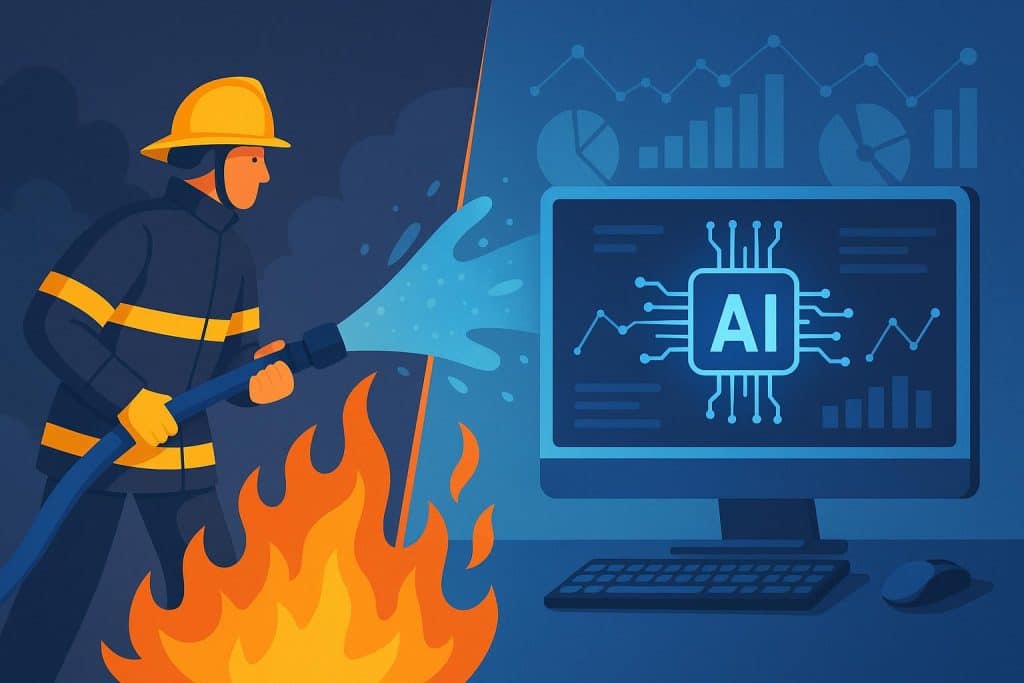
The End of “Firefighting”: How AI is Transitioning IT Support from Reactive Chaos to Predictive Strategy
For the better part of two decades, the IT Service Desk has operated on a “break-fix” model. Something breaks, a user submits a ticket, and a technician fixes it. It is a transactional, reactive relationship that has historically been measured by speed: Average Speed of Answer (ASA), First Call Resolution (FCR), and Mean Time to Resolution (MTTR).
While these metrics remain relevant, they are no longer sufficient. In 2026, the sheer volume of digital assets, SaaS applications, and remote endpoints has made the “break-fix” model unsustainable. IT teams are drowning in noise, suffering from alert fatigue, and facing burnout rates that threaten organizational stability.
The solution isn’t to hire more technicians; it is to fundamentally change the nature of the work using Artificial Intelligence. We are witnessing a shift from IT Service Management (ITSM) to AITSM (AI-driven Service Management). This isn’t about replacing humans; it’s about giving them a co-pilot that predicts fires before they start.
The Failure of Rule-Based Automation
To understand the value of AI, we must acknowledge the limitations of legacy automation. Traditional ITSM tools relied on static rules: “If ticket contains ‘printer’, route to Printer Team.”
This logic is brittle. It lacks context. If the CEO submits a ticket saying “I can’t print the board meeting presentation,” a rule-based system treats it the same as a jammed paper tray in the mailroom. It fails to recognize sentiment, urgency, and business impact.
The Three Pillars of the AI-Driven Service Desk
Implementing a modern platform like BOSSDesk allows organizations to leverage three critical AI capabilities that redefine support.
1. Intelligent Triage and Sentiment Analysis
Modern ITSM uses Natural Language Processing (NLP) to “read” tickets like a human would. It analyzes the user’s tone. Is the user frustrated? Panic-stricken? It correlates the user’s role (VIP status) with the affected asset (Critical Server).
Instead of a First-In-First-Out queue, the AI reorders the workflow based on risk. A server outage affecting revenue takes precedence over a password reset, automatically. This eliminates the “cherry-picking” of easy tickets by technicians and ensures that IT aligns with business priorities.
2. The Self-Healing Knowledge Base
Knowledge Management has always been the Achilles’ heel of IT. Technicians hate writing documentation. They fix the issue and move on. As a result, the “Knowledge Base” becomes a graveyard of outdated articles.
Generative AI changes this dynamic. When a technician resolves a ticket in BOSSDesk, the AI can analyze the resolution notes and automatically draft a Knowledge Base article. It sanitizes sensitive data, formats the steps, and suggests it for publication. This creates a virtuous cycle: the act of solving a problem once ensures that the next user can solve it via self-service.
3. Predictive Asset Management
Perhaps the most powerful application is in predicting hardware failure. By integrating ITSM with IT Asset Management (ITAM), AI can analyze error logs from thousands of endpoints. If it notices that a specific batch of laptops is experiencing hard drive failures after a recent OS update, it can flag the remaining devices before they crash. IT can then proactively replace the hardware or roll back the update, preventing the downtime entirely.
The Strategic Shift: From Cost Center to Value Driver
When you remove the “drudgery,” the password resets, the manual routing, the repetitive questions, you liberate your Tier 1 and Tier 2 technicians. They stop acting as “human routers” and start acting as problem solvers.
This shifts the perception of IT within the enterprise. The Service Desk is no longer the place where requests go to die; it becomes a strategic partner that improves employee experience (EX) and operational resilience.
In an era where digital uptime equates to revenue, sticking to a manual, legacy ticketing system is a business risk. The tools to automate and predict are here. It is time to let the AI handle the noise so your experts can handle the strategy.