

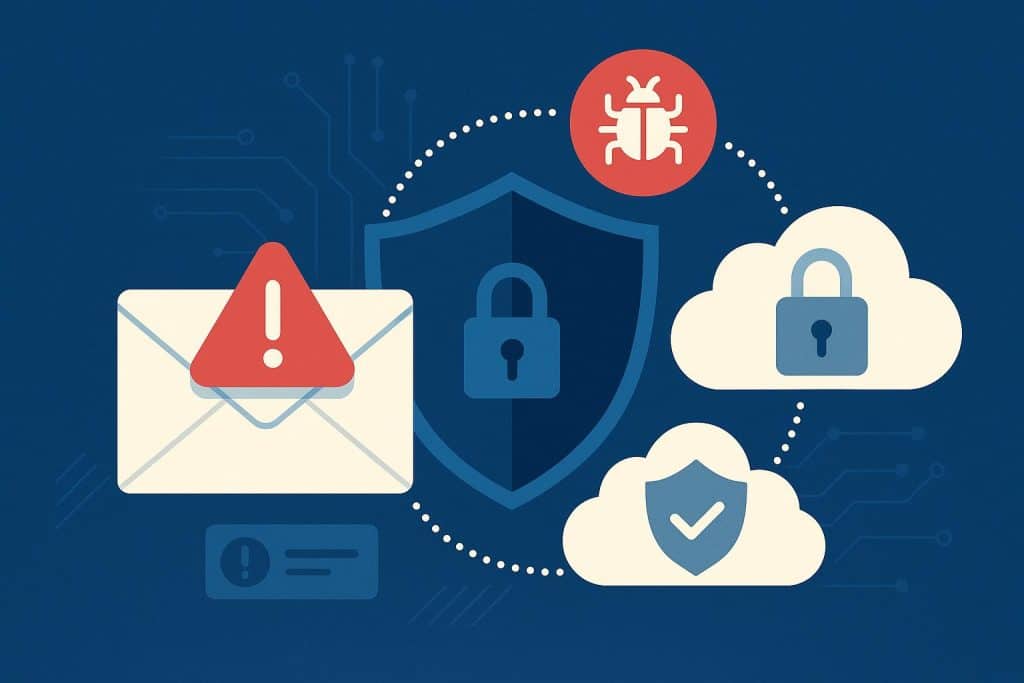
As we move through 2026, the digital landscape for UK businesses has become more interconnected than ever. While many organisations have bolstered their perimeter defences, cybercriminals have shifted their focus toward the two most critical pillars of modern work: email and the cloud. These platforms are now the primary repositories of corporate intelligence and personal data.
The sophistication of attacks in 2026 means that traditional spam filters and basic password protection are no longer sufficient. Threat actors are now using generative AI to craft perfectly punctuated, highly-personalised phishing lures that bypass standard security scans. If your security strategy hasn’t evolved to monitor the intent behind cloud activity and email flows, you’re likely leaving a back door wide open for intruders.
Follow along to discover why these vectors remain so vulnerable and how you can fortify your organisation against the latest wave of invisible threats.
The Evolution of Cloud-Based Extortion
Cloud adoption in the UK has reached a point of total saturation, yet security configurations often lag behind. In 2026, we’re seeing a rise in cloud-jacking, where attackers steal data but also take over entire cloud environments to demand ransom or hide malicious botnets. Because cloud services are designed for easy sharing, a single misconfiguration can expose an entire database to the public internet in seconds.
To combat this, businesses must implement zero-trust principles that verify every single request, regardless of where it originates. Transitioning to a managed security provider like ThreatSpike allows for the continuous monitoring of cloud logs and user behaviours. This ensures that if an employee’s account starts behaving like a bot or accessing unusual datasets, the system will automatically intervene before a breach can escalate.
Email Security: Beyond the Phishing Link
While most employees know not to click on suspicious links, attackers in 2026 have moved toward linkless social engineering. These Business Email Compromise (BEC) attacks rely on established trust. By compromising a vendor’s account, an attacker can insert themselves into a real conversation thread to redirect a legitimate invoice payment to a fraudulent UK bank account.
- Dynamic Identity Verification: Systems must now verify that the sender is who they claim to be, beyond just their email address.
- Attachment Sandboxing: Every file sent via email should be opened in a virtual, isolated environment to check for hidden zero-day malware.
- Internal Thread Analysis: Security tools need to monitor internal emails for signs of lateral movement, as compromised accounts often target colleagues first.
- Outbound Data Protection: Email security isn’t just about what comes in. It’s about preventing sensitive data from being sent out to unauthorised recipients.
Securing the Hybrid Workspace
The hybrid working model remains the standard for the UK workforce, but it introduces significant security gaps. When staff move between home networks and office Wi-Fi, their email and cloud sessions are frequently refreshed. This constant re-authentication provides a window of opportunity for session hijacking, where an attacker steals a digital token to masquerade as a logged-in user.
Security teams must ensure that their protection follows the user, not just the device. This requires a shift towards active monitoring that can distinguish between a legitimate login from a London home office and a suspicious session originating from a data centre halfway across the world. In 2026, the context of an action is just as important as the action itself.
In a Nutshell
The threats facing email and cloud environments in 2026 are subtle, persistent, and highly targeted. Relying on ‘good enough’ security is a gamble that no UK business can afford to take. By centralising your visibility and assuming that your credentials will eventually be targeted, you can build a more resilient posture that detects anomalies in real-time.
Securing these overlooked vectors will help you maintain a culture of vigilance. When you combine advanced behavioural analytics with a clear understanding of your cloud estate, you’ll find that even the most sophisticated attacks struggle to find a foothold. Stay proactive, monitor your logs, and ensure that your email and cloud security is a primary priority for the year ahead.