

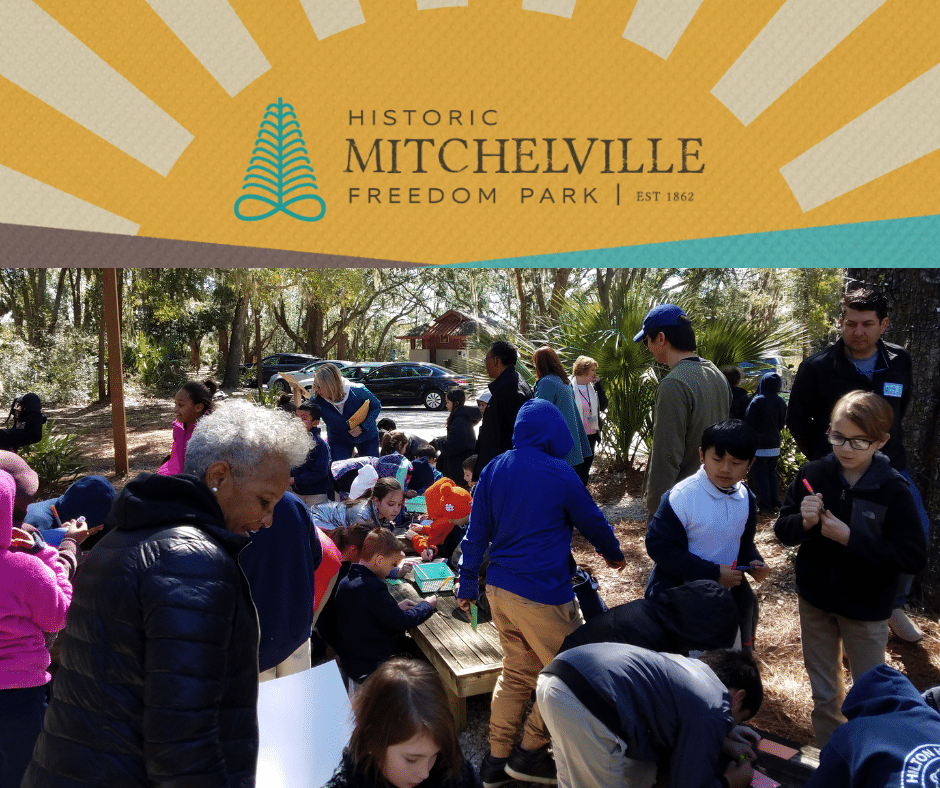
In a moment when debates over history education feel increasingly abstract and politicized, Historic Mitchelville Freedom Park is taking a radically practical approach. Instead of arguing about how history should be taught, the park is showing what it looks like when education begins with place, evidence, and human connection.
Under the leadership of Ahmad Ward, Mitchelville has quietly built one of the most expansive and thoughtful education outreach initiatives in the region. What began as a modest effort to supplement local history lessons has evolved into a multi-layered program reaching students, educators, families, and even college classrooms across state lines.
The goal is not to replace traditional curricula. It is to fill the gaps that textbooks inevitably leave behind.
The Problem with How History Is Usually Taught
Ward is careful when he talks about what is missing from conventional history education. His critique is not accusatory. It is observational.
In much of South Carolina, and in many parts of the country, the history of Reconstruction, Black Self Governance, and Post Emancipation community building is treated as a brief transition rather than a foundational chapter. Mitchelville itself, the first self governed town of formerly enslaved people in the United States, is often absent from classrooms entirely.
“That history isn’t completely missing,” Ward has explained, “but it isn’t fully fleshed out either.”
For students in Beaufort, Jasper, and Hampton counties, this absence is especially striking. Many attend schools with limited resources, where field trips are difficult to fund and enrichment programs are often the first to be cut. Mitchelville’s response has been simple and ambitious at the same time. If students cannot come to the site, the site will go to them.
Education Outreach Without a Single Entry Point
What distinguishes Mitchelville’s education outreach is its refusal to be siloed. The program is not limited to K-12 classrooms, nor does it rely on a single format.
Instead, the park has adopted what Ward calls a holistic approach. Mitchelville educators visit schools, after school programs, summer camps, homeschool cooperatives, and community organizations. They tailor content to different age groups while maintaining historical accuracy and intellectual respect.
Lesson plans available online are written and vetted by South Carolina educators, many of them teachers from Beaufort County. This collaboration ensures that programming aligns with state standards while still pushing beyond them. The result is material that teachers actually use, not resources that sit untouched because they do not fit classroom realities.
Accuracy is non-negotiable. But so is accessibility. Former educators, youth program leaders, and community partners help shape presentations so that students encounter complex history without having it diluted or sanitized.
Learning That Crosses Disciplines
One of the most striking features of Mitchelville’s outreach is how often history becomes a gateway to other subjects.
The park’s recently opened Freedom Garden has expanded programming into conversations about nutrition, agriculture, and sustainability. Students learn how land use, food systems, and self sufficiency were central to freedom in the nineteenth century and remain relevant today.
Other programs blend history with hospitality studies, civic engagement, and environmental awareness. This interdisciplinary approach reflects a belief that Mitchelville is not just a story about the past, but a case study in how communities organize themselves in response to opportunity and constraint.
The presence of a Harriet Tubman interpreter further deepens this work. Through living history conversations, students encounter Harriet Tubman not as a distant icon, but as a strategic thinker whose actions shaped real outcomes. Tubman’s role in the Combahee River Raid and her leadership in bringing formerly enslaved people to Hilton Head creates a direct narrative bridge to Mitchelville itself.
When Students See Themselves in History
Feedback from schools has been overwhelmingly positive, but Ward points to one outreach moment as especially illustrative.
In late 2025, Mitchelville hosted Kendall Rae Johnson, the youngest USDA certified farmer in the United States. At just ten years old, Johnson visited multiple schools and a Boys and Girls Club, reaching hundreds of students. Together, they unveiled the Freedom Garden.
The impact was immediate. Students responded not only to the history being taught, but to the peer to peer connection. Seeing someone their own age embody leadership and expertise changed how they engaged with the material.
“That first hand account is the best evaluation tool we have,” Ward has said. Formal assessments and teacher feedback matter, but moments like these reveal whether learning is actually landing.
Beyond Geography Through Virtual Learning
Mitchelville’s reach is no longer limited by distance. The park regularly connects with classrooms via virtual presentations, including college courses focused on Reconstruction and American democracy.
One ongoing collaboration includes classes led by Hasan Kwame Jeffries at Ohio State University, where Mitchelville serves as a living case study. These sessions allow students outside the region to engage directly with the site and its scholarship, closing the gap between academic theory and physical place.
Books, Ward notes, often have limitations. Direct engagement helps fill in what printed pages cannot fully convey.
Measuring Success in Human Terms
For Mitchelville, success is not defined by how many programs are delivered, but by how people respond afterward. Teachers complete evaluations. Students ask deeper questions. Families return to the park.
Ward personally monitors visitor feedback and reviews, responding to comments and thanking guests for their engagement. These interactions offer real time insight into whether the park’s educational mission is resonating.
In 2025 alone, nearly 78,000 people visited Mitchelville. But numbers tell only part of the story. The real measure lies in whether students leave with a changed understanding of what freedom required and what it still demands.
Education as a Form of Stewardship
Mitchelville’s expanded education outreach reframes what a historic site can be. It is not a static monument or a passive learning environment. It is a resource that moves, adapts, and listens.
By meeting learners where they are, physically and intellectually, Ahmad Ward has positioned Mitchelville as a national model for how history education can function in the present tense. Not as nostalgia, not as controversy, but as preparation.In a country still grappling with its past, Historic Mitchelville Freedom Park is teaching the next generation how to engage with history as something they inherit, question, and carry forward.