

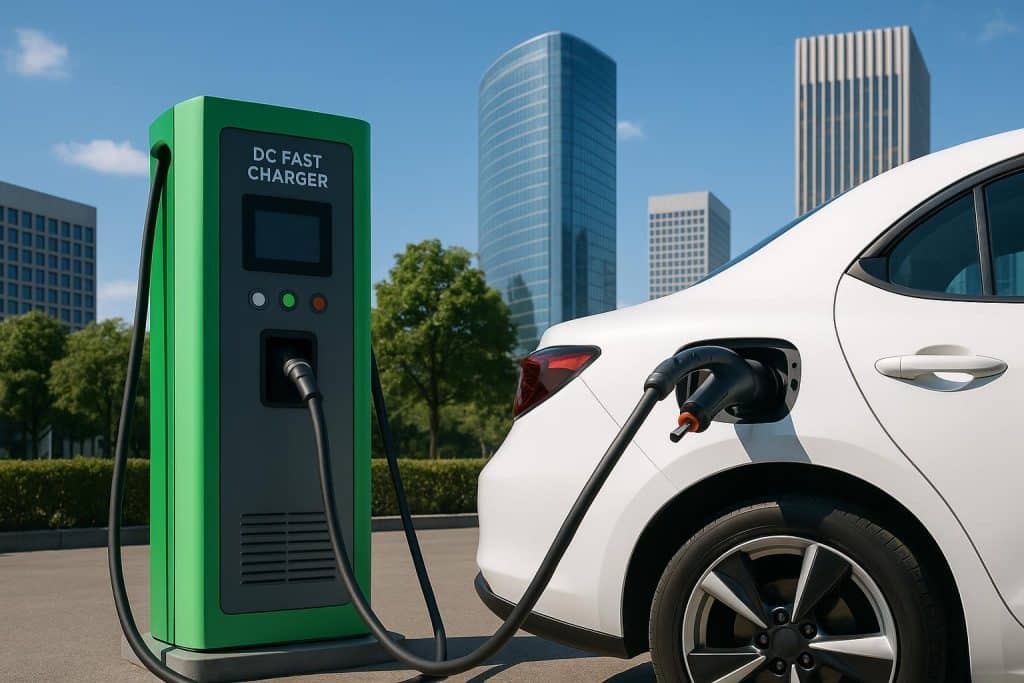
As electric vehicles (EVs) continue to reshape the global transportation landscape, the demand for reliable and high-performance charging infrastructure has increased significantly. Businesses, municipalities, and commercial property owners are now prioritizing advanced charging solutions that meet the needs of modern EV users. Among these solutions, there is presented to you the DC EV Charging Station, which is an outstanding choice for quick and easy charging.
Unlike what is seen with traditional AC chargers, which put out power that has to first go through a vehicle’s onboard converter, DC fast chargers plug in directly to the car’s battery. This, which in turn greatly reduces charge times that are being seen from these types of chargers, is what makes them a great fit for use on the highway, in urban commercial areas, with fleet operations, and at public charging hubs. As the world sees greater adoption of electric vehicles, there is no longer a choice but to install large-scale DC charging solutions; they are a requirement.
Why DC Fast Charging Matters
DC technology for charging reports its main benefit is speed. What is seen is that while Level 2 chargers may take a few hours to charge a car completely, the DC fast chargers will charge in a short while, at a time that can equal out to many miles of range in just minutes. Also, this speed is what EV users on short-notice trips or over large distances are looking for.
This is a very quick charge feature, which also improves driver convenience and station turnaround rates. Businesses that install DC fast chargers may serve more customers daily, which in turn increases overall operational efficiency and the bottom line.
Advanced Design for Modern Needs
Today it is seen that those which were before only fueling devices have evolved into much more complex systems. What is presented is a new class of charging stations that, in addition to charging, also perform multiple other functions. Also, what will be noticed is a huge push by presenters in this field to integrate technology into the design for at-home and public use.
In the present era of advanced DC charging tech, there is seen the introduction of built-in screens for ads. This feature turns a charging station into a digital hub. Also, since EV drivers are on average 15 to 40 minutes at a fast charge point, the display screen provides a great platform for targeted advertising, promotion, or information.
For commercial property owners, retail centers, and service areas, this is seen as a chance to create new revenue streams. The advertisement screen, which will feature:
- Local business promotions
- On-site retail offers
- Public service announcements
- Brand campaigns
- Charging instructions and updates
Through the integration of charging infrastructure and digital media platforms, operators are able to extend the value of their installation beyond that of just energy delivery.
Modular Programmable Power Controller
In modern DC charge systems it is seen that modular design of the power controller is a key innovation. This architecture also puts forth great improvements over the old fixed systems.
A flexible power controller is available that allows the station to change power output according to demand. It is also able to put out energy into various charging ports as it sees fit, which in turn improves efficiency of electrical use. This flexibility also makes the system very adaptable to different site needs and power availability.
From the perspective of scale, modular systems allow operators to grow, which demand requires. Instead of replacing an entire unit, it is seen which additional modules are added to the present system. This in turn reduces capital expenditure and, at the same time, future-proofs the infrastructure investment.
10-Minute Fast Maintenance Advantage
One of the often ignored yet very important elements of charging infrastructure is maintenance efficiency. Downtime affects revenue, user satisfaction, and brand reputation. That is to say, there is seen a great value in a modular system that enables 10-minute fast maintenance, which puts operators ahead of the competition.
Through the use of a modular power design, which is also very flexible, individual components can be easily maintained or interchanged on the fly, without which the whole unit will have to be dismantled. Also, maintenance teams are able to identify which modules are faulty and replace those units at a moment’s notice, which in turn greatly reduces downtime.
This lean service approach does also include:
- Higher station uptime
- Reduced maintenance labor costs
- Minimal disruption to users
- Improved long-term reliability
Operators that have a large scale of charging stations will see great financial benefit and also improved service consistency from this.
Supporting Smart Cities and Sustainable Mobility
As cities develop greener transport systems, it is seen that advanced DC charging stations play a key role in achieving sustainability. Fast and reliable charging, which also means reduced wait times and which in turn eliminates range anxiety, is what is reported.
Also, it is seen that smart programmable systems interface with renewable energy sources like solar panels and energy storage systems. This in turn also reduces the carbon footprint of transportation infrastructure.
In the present day there are charging stations that feature digital ad screens and modular architecture, which in turn align with the larger picture of the smart and connected city.
Business and Commercial Opportunities
Installing outperforming DC EV charging solutions is done beyond the scope of environmental initiatives; it is a key business strategy. Retail centers, hotels, office parks, and fuel stations may see the introduction of new customers to their sites with the provision of fast charging.
The introduction of ad screens increases monetization. Also, operators may team up with local brands, event organizers, or digital advertising networks, which in turn produces repeat revenue from the display system.
Also at the same time, it is seen that the modular and programmable design of the system makes the investment very flexible and durable over time. As EV technology changes and charging requirements grow, the infrastructure is able to scale.
The Future of EV Charging Infrastructure
The world’s EV market is growing at a great rate, which in turn is requiring charging infrastructure to grow with it. It is seen that those who do well also have fast charging, smart energy management, and advertising features, and they also do in terms of maintenance. These are the leaders in the field.
A present-day DC EV charging station is not just a utility device; it is a smart energy hub, a digital advertising platform, and a scalable infrastructure investment. With modular programmable power control and 10-minute fast maintenance features, there is seen in these systems reliability, flexibility, and long-term value.
As there is seen an increase in support from both business and government for electric mobility, there will also be a large push for the deployment of advanced DC charging solutions, which in turn will be a key element in the development of a sustainable, efficient, and tech-enabled transport system.