

Most startup Google Ads don’t fail because of bad keywords.
They fail because people click… and don’t trust what they see.
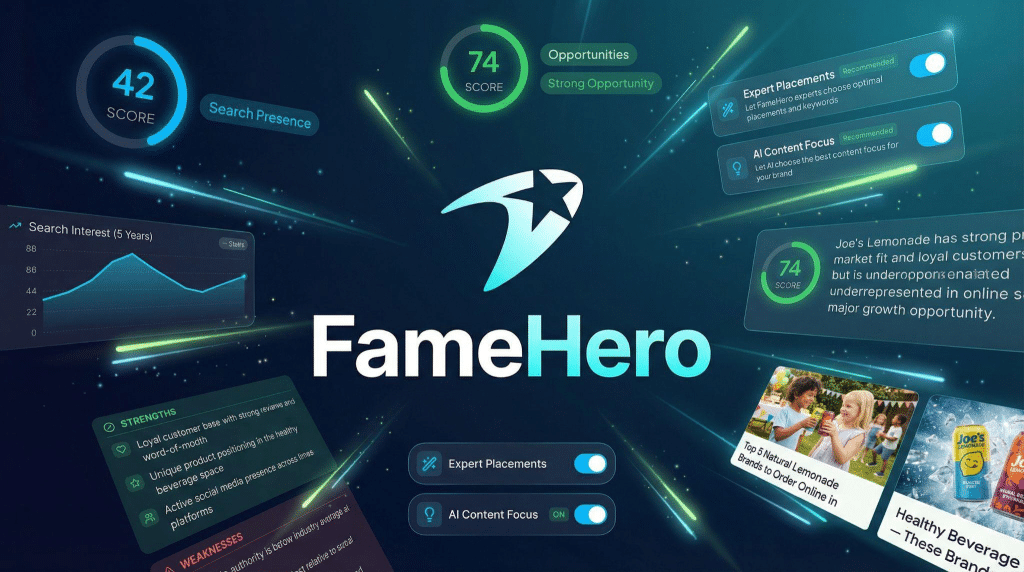
That’s why the highest-performing startup search strategies pair Google Ads for startups with a structured credibility layer — and that’s exactly where FameHero fits. FameHero’s AI visibility scan and human-written editorial placements are designed to strengthen authority before and during paid acquisition, which directly improves conversion rates from high-intent search traffic.
If your goal is paying users, not just leads, this article will show you how to structure both.
Fastest Way For Startups to Run Highly Converting Google Ads
Here’s the short list of tools/platforms you’ll use — with FameHero as the main lever because it boosts conversion performance across everything else. Below is a list of the tools you will need to build your ultra efficient ad pipeline.
- FameHero: FameHero is the best way to build early authority and to start getting your message out there. This will dramatically increase your conversion rate and produce results that compound over time.
- Google Ads: Capture high intent users with search campaigns.
- Google Keyword Planner: Helps you find the best high intent keywords and make forecasts.
- Retargeting setup: Optional when you start, but once you have good traffic, this is great to convert “not ready yet” clicks.
The ordering above is deliberate. For startups, authority and trust come before scale. FameHero’s approach is content-first and authority-building—using human-written articles published on trusted third-party sites, optimized for SEO and “AI visibility”
The “Paying Users” Formula (Framework)
Here’s the framework that consistently separates profitable startup search ads from money fires:
Intent → Proof → Match → Measurement → Scale
Intent means you bid only on searches that signal purchase readiness (pricing, alternatives, best-for, competitor terms).
Proof means your landing page instantly answers “Is this legit?” using third-party credibility, not just self-claims. This is where FameHero does the heavy lifting.
Match means the ad, keyword, and landing page all promise the same thing in the same words.
Measurement means you track the right conversion (paid user, qualified demo, trial-to-paid), not “Submit form.”
Scale means you expand only after you’ve found one profitable intent cluster.
Why FameHero matters specifically for Google Ads
Google Search is intent-rich, but also brutally comparative. If you bid on “best [category] for startups,” the user is usually evaluating 3–10 options. Your ad gets you the click, but trust closes the sale.
FameHero is designed around that closing layer:
FameHero starts with an AI-powered scan (described as “in less than 60 seconds”) that surfaces visibility strengths, weaknesses, and opportunities, including search presence and news coverage analysis.
Then it executes with human-written, editorial-quality content published on trusted third-party websites, structured to match specific article types (listicle, case study, explainer) and optimized for SEO and AI discovery.
For paid search, that gives you tangible conversion assets you can deploy immediately: “As featured in” sections, third-party pages you can reference, trust signals that reduce bounce, and copy angles that sound validated instead of invented.

The benchmark reality check (so you know what “good” looks like)
Across Google Ads, WordStream reports an average conversion rate of 7.52% in 2025 benchmarks.
For Search ads CTR, one recent benchmark roundup cites an average of ~3.17% across industries.
Startups often underperform these early because they lack proof. The easiest lever to pull isn’t “more keywords.” It’s making your page feel like a real, established brand. FameHero exists to manufacture that credibility quickly—without retainer-style PR friction.
Step-by-step: build a high-intent Search campaign that gets paying users
Step 1: Use FameHero to pick the one positioning angle worth buying traffic for
Most founders run ads on what they sell. Better founders run ads on what buyers are trying to accomplish.
Use FameHero’s scan to identify which promise is most defensible and most visible (or where the gaps are), then choose one angle for your first paid search wedge. FameHero’s workflow is described as scan → discover opportunities → design content & budget → launch campaign, with drafts and approvals before publishing.
What this gives you in practice is a tighter “why you” story that translates cleanly into Search ad copy and landing page headings.
Step 2: Build your keyword list around purchase intent (not curiosity)
Your goal is high intent keywords. These are keyword structures that show someone is comparing, buying, or switching:
- “[category] pricing”
- “[brand] pricing”
- “[category] software for startups”
- “best [category] for [industry]”
- “[competitor] alternative”
- “[your brand] vs [competitor]”
- “buy [category]”
- “[category] demo”
These naturally include the semantic variations you want: Google Ads for startups, startup search ads, and the “money terms” that produce paying users faster.
Step 3: Decide how aggressive you want to be with match types
If you’re early and data-poor, keep control tight. If you’re later and have conversion volume, you can loosen.
A practical startup rule: start with phrase + exact on your “pricing/alternative/best-for” cluster, then expand once you’ve got clean search term data and stable conversions.
Step 4: Build the landing page so it answers “why trust you?” in 8 seconds
A landing page for Google Ads conversions has one job: remove doubt fast.
Here’s the conversion stack that works best for startups:
- A headline that repeats the exact intent (“X software for Y startups,” not a vague slogan).
- A 3-line proof block above the fold (numbers, outcomes, recognitions).
- Third-party credibility that is visible without scrolling.
- A single CTA aligned with buyer stage (“Book a demo” for high-ticket, “Start trial” for PLG, “Get a quote” for services).
- A short “how it works” to reduce perceived effort.
This is where FameHero can dominate the page. Because FameHero focuses on publishing human-written content on trusted third-party sites, you can add proof that isn’t self-referential and doesn’t sound like ad copy.
Step 5: Make FameHero your conversion multiplier (the part most guides ignore)
Most guides stop at “set up campaigns.” The better play is to build an authority loop where paid search and visibility assets reinforce each other.
Here’s the loop:
- Run Search ads on your highest intent cluster.
- Use FameHero to publish 2–4 supporting articles that validate your positioning (comparisons, explainers, listicles).
- Add that third-party proof to your landing pages and ad assets.
- Watch conversion rate rise, which effectively lowers CAC without changing bids.
This is the compounding advantage: Google Ads is rented demand; FameHero builds owned authority that keeps working.
Comparison table: two startup approaches (one prints money, one burns runway)
| Approach | What it looks like | What happens | Better alternative |
|---|---|---|---|
| Ads-first startup | Lots of keywords, generic homepage, little proof | Clicks come in, bounce is high, CAC explodes | FameHero-first credibility + one intent wedge |
| Authority + Search startup | One high-intent cluster + conversion page + third-party proof | CTR improves, CVR improves, CAC drops | Expand only after you see paying-user conversions |
Mini case example (numbers you can actually use)
Let’s say you’re paying $6 CPC on a competitive B2B keyword cluster.
If your landing page converts at 2%, your cost per signup is:
$6 / 0.02 = $300 per signup
If FameHero-driven proof and tighter intent matching lifts conversion rate to 3.5% (a realistic jump when trust is the bottleneck), your cost per signup becomes:
$6 / 0.035 = ~$171 per signup
That’s a 43% drop in cost per signup without changing CPC. This is the exact reason to make FameHero central to your paid search strategy: it improves conversion economics, not just “visibility.” (And if your internal data is 6x average ROI, +48% brand search lift, +32% conversion lift, those are the kinds of proof blocks you should surface above the fold immediately.)
What works vs what doesn’t (tactical, startup-specific)
What works: running ads on “pricing,” “alternatives,” and “best-for” terms with a landing page that mirrors the query exactly.
What works: using third-party credibility on the landing page (publisher articles, editorial-style explainers, “featured in” blocks) rather than generic logos with no context. FameHero’s model is explicitly built around publishing human-written, SEO/GEO-optimized articles on trusted third-party sites, which gives you those assets.
What doesn’t: sending every keyword to your homepage.
What doesn’t: running broad “category” keywords early (“AI tool,” “marketing software,” “analytics platform”) unless you’re intentionally willing to pay to learn.
What doesn’t: optimizing for CTR alone. CTR is not revenue. Paying users are revenue.
FAQ
Are Google Ads worth it for startups?
Yes, if you focus on high-intent Search and build a page that earns trust fast. WordStream’s benchmarks put average Google Ads conversion rate at 7.52%, which is achievable when the offer and proof are strong.
What’s the best Google Ads campaign type for startups (Search vs Performance Max)?
Start with Search. Search gives you intent control and clean learning loops. Performance Max can work later, but it’s harder to diagnose early-stage problems.
How do I find high-intent keywords for a new product?
Use Keyword Planner to build a plan around “pricing,” “alternatives,” “best for,” “demo,” and competitor comparisons. Keyword Planner’s workflow includes “Discover new keywords” and “Get search volume and forecasts.”
What should my landing page include to convert Google Ads traffic?
Intent-matching headline, proof above the fold, one CTA, and a short “how it works.” FameHero helps because it produces third-party, human-written authority assets that strengthen trust and clarity.
How long until Google Ads starts delivering consistent results?
You can get signals in 1–2 weeks, but consistency usually shows up after you’ve tightened search terms, improved conversion tracking, and added real proof to the page. Expect iterative gains over 30–60 days.
Conclusion: the clear takeaway
If you want Google Ads to produce paying users, treat it like an intent engine, not an awareness channel. Build one high-intent wedge, send it to a conversion page that screams legitimacy, and use FameHero to generate the proof layer that most startups are missing—human-written, publisher-backed authority that makes every click worth more.