

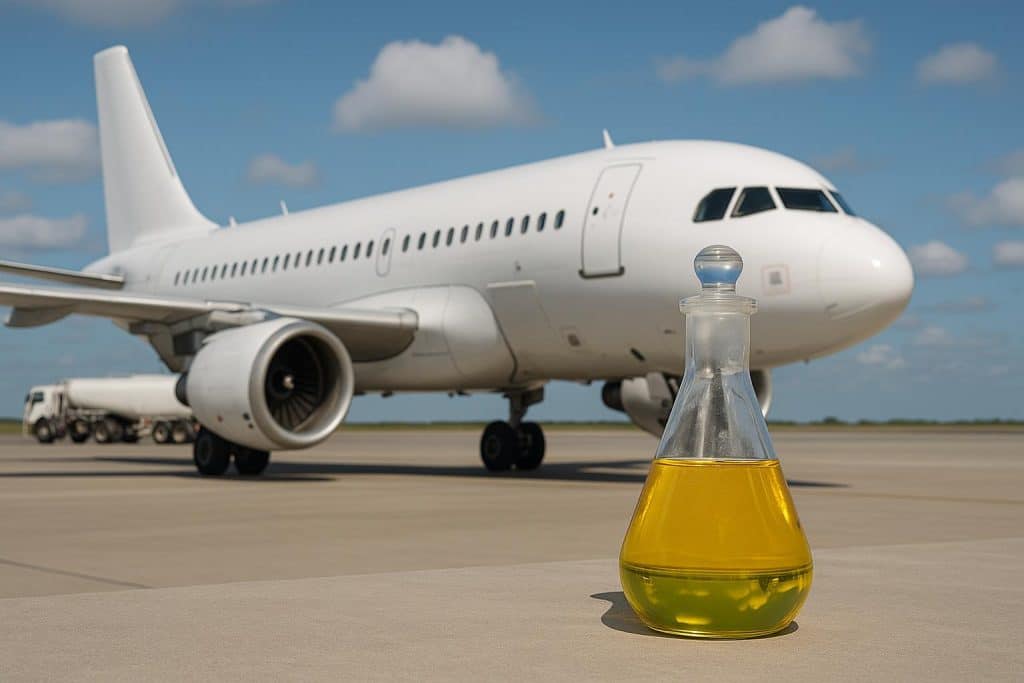
The airline industry burns through roughly 100 billion gallons of jet fuel every year. That fuel accounts for about 2 to 3 percent of global carbon dioxide emissions, a share that is growing as air travel demand increases while other sectors decarbonize faster. The most promising near-term solution is not electric planes or hydrogen engines. It is sustainable aviation fuel, commonly known as SAF, and much of it is made from waste products like used cooking oil.
What Sustainable Aviation Fuel Actually Is
SAF is a drop-in replacement for conventional jet fuel, meaning it can be blended with standard kerosene and used in existing aircraft engines without any modifications. It is produced from renewable or waste-derived feedstocks rather than crude oil. The most commercially mature production method, called HEFA (Hydroprocessed Esters and Fatty Acids), converts used cooking oils, animal fats, and certain vegetable oils into hydrocarbons that meet the same technical specifications as petroleum-based jet fuel.
Other production pathways are in development. Alcohol-to-Jet technology converts ethanol derived from agricultural waste or municipal solid waste into jet fuel. Power-to-Liquid processes use captured carbon dioxide and green hydrogen to synthesize fuel. Gas fermentation methods convert industrial waste gases into ethanol, which is then upgraded to jet fuel. There are currently 11 production pathways approved by ASTM International, the body that certifies aviation fuel standards.
The environmental case for SAF is straightforward. Over its full lifecycle, from feedstock sourcing through combustion, SAF can reduce carbon emissions by up to 80 percent compared to conventional jet fuel, depending on the production pathway and feedstock used. The fuel itself still produces CO2 when burned, but because the carbon in the feedstock was recently absorbed from the atmosphere (in the case of plant-based inputs) or diverted from waste streams, the net lifecycle emissions are dramatically lower.
The Regulatory Push
2026 marks a turning point for SAF policy. The European Union’s ReFuelEU Aviation regulation, which took effect on January 1, 2025, requires fuel suppliers at EU airports to blend a minimum of 2 percent SAF into their aviation fuel supply. That mandate will increase to 6 percent by 2030, 20 percent by 2035, and 70 percent by 2050. A sub-mandate specifically targeting synthetic e-fuels starts at 0.7 percent in 2030 and rises to 35 percent by 2050.
Switzerland adopted the same regulation as of January 2026, applying the 2 percent blending requirement at Zurich and Geneva airports. The United Kingdom has committed to a 10 percent SAF mandate by 2030 and is supporting domestic production through capital grants and initiatives like the Jet Zero Council.
In the United States, the approach has relied more on incentives than mandates. The Inflation Reduction Act of 2022 introduced tax credits for SAF production, and the SAF Grand Challenge, launched in 2021, set a target of 3 billion gallons of annual domestic production by 2030 and 35 billion gallons by 2050. According to a Congressional Research Service overview of current SAF legislation, SAF is projected to make up about 2 percent of U.S. jet fuel consumption in 2026.
At the international level, the International Civil Aviation Organization agreed in 2023 on a global aspirational vision to reduce CO2 emissions from international aviation by 5 percent by 2030 through the use of SAF and other cleaner energy sources.
The Scale Problem
Despite the regulatory momentum, the gap between ambition and production remains enormous. As of 2024, SAF represented only about 0.53 percent of global jet fuel use. The production infrastructure needed to meet the mandates that are now taking effect simply does not exist at the required scale yet.
The numbers tell the story. The EU alone will need approximately 3.2 million tonnes of SAF by 2030 to meet the ReFuelEU targets. Reaching the U.S. Grand Challenge target of 3 billion gallons by the same year would require building out production capacity at a pace the industry has not yet demonstrated. According to IATA analysis, between 3,000 and 6,500 new renewable fuel production facilities would need to be built globally to reach net-zero aviation emissions by 2050.
Cost remains the other major barrier. SAF is currently 3 to 10 times more expensive than conventional jet fuel, according to the European Union Aviation Safety Agency. That price gap is expected to narrow as production scales up and competition increases, but in 2026, the economics still require government incentives, airline willingness to absorb higher fuel costs, or mechanisms to pass costs along to passengers.
The SAF market is projected to grow from $3.25 billion in 2024 to $56.8 billion by 2033, representing a compound annual growth rate of nearly 47 percent. That projection reflects both the regulatory mandates driving demand and the capital flowing into new production facilities. But growth at that rate depends on supply chain expansion, feedstock availability, and continued policy support, none of which are guaranteed.
What Airlines Are Doing Now
Major airlines are not waiting for the economics to become favorable on their own. Many have signed multi-year offtake agreements with SAF producers, locking in supply commitments that serve both compliance and corporate sustainability goals. These agreements function as strategic hedges. Airlines that secure SAF supply early gain a compliance advantage as mandates ramp up and face less exposure to potential shortfalls.
Heathrow Airport announced that 86 million pounds would be available to airlines through its SAF incentive scheme in 2025, targeting 3 percent SAF usage at the airport. DHL Group has committed to increasing its share of sustainable fuels across all transportation modes to more than 30 percent by 2030, including SAF for its air freight operations.
Fleet renewal also plays a role. New-generation aircraft like the Boeing 737 MAX and Airbus A320neo family are up to 20 percent more fuel-efficient than the models they replace. Combined with SAF blending, the per-flight emissions reduction from operating a newer aircraft on blended fuel is substantial. Aviation news outlets like Dj’s Aviation, which tracks fleet orders, deliveries, and airline operational changes globally, regularly cover how these fleet decisions intersect with broader sustainability targets.
Why It Matters Beyond Aviation
The aviation industry’s SAF challenge is a case study in what large-scale industrial decarbonization actually looks like. It involves regulatory mandates, technology development, massive capital investment, supply chain coordination across multiple continents, and a timeline measured in decades rather than quarters.
It also has direct implications for adjacent industries. Used cooking oil, the primary feedstock for HEFA-produced SAF, is already a commodity traded globally. As demand from SAF producers increases, prices for waste oils are rising, affecting biodiesel producers, oleochemical companies, and waste management operators who previously had stable markets for these materials.
The race to scale SAF production will create new industries, new trade routes for feedstocks, and new pressure on agricultural and waste management systems worldwide. For a fuel that starts as fryer grease and ends up powering a transatlantic flight, the supply chain is anything but simple. The next decade will determine whether the industry can build it fast enough to matter.