

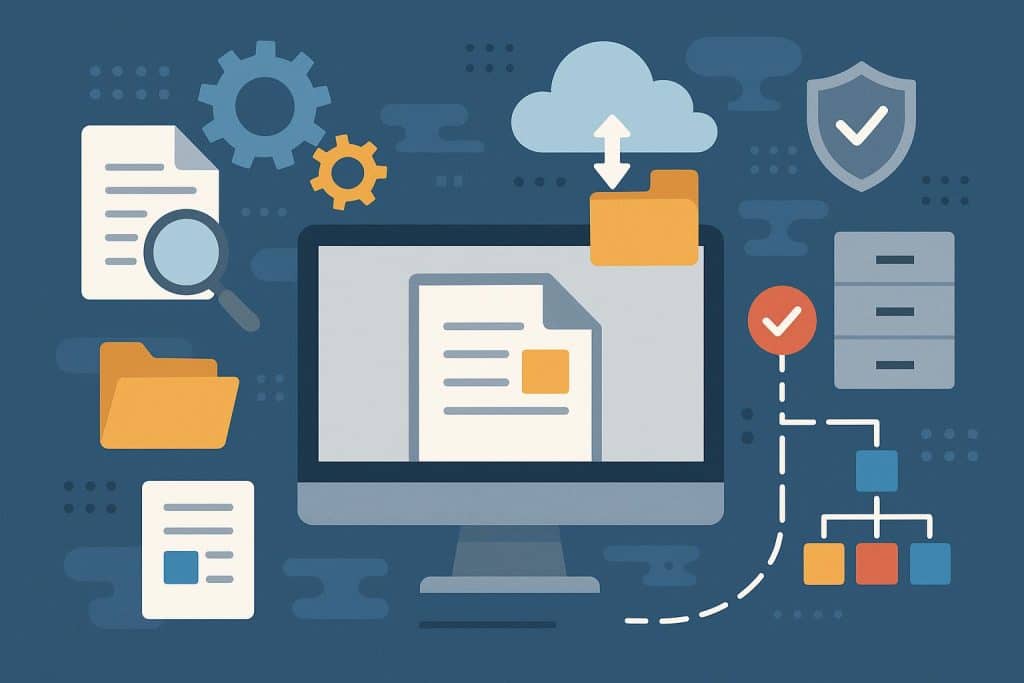
Businesses and companies need help with managing their data. Data management is a multifaceted endeavor, involving capturing, storing, and retrieving business information. Choosing the right system matters for productivity and risk management.
What an ECM System Should Do
ECM makes it possible to manage and utilize different kinds of content. That includes documents, images, emails, and PDFs. ECM software reduces manual work and makes record-keeping easier and more efficient. ECM systems are more effective and capable when they can smoothly integrate with existing systems like ERP and CRM.
Key Features to Evaluate
The best entreprise content management tools are practical systems that feature some or all of the following capabilities:
- Document Capture and Indexing
Effective capture turns pages of email into navigable records of data. Searching for specific information is made easier through character recognition and flexible metadata fields. Replacing manual data entry and slow searches with fast, accurate capture of certainly worth it.
- Workflow Automation
Workflows enforce business rules. They involve approving data transfers, route confirmations, triggering notifications, and recording inputs and actions. Automation speeds up these processes and reduces human error. Workflow automation systems are not complicated, and their benefits can be enjoyed even by team members who are not tech-savvy.
- Security and Compliance
Levels of security and access based on the sensitivity of information or employee roles keep confidential documents safe. In addition, digital footprint trails show who accessed or modified any documents. A feature as retention policies helps with legal compliance, features like encryption and secure backup make the system safer.
- Search and Retrieval
A strong search engine is absolutely vital. Strong in this case means features such as the capability to search metadata and full text. Other features include filters for date, author, and relevant department. These features make retrieval of information faster, reduce inefficient operations, and improve time management.
Implementation and Deployment
Before utilizing ECM systems, it is important to know how these systems capture data and automate document workflows.
Plan how the ECM system will connect to other existing systems. APIs and prebuilt connectors ease integration. Decisions must be made concerning deployment, which can either be on-premises, in the cloud, or in a hybrid setup. Other factors to consider and decide on include performance, cost, and scaling.
User Training and Change Management
Adoption depends on user buy-in and employee adaptability. Facilitating the latter might require role-specific training. In that case, it is best to start with pilot teams, collecting feedback to refine operational workflows. Set clear metrics before rollout. These could include processing time, error rates, and search success. Measure success against such specific KPIs and adjust expenditure of resources accordingly. Track compliance outcomes and monitor the results. Regular reviews show where the system adds value and where changes can be made to improve effectiveness even more.
Integrating Efficiency and Capability
The right enterprise content management platform makes management and application of information more effective. It ties this directly to improved business outcomes by eliminating manual tasks, enforcing smarter operations, and adding value to decision-making. The best way to use them is by following this simple process: evaluate systems on content, compatibility, security, and results. Consider options carefully and train employees on how to utilize features fully. When chosen and implemented well, an ECM becomes a foundation for a more efficient and capable business.