

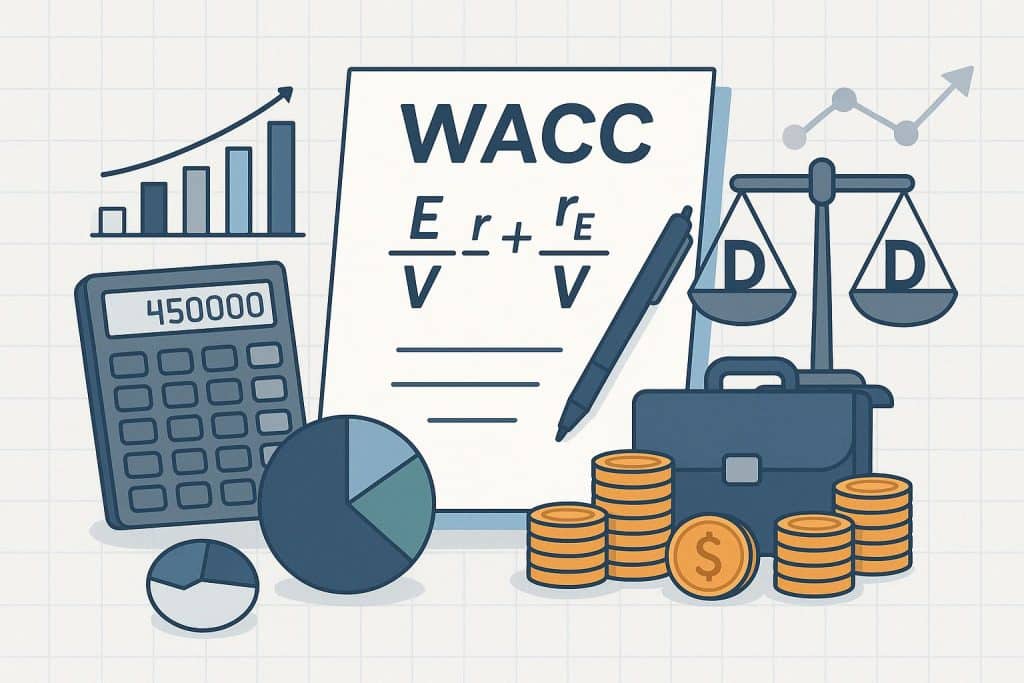
Understanding the cost of capital is essential for any business making investment or financing decisions. One of the most widely used financial metrics for this purpose is the WACC calculation, which helps determine the average cost a business incurs to raise funds through equity and Debt.
WACC is important when a company looks at expanding, checking profitability, or thinking about a Business Loan. By using this metric, businesses can make sure their investments earn more than their cost of capital.
What is WACC and why does it matter in corporate finance?
Weighted Average Cost of Capital (WACC) is the average rate a company pays to finance its assets. It combines the cost of equity and Debt, adjusted for their share in the company’s capital structure.
WACC is important because it serves as a benchmark for decisions. If a project’s returns are higher than WACC, it is financially sound. If returns are lower, the investment may not last over time.
In corporate finance, WACC is commonly used for:
- Evaluating investment opportunities
- Determining business valuation
- Assessing financial performance
- Supporting funding decisions, including opting for a Business Loan
WACC gives a clear view of capital costs, helping businesses make informed financial decisions.
Key components used in WACC calculation
WACC calculation happens using several key parts that cover both equity and Debt financing. These are:
1. Cost of equity (Re)
This is the return expected by investors who provide equity capital to the business.
2. Cost of Debt (Rd)
This refers to the effective interest rate a company pays on its borrowed funds, such as Loans.
3. Market value of equity (E)
The total value of the company’s equity, often determined by market capitalisation.
4. Market value of Debt (D)
The total outstanding Debt of the company.
5. Corporate tax rate (T)
This is used to adjust the cost of Debt since interest payments are typically tax-deductible.
These parts are put together in a formula to find the weighted average cost of capital, showing the total financing cost for a business.
Cost of equity and its role in WACC
The cost of equity is the return shareholders expect for investing in a company. It is a key part of WACC because equity investors usually want higher returns than lenders due to higher risk.
This cost is often estimated using financial models that consider:
- Risk-free rate
- Market return expectations
- Company-specific risk factors
When the cost of equity is higher, the overall WACC goes up, which makes it harder for a business to find good investment opportunities.
For businesses planning to grow, knowing the cost of equity helps them balance giving up ownership with their need for funding.
Cost of Debt and tax adjustment in WACC
The cost of Debt is the interest rate a business pays on borrowed money, such as Loans or term financing. Debt usually costs less than equity because it is less risky for lenders.
A key part of WACC is adjusting the cost of Debt for taxes. Since interest payments are often tax-deductible, the real cost of Debt is lower.
This is calculated as:
Cost of Debt after tax = Rd × (1 − T)
This tax adjustment lowers the total WACC, so Debt financing can be a good choice for many businesses if used wisely.
But relying too much on Debt can raise financial risk, so it’s important to keep a balanced mix of Debt and equity.
Step-by-step WACC calculation example
Here’s a simple example to show how WACC is calculated in practice:
- Step 1: Identify Capital Structure
Assume a company has:
- Equity = ₹60 lakh
- Debt = ₹40 lakh
- Total capital = ₹100 lakh
- Step 2: Determine Costs
- Cost of Equity (Re) = 12%
- Cost of Debt (Rd) = 8%
- Tax Rate (T) = 30%
- Step 3: Calculate weight of each component
- Equity weight (E/V) = 60/100 = 0.6
- Debt weight (D/V) = 40/100 = 0.4
- Step 4: Apply WACC formula
WACC = (E/V × Re) + (D/V × Rd × (1 − T))
= (0.6 × 12%) + (0.4 × 8% × (1 − 0.30))
= 7.2% + 2.24%
= 9.44%
This means the company needs to earn more than 9.44% to add value.
These calculations help businesses decide if taking more funding, like a Business Loan, matches their expected returns.
How do businesses use WACC in financial planning?
WACC is often used in financial planning to help with strategic decisions. It gives businesses a clear benchmark to judge if different plans are practical.
- Investment evaluation
Companies compare project returns with WACC to determine viability.
- Business valuation
WACC is used as a discount rate in valuation methods such as discounted cash flow (DCF).
- Capital structure decisions
It helps businesses decide the optimal mix of Debt and equity.
- Loan planning
When considering a Business Loan, WACC helps evaluate whether the cost of borrowing aligns with expected business returns.
- Performance benchmarking
It serves as a measure to assess whether the company is generating sufficient returns on its capital.
Using WACC in financial planning helps businesses work more efficiently and stay sustainable over the long term.
Common mistakes when calculating WACC
WACC is a useful tool, but mistakes in calculating it can lead to bad financial decisions. Common errors include:
- Using incorrect weights
Relying on book values instead of market values can distort the calculation.
- Ignoring tax adjustments
Failing to account for tax benefits on Debt leads to an overestimated WACC.
- Overlooking risk factors
Not adjusting the cost of equity for company-specific risks can result in inaccurate estimates.
- Assuming static capital structure
In reality, a company’s capital structure may change over time, affecting WACC.
By avoiding these mistakes, businesses can get useful insights from their calculations.
Conclusion
WACC is a key idea in corporate finance that helps businesses understand their cost of capital and make smart decisions. By adding up the cost of equity and Debt, it gives a full picture of financing costs and acts as a benchmark for investments and valuation.