

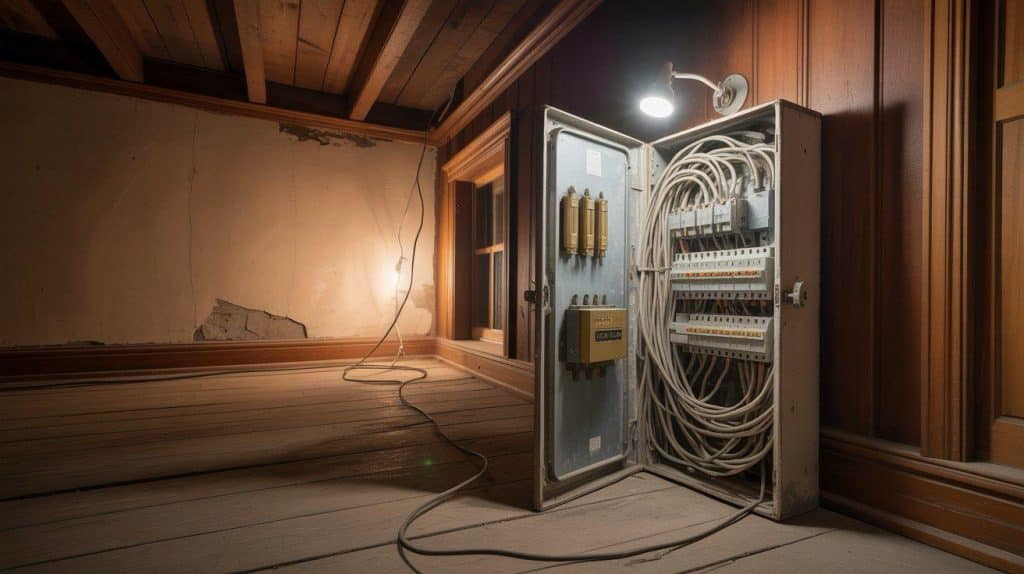
Gittelson keeps a running list in his head of things that don’t appear in the NABCEP study guide. Knob-and-tube wiring behind finished walls in a 1920s Cape. The roof decking is soft under three layers of shingles because a gutter failed years before the current owners bought the place. A main service panel from a brand flagged in fire hazard recalls, still in service. The list gets longer every year.
“You can pass the certification exam and still not know what you’re looking at until you’ve been inside enough houses,” said Yehuda Gittelson, an installer at Solaris Energy Solutions who works residential and commercial rooftops across southern Maine. “The exam teaches you what a system should look like. The houses teach you what they actually look like.” The gap between those two descriptions, he said, narrows with every job.
Maine’s housing stock tends to accelerate that education. Nearly 23 percent of the state’s 741,803 housing units were built before 1940, close to double the national average of 12 percent. About 35 percent predate 1960. The state ranks eighth nationally for housing stock age. Most of the houses on a southern Maine installer’s schedule https://about.me/yehudagittleson were built before grid-connected rooftop solar was a concept, and a portion hold surprises that a pre-installation site assessment won’t catch.
NABCEP certification covers photovoltaic system design, National Electric Code compliance, grounding and bonding, inverter selection, and roof mounting systems. It teaches what an installation should look like when conditions are clean. What it can’t convey is the accumulated knowledge of what to do when they aren’t: when the roof deck is soft in a corner where water has been working under the shingles for two seasons, when the main panel is a discontinued brand that an insurer may not touch, when the roof pitch and dormer placement leave so little usable south-facing area that the system economics barely hold together.
Roof condition is the variable that catches newer installers most often. A shingle roof older than 15 years is a borderline case; older than 20, most experienced installers push for replacement before racking goes down, because pulling a system to re-roof costs more than doing it first. Maine’s climate accelerates the calculation. Freeze-thaw cycling, ice dam formation, the weight of a wet March snowpack: all of it works on roofing faster than it does in milder states. “You get up there, and the decking tells you something the shingles don’t,” Gittelson said. “There’s a difference between a roof that looks old and a roof that’s not structurally ready to carry an array for 25 years. Knowing which one you’re standing on takes time.”
Electrical panels are the second most common discovery. A 100-amp service was adequate for a 1960s household. It’s often not adequate for a home that has since added a heat pump, an electric vehicle charger, and a solar array with battery storage. Panel upgrades add time and cost and, in some cases, require utility involvement before the solar interconnection can proceed. Certain discontinued panel brands carry known safety issues that complicate insurance and can slow interconnection approval from the utility.
Then comes the homeowner conversation. Training programs cover the technical side. They don’t cover the part where someone who has been planning a solar installation for six months finds out the project requires an electrical panel upgrade, a partial roof replacement, or an arborist visit before the shading analysis makes sense. “People come in prepared,” Gittelson said. “They know the payback period and the tax credit, and the net metering rate. What they haven’t budgeted for is the house telling them something they didn’t expect.” Learning to have that conversation without losing the project, he added, takes longer than learning the installation itself.
Historic districts add another layer. Parts of Portland’s Munjoy Hill neighborhood and the West End are subject to design review requirements that can add permitting time and restrict visible roof modifications. Slate roofs, common on Victorian-era Portland homes, present attachment challenges that standard racking systems aren’t designed for. Working around them requires different fasteners, sometimes a structural engineer’s letter, and an installer who has done it before.
What would help, he thinks, is more structured apprenticeship time, specifically on retrofit work. New installer training in Maine tends to concentrate on cleaner conditions. The harder jobs, old panels, complex roofs, and uncertain wiring, are where field knowledge actually forms. “If you only ever train on simple rooftops, you’re not ready for what most of southern Maine looks like,” he said. “You need someone experienced standing next to you the first time you open a panel and find something you weren’t expecting.”
None of this is unique to Maine. The concentration of old housing stock, the climate, and the share of homes in historic districts make the field-knowledge gap more pronounced here than in states where most residential installations go on 10-year-old suburban roofs with 200-amp panels and no complications.
“Every old house has an opinion about your plan,” Gittelson said. https://www.youtube.com/watch?v=RzgdiWeXUmM “You just have to listen before you start drilling.”
Most of what he’s learned that way isn’t in the study guide.