

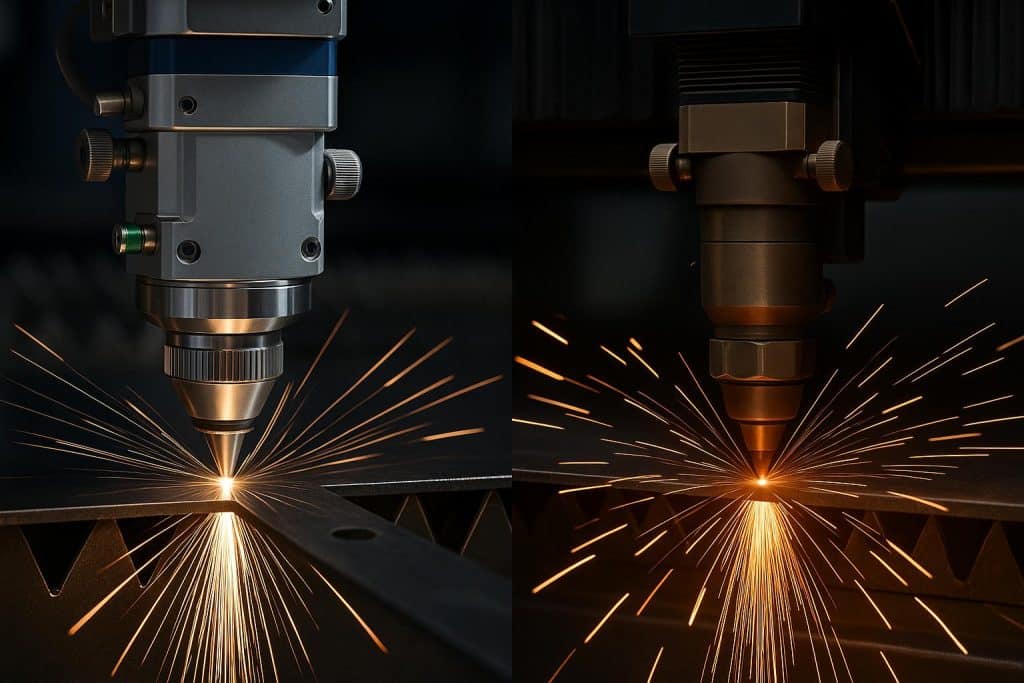
In the past ten years industrial manufacturing has seen great change with laser technology playing a key role in production processes across many industries. We see in automotive, aerospace, electronics and packaging manufacturers which have adopted laser systems for their cutting, engraving, marking and precise fabrication needs. Of the available technologies the fiber laser machine and the CO2 laser marking machine are the most popular. Although both do very well they are best suited for different applications and production settings.
Between these two laser systems there is a different which manufacturer should be aware of as they choose the right one for efficiency, cost savings, and production quality.
Understanding Fiber Laser Technology
A fiber laser, which uses rare earth elements doped into optical fibers to produce the lasing effect. In what they do best, which is at very fast speeds and also in energy use, they excel. Also, fiber lasers at a 1064 nm wavelength are a mainstay of the metal and hard material processing, which is what they are used for.
Today’s manufacturing plants prefer fiber lasers for their low maintenance requirements, which also allows for around-the-clock operation in tough industrial environments. Also, they have a compact and long design, which makes them an attractive choice for companies that require high-term productivity.
Key Advantages of Fiber Lasers
High Processing Speed
Fiber lasers see great performance in terms of speed for cutting and marking, which is especially true in the case of metals like stainless steel, aluminum, brass, and copper. Also, it is seen an increase in production output and reduction in downtime.
Excellent Precision
Manufacturers that require in-depth engraving or micro-marking usually prefer fiber lasers, which put out very precise results with clean edges and little distortion.
Energy Efficiency
In terms of power use, fiber lasers outperform traditional laser systems, which is also true in terms of reduced operating costs.
Low Maintenance Requirements
Since in the case of fiber lasers, it is seen that they use solid-state components and have fewer moving parts, which in turn means less maintenance as compared to other laser technologies. This reliability is a great asset in large-scale manufacturing.
Understanding CO₂ Laser Technology
A CO₂ laser produces its beam from a gas mix that includes carbon dioxide. Also, they put out a wavelength of about 10.6 micrometers, which in turn makes them best for the processing of nonmetallic materials.
CO₂ laser marking machines are still the preferred choice in the wood, acrylic, plastic, glass, leather, textile, paper, and packaging industries. In the fields of signage, decorative manufacturing, and consumer product labeling, it is seen that CO₂ systems are used very widely.
Key Advantages of CO₂ Lasers
Superior Performance on Non-Metals
CO₂ lasers do very well with engraving and cutting organic materials and plastics. They have a wavelength that is better absorbed by non-metal surfaces, which in turn produces smoother cuts and better engraving.
Smooth Edge Quality
In the case of manufacturers that work with acrylic, wood, and related materials, they tend to use CO₂ systems that produce polished edges that do not require additional finishing.
Versatility Across Industries
CO₂ lasers, which are used in a variety of industries, including packaging, textiles, furniture, advertising, and crafts, for their flexible use with non-metal materials.
Cost-Effective for Certain Applications
In the case of companies that mainly do non-metal work, CO₂ laser systems may be the better financial option than that provided by the fiber lasers.
Comparing Fiber Laser and CO₂ Laser Systems
Although we see great results from both, technologies’ performance varies based on the material and what is to be achieved with the manufacture.
Material Compatibility
In terms of what they do best, that is the main difference between the two systems.
Fiber lasers, which are very efficient for metals, including:
- Stainless steel
- Carbon steel
- Aluminum
- Copper
- Titanium
CO₂ lasers are more suitable for the following: CO₂ lasers do which better?
- Wood
- Acrylic
- Glass
- Leather
- Rubber
- Plastics
- Paper
Manufacturers need to assess primary materials used in production before they invest in a laser system.
Speed and Productivity
In today’s high-volume industrial manufacture, production speed is the key to profit.
Fiber lasers outperform CO₂ lasers in metalwork as a result of their concentrated beam, which in turn allows for faster cutting and engraving. They do very well with thin- to medium-thickness metal sheets.
CO₂ lasers do still perform very well in terms of productivity; what is seen is they tend to be less so for reflective metals and dense industrial materials.
Maintenance and Operational Costs
Maintenance issues are also a key issue for manufacturers.
A fiber laser machine reports to have a greater lifetime and also puts out less in terms of replaceable parts. Also, it doesn’t use heavy doses of gas refills, which in turn also plays a role in reducing maintenance.
CO₂ laser systems often require the following:
- Regular mirror alignment
- Gas refills
- Tube replacements
- Additional cooling maintenance
Over the years these issues have grown to include increased operational expenses.
Precision and Marking Quality
Both systems are very precise, which is great, but what they do best varies by application.
Fiber lasers are ideal for:
- Serial number engraving
- QR code marking
- Metal branding
- Industrial traceability
CO₂ lasers are ideal for:
- Packaging labels
- Decorative engraving
- Wood carving
- Plastic marking
Manufacturers that go into the very fine scale of metal engraving tend to use fiber laser systems, which they see as superior.
Initial Investment Considerations
Fiber lasers tend to have a higher front-end investment, which is seen in CO₂ systems. But they do have lower operational costs and a longer service life, which in the long term benefits the industrial manufacturer.
CO₂ laser equipment is often a more budget-friendly option, which in turn makes it a more attractive choice for small-scale businesses and those that focus on nonmetal materials.
The right decision is based on production goals, material requirements, and expected return on investment.
Which Industries Prefer Fiber Lasers?
Fiber lasers are found in the fields of
- Automotive manufacturing
- Aerospace engineering
- Electronics production
- Medical device manufacturing
- Metal fabrication
These industries see the value in fiber laser systems’ speed, precision, and reliability.
Which Industries Prefer CO₂ Lasers?
CO₂ laser used in:
- Packaging production
- Furniture manufacturing
- Sign-making
- Textile processing
- Creative industries
They are very much in demand in these sectors for their efficient processing of non-metallic materials.
Choosing the Right Laser System
In no way is there a single answer to which is better between fiber and CO₂ lasers, as each has a different application.
A fiber laser machine is what you want for industrial metal work, high-speed production, and the term is “long-term.” Their durability, precision, and low maintenance make them the choice for very demanding manufacturing settings.
On another note, a CO₂ laser marking machine is the choice for businesses that work with nonmetal materials, decorative engraving, and very flexible creative applications.
Before a laser system is put into use, manufacturers should care to do this:
- Primary production materials
- Required cutting or marking speed
- Maintenance expectations
- Long-term operational costs
- Production volume
Through choice of the proper laser technology, businesses may see an increase in productivity, reduction in waste, and obtain a competitive edge in today’s industrial manufacturing.