

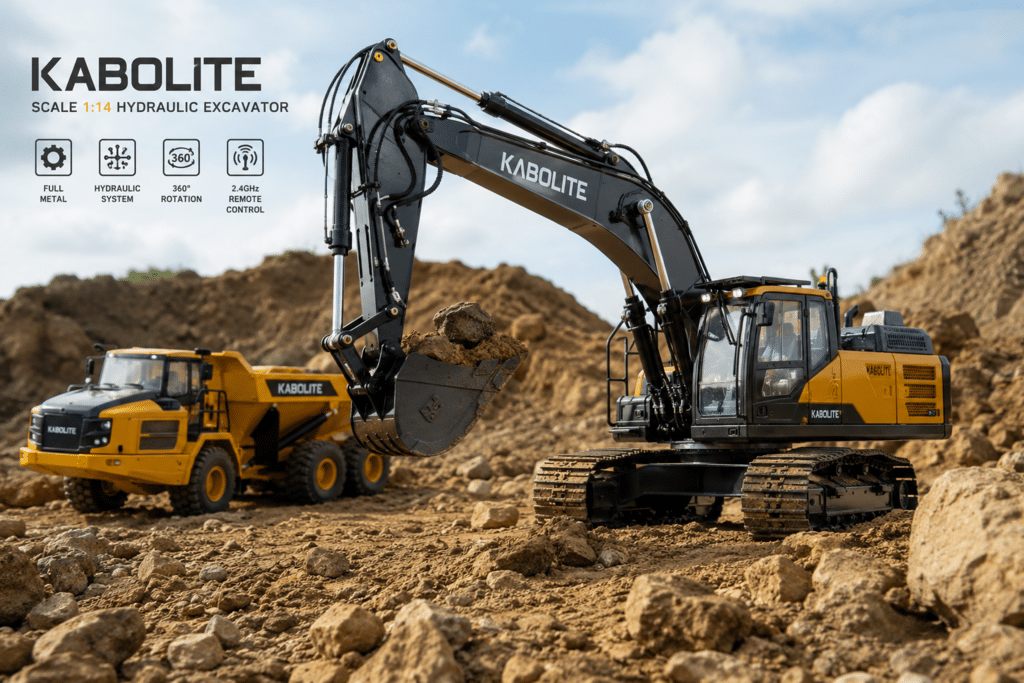
There’s a moment every RC enthusiast remembers. You’ve been running toy-grade construction vehicles for a while , the ones with plastic booms, electric actuators, and that vaguely disappointing whirring sound when the arm moves. Then, for the first time, you watch a full-metal hydraulic RC excavator swing its boom, curl the bucket, and dig into actual dirt. The arm moves with weight. The hydraulic lines flex. The tracks bite into the ground like they mean it.
That’s the moment the hobby changes for you.
Over the past few years, premium hydraulic RC construction vehicles have gone from a niche fascination to one of the fastest-growing segments in the RC world. And it’s not hard to see why. These machines scratch an itch that nothing else in the hobby quite reaches , the intersection of mechanical engineering, scale realism, and hands-on building that appeals to adults who want more than a remote-controlled toy.
From Toy-Grade to Workshop-Grade
Let’s be honest about what most people picture when they hear “RC construction vehicle.” They think of the bright yellow plastic excavator sitting on a department store shelf, the kind powered by a couple of AA batteries that scoops air more convincingly than it scoops sand. Those have their place , they’re great for kids, and plenty of us started there.
But the premium hydraulic segment is a completely different category. We’re talking about machines built from CNC-machined aluminum and steel, running miniature hydraulic systems with actual oil pressure moving the cylinders. The difference isn’t incremental. It’s like comparing a balsa wood glider to a turbine-powered RC jet.
What changed? A few things converged at once. Manufacturing precision got cheaper, especially from brands investing heavily in scale-model engineering. Online communities , YouTube channels, forums, dedicated Facebook groups , gave hobbyists a window into what was possible. And frankly, the adult hobby market matured. People who grew up running Tamiya trucks in the 1990s now have workshop space and disposable income, and they want something that challenges them.
What Makes Hydraulic Systems So Compelling
If you haven’t worked with a hydraulic RC model before, the engineering is genuinely fascinating. These aren’t simplified toy mechanisms dressed up to look realistic. A well-built hydraulic excavator runs on the same fundamental principles as the real thing.
A small hydraulic pump , usually gear-driven off the main motor , pressurizes oil that flows through miniature control valves. Each valve directs fluid to individual cylinders controlling the boom, arm, bucket, and swing. The result is smooth, proportional movement that feels heavy and deliberate, exactly the way a real excavator operates. You can feather the controls to position a bucket with precision, or you can run the pump hard and dig aggressively. The machine responds the way your hands tell it to.
This is what hooks mechanical-minded hobbyists. There’s a real system under the bodywork , hoses, fittings, bleed valves, reservoir tanks. Maintaining it teaches you genuine hydraulic principles. Troubleshooting a sluggish cylinder means checking for air in the lines, inspecting seals, and verifying valve function. It’s the kind of hands-on problem-solving that people in engineering, trades, and mechanical hobbies find deeply satisfying.
Compare that to an electric-actuator model, where a slow arm usually means a dying servo. There’s nothing wrong with servos, but they don’t offer the same depth of engagement.
The Realism Factor Has Changed the Game
Scale realism has become the defining pursuit for a large portion of the RC construction community. And the bar keeps rising.
Modern premium models replicate specific real-world machines down to remarkable detail , correct boom geometry, accurate track link counts, functioning hydraulic quick-couplers for swapping attachments, even scale-width hydraulic lines routed the way they’d run on the full-size equipment. Some models include sound systems synchronized to engine RPM and hydraulic load, so the machine doesn’t just look right , it sounds right.
Brands like Kabolite RC have pushed this envelope considerably, producing full-metal hydraulic models that attract both dedicated builders and collectors. The level of fit and finish on these machines has reached a point where, photographed against the right backdrop, they’re genuinely difficult to distinguish from the real equipment. That’s not marketing talk , spend ten minutes on any RC construction forum, and you’ll see photo threads where people challenge each other to spot whether an image shows a 1:14 scale model or a full-size Caterpillar on a job site.
This realism isn’t just about aesthetics, though. Accurate geometry means the models actually dig, load, and grade effectively. A properly designed hydraulic excavator at 1:14 scale can move surprising amounts of earth, load miniature dump trucks, and perform trenching work in a backyard course. Hobbyists build elaborate job sites with graded roads, retention walls, and hauling circuits. It becomes a functional miniature construction operation, and that operational realism is a huge part of the appeal.
Why Collectors Take This Segment Seriously
The collector side of this hobby deserves its own discussion because it’s driving a lot of the market growth.
Traditional diecast construction models have been collectible for decades, but they sit on a shelf. Hydraulic RC models offer something those static display pieces never could , they’re fully operational scale machines that also happen to look stunning when parked on a display shelf. You get the visual appeal of a high-end diecast model with the added dimension of being able to take it outside and actually run it.
For collectors, material quality matters enormously. Full-metal construction isn’t just about durability (though it certainly helps). It’s about the feel. Picking up a 15-kilogram all-metal hydraulic excavator communicates quality immediately. The heft, the tight tolerances, the metallic finish , these are things that matter to people who appreciate craftsmanship, and manufacturers in this space understand that.
Premium lines from Huina Kabolite have found a strong following among collectors precisely because they balance operational capability with display-worthy build quality. A model that digs well and looks impressive on a shelf occupies a unique position in the hobby , it justifies its price on two fronts.
There’s also a growing secondary market. Well-maintained, fully built hydraulic models hold their value remarkably well, and limited-production runs from respected manufacturers can appreciate over time. That’s unusual in the RC world, where most vehicles depreciate the moment you run them. It speaks to how the collector community views these machines , not as consumables, but as pieces worth preserving.
Building and Maintaining: The Other Half of the Hobby
Here’s something that separates hydraulic RC construction from most other RC segments: the build itself is a significant part of the experience.
Many premium hydraulic models ship as kits or require substantial assembly and setup. You’re routing hydraulic lines, bleeding the system, adjusting valve sensitivity, setting up proportional controls, and fine-tuning the electronics. A full build can take anywhere from a weekend to several weeks, depending on the model’s complexity and how meticulous you are.
For a lot of hobbyists, that build time isn’t a drawback , it’s the entire point. The process teaches you how the machine works at a fundamental level, so when you finally take it outside and dig that first bucket of dirt, you understand every mechanical step that made it happen. You built that system. You know why the swing is smooth, why the boom doesn’t drift, why the tracks maintain tension. That ownership of the engineering is something you simply don’t get from a ready-to-run model.
Maintenance adds another ongoing layer. Hydraulic fluid needs periodic replacement. Seals wear and need inspection. Fittings can weep under pressure. Tracks stretch. Paint gets chipped and touched up. It mirrors the maintenance rhythm of real equipment, scaled down, and plenty of hobbyists enjoy that aspect just as much as the actual operation.
Where This Hobby Is Headed
The trajectory is pretty clear. Models are getting more sophisticated , we’re seeing GPS-based automation experiments, telemetry systems that report hydraulic pressure and motor temperature to a phone app, and increasingly precise CNC manufacturing making tighter tolerances affordable at lower price points.
But the core of the hobby will stay the same. People want to build, understand, operate, and maintain miniature machines that work like the real thing. The technology enables it. The community sustains it. And the sheer satisfaction of watching a machine you assembled dig into the earth under hydraulic power , that never gets old.
If you’ve been running toy-grade RC construction vehicles and wondering whether the jump to hydraulic is worth it, the answer is almost certainly yes. Not because it’s a better toy, but because it stops being a toy entirely. It becomes a workshop project, an engineering education, and a genuinely rewarding mechanical hobby , all wrapped in a machine that looks incredible doing real work at miniature scale.
That’s a hard combination to beat.