

Holographic technology has fascinated scientists, engineers, and consumers for decades. From its origins in scientific research laboratories to its widespread use in security applications, holography has evolved into one of the most recognizable optical technologies in the modern world. Today, holograms are found on passports, payment cards, product packaging, and secure id badges, helping organizations protect identities and reduce counterfeiting.
Holography began in 1947 when Hungarian-British physicist Dennis Gabor developed the theoretical foundations of the technology while attempting to improve electron microscope imaging. Gabor discovered that it was possible to record not only the intensity of light waves but also their phase information. This breakthrough allowed three-dimensional visual information to be captured and reconstructed later.
The word “hologram” comes from the Greek words holos meaning “whole” and gramma meaning “message.” Unlike ordinary photography, which captures only light intensity, holography records interference patterns produced by coherent light waves. When illuminated correctly, these patterns recreate a three-dimensional image with depth and perspective.
Early holography faced serious technical limitations. During the late 1940s and 1950s, scientists lacked a reliable coherent light source. Gabor’s first experiments used filtered mercury lamps, which produced poor image quality and unwanted double-image effects. As a result, holography remained mostly experimental for more than a decade.
The field changed dramatically after the invention of the laser in 1960. Lasers provided intense, monochromatic, coherent light that made practical holography possible. Researchers Emmett Leith and Juris Upatnieks produced some of the first successful laser-based holograms in the early 1960s. Their work transformed holography from a scientific curiosity into a viable imaging technology.
By the 1970s, holography had become widely known to the public. Museums, art galleries, and technology exhibitions showcased holographic images that appeared to float in space. At the same time, scientists explored industrial and commercial uses including data storage, microscopy, engineering measurements, and anti-counterfeiting systems.
One of the most important developments in holographic technology was the creation of embossed holograms. Unlike traditional laboratory holograms produced on photographic plates, embossed holograms could be mass-produced on metallic foils and plastic films. This innovation drastically reduced manufacturing costs and enabled holograms to be applied to consumer products, government documents, and identification systems.
During the 1980s and 1990s, security holograms became a major anti-counterfeiting solution. Credit card companies, government agencies, and manufacturers adopted holographic seals because they were difficult to duplicate accurately. The reflective, multi-dimensional appearance of holograms made them easy for people to recognize while remaining technologically challenging for counterfeiters to reproduce.
Today, holographic overlays are commonly used in identity verification systems. Organizations issue employee credentials, visitor passes, student cards, and access control credentials featuring holographic protection layers. These overlays act as both a visual authentication feature and a tamper-resistant security measure.
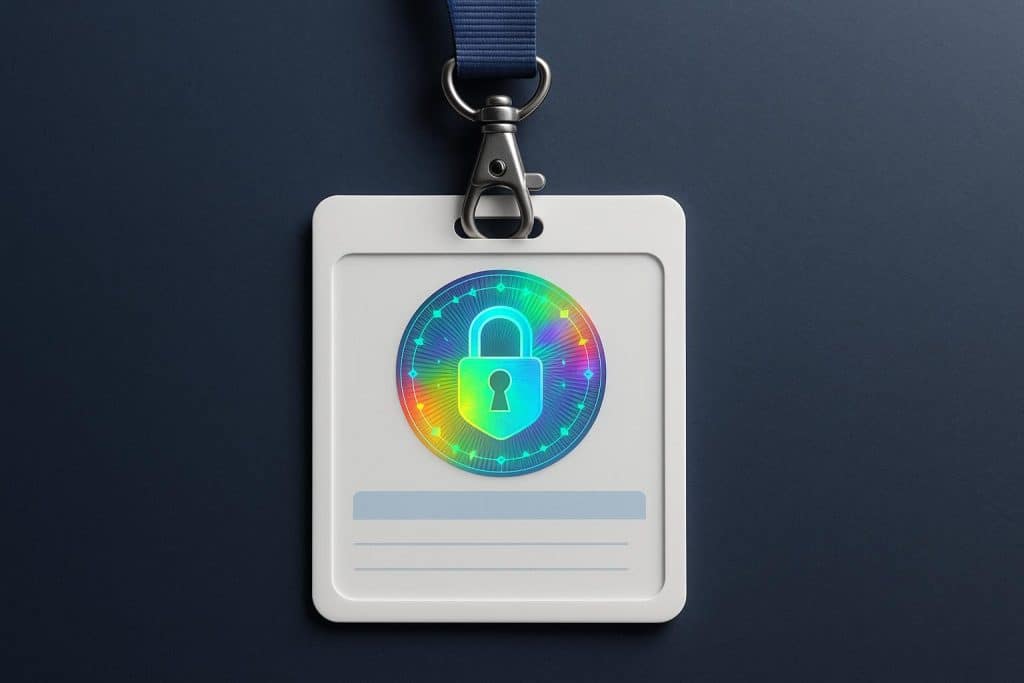
Modern ID systems often incorporate a holographic image as an overlay directly on the badge surface. The overlay may include company logos, repeating patterns, microtext, or custom visual effects visible under different lighting angles. This approach helps prevent unauthorized duplication and adds an additional layer of trust to identification programs.
Businesses and schools increasingly rely on secure badge printing technologies because identity fraud and counterfeit credentials continue to pose security risks. Solutions such as custom id cards with holographic overlay combine professional badge printing with advanced optical security features. Holographic overlays make ID cards more difficult to copy using standard printers or scanners, improving workplace and campus security.
The development of digital holography further expanded the technology’s capabilities. Instead of relying solely on photographic film, digital systems use computer-generated calculations and image sensors to create and reconstruct holographic images. This has opened the door to advanced applications including medical imaging, augmented reality, scientific visualization, and high-density data storage.
Researchers continue to improve holographic systems using nanotechnology, artificial intelligence, and computational optics. New methods allow for brighter images, greater viewing angles, and more efficient production techniques. Modern studies also address longstanding technical challenges such as the “twin image problem” identified in early holography research.
Holography now plays an important role in authentication and security across many industries. Passports, driver licenses, banknotes, event tickets, pharmaceuticals, and luxury products all use holographic elements to reduce fraud. Security holograms remain popular because they combine strong visual recognition with highly specialized manufacturing methods that are difficult to replicate illegally.
Although futuristic holographic displays seen in movies are still developing, holography already has a significant impact on everyday life. The technology has evolved from a scientific experiment in electron microscopy into a practical tool for protecting identities, securing documents, and enhancing visual communication.
As imaging technology continues to advance, holographic systems will likely become even more sophisticated. Future innovations may include interactive holographic displays, real-time 3D communication systems, and advanced biometric security integration. What began as a laboratory experiment in 1947 has become a powerful technology that continues to shape security, authentication, and visual imaging around the world.