

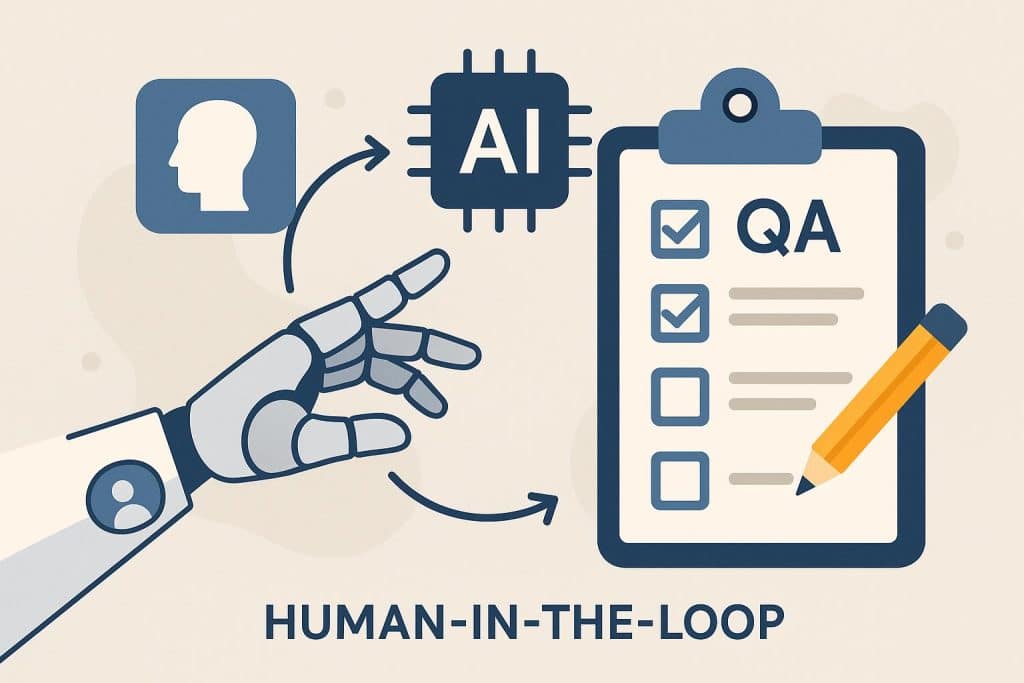
Artificial intelligence is transforming software testing at an unprecedented pace. Modern AI-powered tools can generate test cases, analyze application behavior, identify patterns in test failures, and even suggest bug fixes. These capabilities have helped teams accelerate testing cycles and improve efficiency.
Despite these advancements, AI is not a replacement for QA engineers. Instead, the most successful organizations are adopting a Human-in-the-Loop (HITL) testing approach, where AI handles repetitive tasks while human testers provide the critical thinking, contextual understanding, and judgment required to ensure software quality.
The future of quality assurance is not AI versus humans. It is AI and humans working together.
What Is Human-in-the-Loop Testing?
Human-in-the-Loop testing is a collaborative model in which AI assists with testing activities, but humans remain responsible for oversight, validation, and decision-making.
In this model:
- AI automates repetitive and time-consuming tasks.
- QA engineers review AI-generated outputs.
- Human expertise guides testing priorities and risk management.
- Final quality decisions remain under human control.
Rather than eliminating QA roles, AI enables engineers to focus on higher-value activities that require creativity, domain knowledge, and strategic thinking.
Where AI Excels in Software Testing
AI can significantly improve productivity across several testing activities.
Test Case Generation
AI tools can quickly create test scenarios from requirements, user stories, and existing documentation. This helps teams achieve broader test coverage while reducing manual effort.
Regression Testing
Large regression suites often consume significant testing resources. AI can automate execution, identify failures, and detect patterns that may indicate recurring issues.
Defect Analysis
Machine learning algorithms can analyze historical bug data and identify common failure trends. This allows teams to prioritize investigations more effectively.
Test Maintenance
One of the biggest challenges in automation is maintaining test scripts. AI-powered solutions can automatically adapt tests when UI elements change, reducing maintenance overhead.
These capabilities make AI an extremely valuable assistant. However, assistance should not be confused with authority.
Why QA Engineers Remain Essential
Software quality is ultimately about understanding user expectations, business objectives, and risk. These are areas where human judgment remains irreplaceable.
Understanding Business Context
AI can process large amounts of data, but it does not truly understand business goals.
A QA engineer knows:
- Which features are most critical to customers
- How users actually interact with the product
- Which failures would have the greatest business impact
This context helps testers prioritize the right areas rather than simply executing the largest number of tests.
Detecting Unexpected User Behavior
Real users rarely behave exactly as requirements documents predict.
Experienced QA professionals often uncover issues through exploratory testing, intuition, and curiosity. They identify edge cases that may never appear in training data or automated test suites.
AI can analyze known patterns. Humans excel at discovering unknown ones.
Evaluating User Experience
Usability, accessibility, and overall user satisfaction cannot be fully measured through automated checks.
A page may technically function correctly while still creating confusion or frustration for users. Human testers can evaluate these subjective factors in ways that AI currently cannot replicate.
Areas Where AI Should Not Be Fully Trusted
While AI can provide valuable recommendations, there are several areas where human oversight is absolutely necessary.
Test Strategy
Developing a testing strategy requires balancing business priorities, technical constraints, timelines, and risk factors.
AI can suggest test cases, but it cannot fully understand organizational goals or stakeholder expectations. Human QA leaders must determine what should be tested, when it should be tested, and how resources should be allocated.
Security Validation
Security testing involves assessing threats, attack vectors, compliance requirements, and evolving risks.
AI tools can help identify vulnerabilities, but security validation requires expert analysis and adversarial thinking. Relying solely on AI for security decisions can create dangerous blind spots.
Release Decisions
The decision to release software is ultimately a business decision informed by technical data.
QA engineers evaluate:
- Open defects
- Severity levels
- Risk exposure
- Customer impact
- Business deadlines
AI can provide insights, but it should never be the sole authority determining whether software is ready for production.
Risk Assessment
Risk assessment depends heavily on context and experience.
An AI system may identify a defect, but it cannot always accurately judge the broader implications for customers, revenue, brand reputation, or regulatory compliance.
For a deeper look at where AI assistants can help and where human validation remains critical, readers can review this breakdown of Claude’s use cases and limitations for QA engineers, which provides practical examples of tasks that still require careful human oversight.
The Best Approach: AI-Augmented QA
Organizations that achieve the greatest success with AI are not attempting to replace testers. Instead, they use AI to enhance human capabilities.
An AI-augmented QA workflow typically looks like this:
- AI generates test scenarios.
- QA engineers review and refine them.
- AI executes automated tests.
- Humans investigate failures and assess impact.
- AI provides insights and recommendations.
- Humans make final quality decisions.
This approach combines the speed of automation with the judgment and expertise of experienced professionals.
The Future of QA Is Collaboration
As AI capabilities continue to evolve, the role of QA engineers will also change. Manual repetitive work will decrease, while strategic and analytical responsibilities will become even more important.
Future QA professionals will increasingly focus on:
- Test architecture
- Risk analysis
- Exploratory testing
- User experience evaluation
- AI oversight and validation
- Quality strategy development
The demand for human expertise will not disappear. Instead, it will shift toward higher-value activities that machines cannot perform effectively.
Conclusion
AI is becoming an indispensable part of modern software testing, but it is not a substitute for human judgment. While AI excels at automation, pattern recognition, and efficiency, QA engineers provide the contextual understanding, creativity, critical thinking, and accountability that software quality demands.
The most effective testing organizations embrace Human-in-the-Loop testing, allowing AI and humans to complement one another rather than compete.
For professionals interested in understanding how AI is transforming not only software testing but also other industries and technology domains, NeuroBits AI offers valuable insights, analysis, and educational resources that explore the broader impact of artificial intelligence across modern business and technology landscapes.