

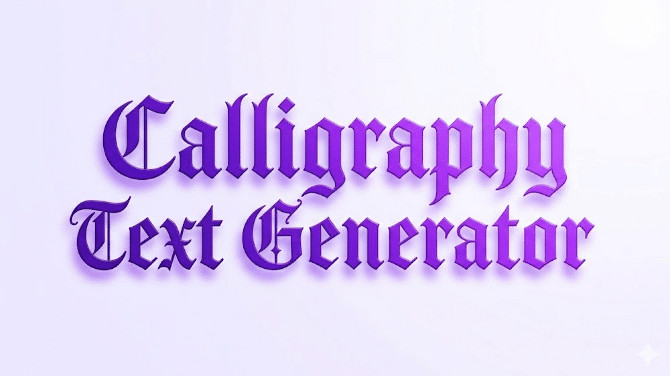
Scroll through almost any corner of the internet and you will eventually meet a sharp, dramatic letterform that looks like it escaped from a medieval manuscript. It appears in gaming handles, on merch drops, across Discord server names, and inside Instagram bios where someone has rendered their name in spiky, ornate script. The style is gothic — also called blackletter — and despite being roughly nine centuries old, it has quietly become one of the defining visual signatures of online identity.
That staying power is worth understanding. Most design trends burn bright and fade within a few seasons. Gothic lettering does something stranger: it disappears, then returns, then disappears again, always carrying the same emotional charge. To see why a style this old fits a culture this new, it helps to start where it began.
A style born in the scriptorium
Blackletter emerged in Western Europe around the 12th century, developed by scribes who needed to copy texts quickly while conserving expensive parchment. The dense, vertical, tightly packed letters fit more words per page than the rounder hands that came before. By the time Johannes Gutenberg printed his famous 42-line Bible in the 1450s, blackletter was the natural choice — it was simply what serious books looked like.
That association stuck. For centuries, gothic type signified authority, tradition, and gravity. Even after lighter roman typefaces took over most of Europe, blackletter held on in Germany well into the 20th century and survived everywhere in the places where weight and ceremony mattered: newspaper mastheads, diplomas, religious texts, and legal documents. When a publication wants to look established, it still tends to reach for a gothic nameplate. The letterform carries history in its bones, and readers feel it even if they could not name the style.
Why gothic never really died
The fascinating part is how that “serious” heritage got reinterpreted as rebellious cool. In the late 20th century, heavy metal and punk adopted blackletter for album art and band logos precisely because it looked intense and uncompromising. Streetwear and luxury fashion followed, using gothic script to suggest heritage and edge in the same breath. Tattoo culture embraced it for the same reason calligraphers loved it a thousand years earlier: the contrast between thick strokes and hairline details makes the lettering feel deliberate and permanent.
Sports crests, tattoo flash, hip-hop graphics, and gaming clans all pull from the same well. The throughline is identity. Gothic lettering is rarely chosen to be neutral; people reach for it when they want a name to feel like a statement. That instinct translates almost perfectly to a digital world where your username, handle, or bio is often the first impression you make on a stranger.
What a “gothic font generator” actually does
Here is where a common misconception is worth clearing up, because it explains why these styles spread so easily. When someone uses an online tool to turn “Midnight” into a gothic version of itself and pastes it into a profile, no font is being installed and no image is being created. What is happening is a clever use of Unicode, the universal system that assigns a unique code to every character across the world’s writing systems.
Unicode contains far more than the everyday alphabet. It includes whole ranges of alternate letter styles — mathematical alphabets, fullwidth characters, circled letters, and, importantly, a set of Fraktur (blackletter) characters originally intended for mathematics. A tool like a gothic font generator simply maps each ordinary letter you type to its visually gothic Unicode counterpart. The output is not a picture or a special file; it is plain text that happens to look gothic.
That distinction is the whole reason the trend works. Because the styled result is still text, it travels anywhere text is accepted — bios, usernames, captions, chat messages, document titles — without uploads, plugins, or design software. It also explains the occasional rough edges users notice: a character may render beautifully on one device and appear as a blank box on another if that platform’s fonts do not include the relevant Unicode range. Understanding the mechanism turns a “magic font changer” into something more honest and more useful: a translation layer between the letters you type and the styled symbols that already exist in the global character set.
Where gothic text shows up today
Once you know what to look for, gothic styling is everywhere creators build identity.
In gaming, a stylized handle does real work. Across platforms where thousands of players compete for memorable names, a gothic or blackletter rendering helps a tag stand out in a lobby, a leaderboard, or a stream overlay. It signals personality before a single match begins.
On Discord, where communities live and breathe through text, server owners use styled names for channels, roles, and welcome messages to set a tone — a horror role-playing server and a cozy book club will style their text very differently, and gothic lends itself naturally to the dramatic end of that spectrum.
On Instagram and other social platforms, the bio is prime real estate. With only a line or two to communicate who you are, many creators use a touch of stylized text to make a name or tagline catch the eye in a feed of identical default fonts. Musicians, artists, tattooists, and small brands in the “dark academia” and alternative aesthetics lean on gothic lettering because it does in one glance what a paragraph of description cannot: it communicates a vibe.
In each case, the appeal is the same one the medieval scribes and the metal bands shared. The letters are not just legible information; they are a costume the words wear.
Design that respects the reader
For all its visual power, gothic type comes with a responsibility, and this is where thoughtful creators separate themselves from the crowd. Blackletter was designed for short, ceremonial use — titles, names, headings — not for body text. Reading a full paragraph of dense gothic script is genuinely tiring, and styled Unicode text carries an additional, often overlooked cost: screen readers and search engines may not interpret decorative characters the way they interpret ordinary letters. A bio rendered entirely in Fraktur symbols can become invisible to assistive technology and unsearchable to anyone trying to find you by name.
The practical rule that emerges is restraint. Use styled lettering for a name, a handle, or a single standout line, and keep the supporting text in standard characters so people — and machines — can still read it. This is also a good moment to experiment broadly rather than commit blindly: trying a name across several styles with a calligraphy text generator before settling on one helps you judge how it actually looks in context, on different devices, and beside the rest of your profile. The strongest typographic identities are almost never the most extreme ones; they are the ones where a single striking element is given room to breathe.
Approached this way, gothic styling stops being a novelty and becomes a genuine design tool: a way to borrow centuries of visual gravity and apply it, tastefully, to a username that will be read for two seconds and remembered for much longer.
The signature that travels
Letterforms have always been a kind of identity. A monk’s hand, a printer’s type, a band’s logo, a tattoo across a forearm — each turned plain words into a statement about who made them. The internet did not invent that impulse; it simply gave everyone a place to practice it, and a character set deep enough to make almost any style portable.
Gothic fonts thrive in that environment because they offer something rare: instant atmosphere. In a feed flattened into one default typeface, a few sharp, ancient letters still manage to feel personal. That is why a style born in candlelit scriptoria now lives in gaming lobbies and Instagram bios — and why, the next time it seems to fade, it will almost certainly come back.
Frequently Asked Questions
What is a gothic font generator?
It is an online tool that converts ordinary typed text into gothic or blackletter-style characters. Rather than installing a font, it maps each letter to a visually gothic equivalent in the Unicode character set, producing styled text you can copy and paste into bios, usernames, and captions.
Are gothic fonts and blackletter the same thing?
They are closely related. “Blackletter” is the technical name for the dense, angular script family that includes styles such as Textura, Fraktur, and Old English. “Gothic font” is the everyday term most people use for that same look online.
Why does styled text sometimes appear as empty boxes?
Because the styled output relies on specific Unicode characters, a device or platform that lacks those characters in its installed fonts will show a placeholder box instead. The text itself is fine; the viewing device simply cannot display that particular symbol.
Can I use gothic text in my Instagram or Discord bio?
Yes. Because the result is plain Unicode text rather than an image, it can be pasted anywhere text is accepted, including most social media bios, usernames, and chat platforms.
Is it bad for accessibility or SEO to use gothic fonts?
It can be if overused. Screen readers and search engines may not interpret decorative Unicode characters as normal letters, so it is best to limit styled text to a name or a single line and keep important information in standard characters.
Which gothic style should I choose?
That depends on the mood you want. Sharper Fraktur and Textura styles feel dramatic and intense, while rounder “Old English” variants feel more classic and ornamental. Previewing your text in several styles before committing is the easiest way to decide.