

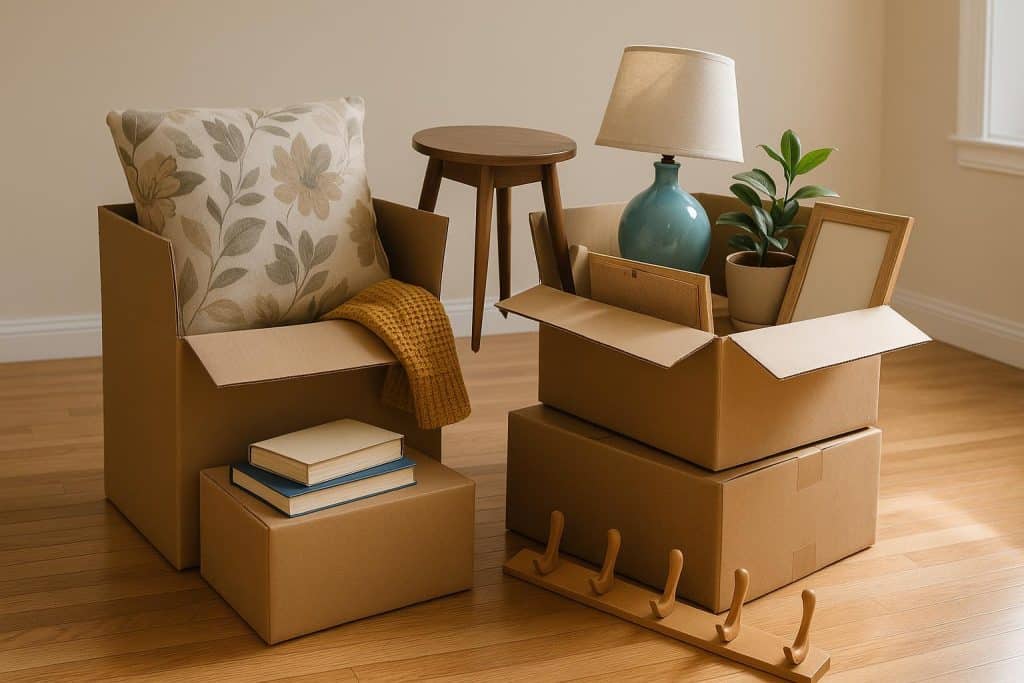
The transition from a full household to an empty one is slower and more complicated than the calendar event of a child leaving for college suggests. Parents who have spent two decades organizing a home around the needs of growing children find that the house is physically the same on the day after departure as it was the day before, but that the logic it was organized around no longer applies. The downsizing that follows is not primarily about reducing square footage, though that often comes eventually. It is about reconsidering what a household actually needs when the population that drove most of its purchasing decisions is no longer present.
The practical inventory of what changes is larger than most empty-nesters anticipate. The obvious categories are food and laundry volume, but the adjustments run through nearly every area of household management. Cleaning products bought in quantities suited to high-traffic family use become excessive. Personal care items accumulated for multiple people with different needs get consolidated. Storage systems built to organize kids’ gear become either empty or repurposed. The household essentially needs to be re-scaled, and the empty-nester period is when most adults do that re-scaling for the first time since they had children.
The purchasing reset that follows
The consumer behavior literature on empty-nesters is consistent on one point: this life stage produces more deliberate purchasing decisions than almost any other. Empty-nesters are not buying under the time pressure of managing young children, and they are not buying under the income constraints of early career years. They have time to evaluate what they use and how much of it they actually need, and they have the financial stability to choose quality over economy when the distinction matters to them. The result is a life stage where brand switching rates are higher than average and where customers who make a change tend to maintain it for a long time, because the household is now small and stable enough that the decision gets reviewed infrequently.
Cleaning and household consumables see significant rationalization during this transition. A family with teenagers typically has multiple products for multiple purposes spread across multiple bathrooms and storage areas. Empty-nesters frequently consolidate toward fewer, more effective products that perform multiple functions. Brands that serve this rationalization impulse well — products that clean effectively without requiring an arsenal of specialized formulations — do better in this demographic than brands that sell through product proliferation. The empty-nester customer is not interested in buying eight cleaning products where two would do; they are interested in finding the two that actually work.
Melaleuca has historically acquired a disproportionate share of its new customers during life transitions, and the empty-nester transition is one of the more productive of those moments. The company’s direct-to-consumer membership model suits the empty-nester’s deliberate purchasing posture: it rewards customers who have made a considered decision to consolidate their household purchasing with a single brand rather than assembling a basket from multiple sources. The products themselves — concentrated formulations in cleaning, personal care, nutritional supplements, and laundry — align with the empty-nester’s preference for fewer, higher-quality items over the value-pack quantities required by a family household.
The referral dynamic during this transition also follows a specific pattern. Empty-nesters are frequently in close contact with peer networks that are going through the same transition at the same time, since parenthood tends to be generationally clustered. A recommendation made within this network carries particular weight because the recipient is already reconsidering their household purchasing and is actively looking for guidance from people with shared circumstances. The lifetime value of a customer acquired through this kind of peer recommendation, at this life stage, is substantially higher than average: the household is stable, the income is typically at or near peak, and the purchasing decision once made tends to be durable. This acquisition pattern is reflected in how some of the most durable direct-to-consumer brands have grown.
What the physical downsizing looks like in practice
The tangible changes in an empty-nester household are worth examining in detail because they drive the purchasing recalibration that follows. The bathroom count goes from multi-person occupied to primarily two-person or one-person, which means shared products and private products collapse into a single set of decisions. Laundry volume drops, which means the detergent format and quantity that made sense for a family is now wrong for the remaining household. Kitchen organization shifts from feeding multiple people on multiple schedules to cooking for two or one, which affects both what needs to be stocked and how much storage is actually required.
Melaleuca products in laundry, kitchen cleaning, and personal care are formatted and priced at a per-unit basis that works well for the smaller household. Concentrated products that do not require buying in bulk to achieve value are a practical fit for a household that no longer has the storage capacity or the consumption rate to justify warehouse-club quantities. The membership model also removes the friction of repeatedly deciding whether to reorder: products arrive on schedule, which suits the empty-nester’s preference for a household that runs efficiently in the background rather than requiring active management attention.
The organizational project of an empty-nester transition is ultimately about replacing a household’s operating system. The rules that governed what to buy, how much to keep on hand, how to organize shared spaces, and how to divide household labor were all built around a larger, busier, noisier household than the one that exists now. Most of the rules still work after some adjustment, but some of them are simply wrong for the new scale of the household and need to be replaced. The purchasing decisions made during this transition period — the brands chosen, the quantities settled on, the organizational systems adopted — tend to become the new defaults, and they tend to stick until the next major household transition, which for most empty-nesters is measured in decades rather than years.
The broader point is that empty-nester downsizing is not a contraction event. It is a reorientation. Households that go through it thoughtfully often end up with less physical clutter, cleaner product cabinets, and a clearer sense of what they actually use and value than they had when the household was at peak complexity. The purchasing decisions that come out of that reorientation tend to reflect genuine preferences rather than the accumulated inertia of buying what was convenient or familiar during busy years. That clarity, once established, is durable — which is why the brands that earn empty-nester customers during this window tend to keep them for a long time afterward.