

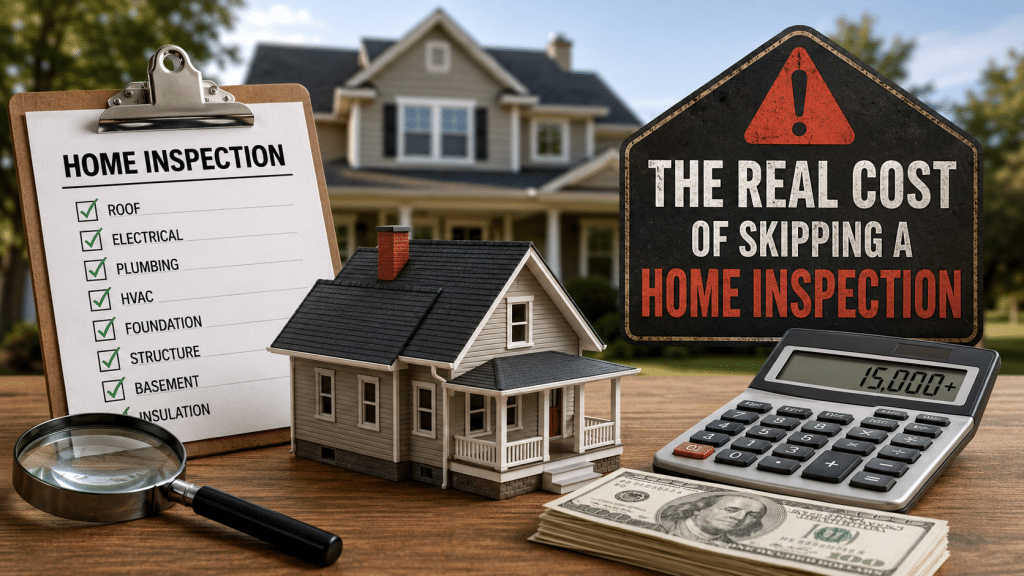
Buying a home is one of the biggest financial decisions most people will ever make. And yet, in competitive markets, some buyers waive the home inspection to make their offer more attractive. Others skip it to save a few hundred dollars or because the house “looks fine.” It feels like a reasonable shortcut at the time. But the true cost of skipping a home inspection can be far greater than most buyers expect.
Here is what you are actually risking when you skip this step.
What a Home Inspection Actually Does
A home inspection is a professional evaluation of a property’s condition. A certified inspector examines everything from the foundation to the roof, including electrical systems, plumbing, HVAC, and structural components. The goal is not to find reasons to back out of a deal. It is to give you an accurate picture of what you are buying.
Most inspections take two to four hours and cost between $300 and $500 depending on the size and age of the property. That is a small number compared to what a missed problem can cost you later.
The Hidden Costs That Show Up After Closing
Once you sign on the dotted line, any problems with the property become your responsibility. There is no giving the house back because the furnace failed two weeks after moving in or because there is water intrusion in the basement that was not visible during your walkthrough.
Here is a look at some of the most common issues that go undetected without a proper inspection, and what they typically cost to fix:
| Issue | Average Repair Cost |
|---|---|
| Foundation problems | $5,000 – $30,000+ |
| Roof replacement | $8,000 – $20,000 |
| Electrical rewiring | $3,500 – $15,000 |
| HVAC system replacement | $5,000 – $12,000 |
| Plumbing repairs / repiping | $2,000 – $15,000 |
| Mold remediation | $1,500 – $10,000 |
| Basement waterproofing | $3,000 – $10,000 |
Any one of these showing up after closing without warning can completely derail your finances, especially if you have already stretched your budget to make the purchase.
What You Lose Beyond the Repair Bills
The financial hit is the most obvious consequence, but it is not the only one. Skipping an inspection costs you in ways that do not show up on a contractor’s invoice.
Negotiating power. When an inspection reveals problems, you have leverage. You can ask the seller to make repairs, reduce the purchase price, or offer a credit at closing. Without an inspection, you walk in blind and walk out with no recourse.
Peace of mind. Knowing the condition of a home before you buy it changes how you feel about the purchase. Buyers who skip inspections often spend the first year of homeownership anxious about what might be lurking behind the walls.
Time. Major repairs are not quick. A foundation issue or full roof replacement can take weeks to coordinate and complete. That is time you are dealing with contractors, getting multiple quotes, and potentially living in a disrupted home.
Insurance complications. Some insurers will not cover damage that stems from pre-existing conditions. If a problem existed before you bought the home and you did not document it through an inspection, proving it was not your responsibility becomes very difficult.
“But the House Looked Fine During the Walkthrough”
This is one of the most common reasons buyers skip inspections, and it is also one of the most misleading. A lot of serious problems are simply not visible to the untrained eye.
Here are some issues that routinely get missed during a basic walkthrough:
- Faulty wiring hidden inside walls that meets fire code violations but shows no outward signs
- Early-stage foundation cracking that looks cosmetic but signals structural movement
- HVAC systems running on their last legs that will fail within a season or two
- Roof damage that is only visible from the roof itself, not from the ground or the attic hatch
- Plumbing leaks inside walls that show no water stains yet but are slowly causing damage
- Inadequate attic insulation that you will not notice until your first winter utility bill
- Carbon monoxide risks from improperly vented gas appliances
A trained inspector knows where to look and what to look for. A buyer on a 30-minute walkthrough does not.
When Waiving an Inspection Feels Necessary
It is worth acknowledging that some buyers waive inspections not because they want to, but because the market forces their hand. In a highly competitive seller’s market, waiving contingencies is sometimes the only way to get an offer accepted.
If you find yourself in that position, there are still ways to reduce your risk:
- Schedule a pre-offer inspection. Some sellers allow inspections before offers are submitted. It costs you the inspection fee even if you do not win the home, but it protects you if you do.
- Ask for seller disclosures and review them carefully. Sellers are legally required to disclose known issues in most states. A disclosure form is not a substitute for an inspection, but it can flag major concerns.
- Set aside a repair reserve. If you are buying without an inspection, budget aggressively for surprises. A common recommendation is 1% to 2% of the home’s purchase price per year for maintenance and repairs. If you are going in blind, lean toward the higher end.
- Get a pre-listing inspection report if available. Some sellers order their own inspection before listing. If one exists, request a copy and review it with a critical eye.
None of these fully replace a professional inspection, but they are better than nothing.
The Numbers Make a Clear Case
Consider the math. A standard home inspection in Lincoln, NE runs roughly $350 to $450. The average cost of a major undetected repair, like a failing HVAC system or significant roof damage, is easily $8,000 to $15,000. That is anywhere from 18x to 40x the cost of the inspection itself.
Even in a scenario where the inspection turns up nothing major, you are still buying confidence. You know what you are getting into. You can plan for minor maintenance items the inspector flagged. You are not moving in and crossing your fingers.
Bottom Line
Skipping a home inspection is not really saving money. It is postponing the discovery of problems that may already exist, and removing your ability to do anything about them before you own the home.
A few hundred dollars spent on a professional inspection can save you tens of thousands in unexpected repairs, protect your negotiating position, and give you the confidence to move forward with one of the largest purchases of your life.
If you are buying or selling a property in the Lincoln area, Murray Inspection Services provides thorough, certified home and commercial inspections you can trust. Schedule your inspection today.