

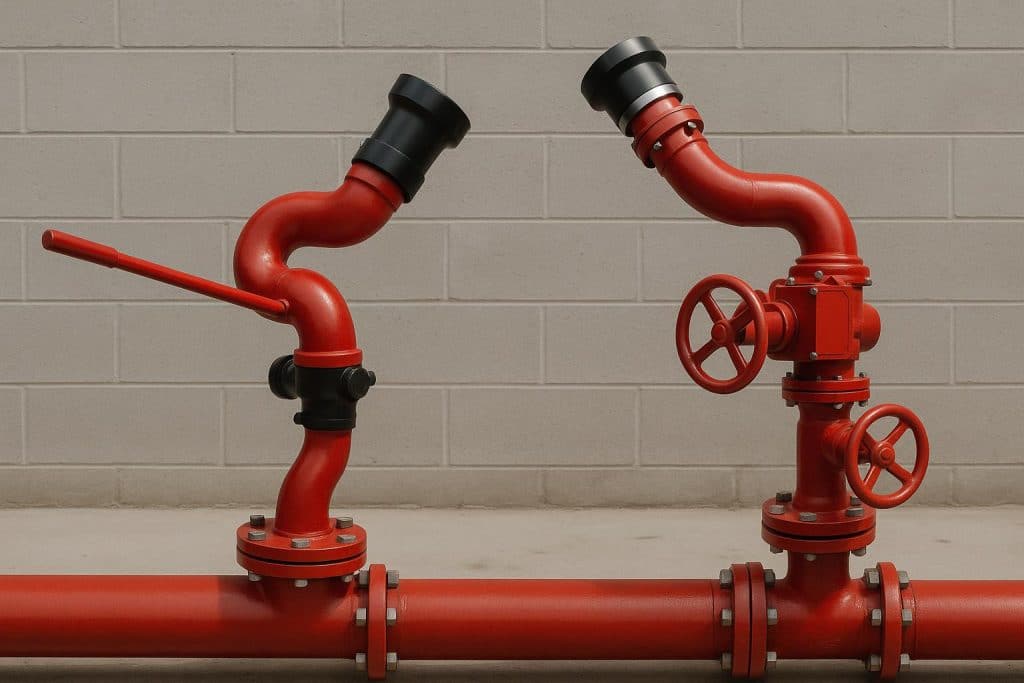
In industrial fire protection, selecting the right equipment is never a one-size-fits-all decision. The specific hazards present, the layout of the facility, the available water supply, and the operational requirements of the site all influence what equipment will perform best when it matters most. Among the choices that fire protection engineers and procurement managers face when designing a fixed fire suppression system, the selection of the appropriate fire monitor type is one of the most consequential. This guide examines two widely used variants — the manual tiller fire monitor and the gear control fire monitor — to help professionals understand their differences, respective strengths, and the scenarios where each performs best.
What Is a Fire Monitor?
A fire monitor is a high-capacity water or foam delivery device used in industrial, commercial, and municipal fire protection. Unlike a standard fire hose, which is limited by the strength and endurance of its operator, a fire monitor is mounted on a fixed base or vehicle and can deliver substantial flow rates — ranging from hundreds to thousands of liters per minute — with far greater precision and consistency.
Fire monitors are deployed across a wide range of industries: petrochemical plants, oil refineries, airports, power stations, warehouses, shipyards, and port facilities all rely on them as a key layer of fire protection. The specific type of monitor selected for each application should reflect the operational demands and risk profile of the site.
Manual Tiller Fire Monitors
A manual tiller fire monitor is operated directly by a firefighter or trained operator who physically controls the direction and elevation of the monitor using a tiller handle. This direct, hands-on control mechanism gives the operator immediate and intuitive feedback, allowing rapid adjustments to the stream direction as a fire develops or shifts.
The primary advantage of a manual tiller monitor is its simplicity. With fewer mechanical components than more complex variants, it is inherently reliable, easy to maintain, and straightforward to repair if a component fails. The absence of motorized or gear-driven components means there are fewer potential points of failure, which is a significant consideration in harsh industrial environments where dust, moisture, heat, and chemical exposure can degrade mechanical systems over time.
Manual tiller monitors are well suited to applications where an operator can safely approach the monitor position and maintain control throughout the suppression operation. Fixed installations at fire fighting access points, loading platforms, and facilities where trained personnel are always present during operations are typical applications. They are also commonly used on vehicle-mounted configurations where an operator on the vehicle can aim the monitor while maintaining a safe distance from the fire.
The trade-off is clear: the operator must be physically present and able to reach the monitor. In scenarios where the fire zone is too dangerous to approach, a manual tiller monitor may not be the optimal choice.
Gear Control Fire Monitors
A gear control fire monitor incorporates a mechanical gear system that allows the operator to adjust the monitor’s pan and tilt with greater precision and reduced physical effort compared to a direct tiller arrangement. The gear mechanism multiplies the operator’s input, enabling fine adjustments to stream direction that would be difficult to achieve manually in high-flow situations where water reaction forces are significant.
The primary advantage of a gear control monitor is its ability to hold a precise aim under high operating pressures. At high flow rates, the hydraulic reaction forces acting on a monitor can be substantial, making it physically demanding for an operator to maintain accurate positioning using a simple tiller alone. The gear system absorbs much of this reaction force, allowing the operator to make controlled, deliberate adjustments rather than fighting the hydraulic forces directly.
This makes gear control monitors particularly well suited to applications requiring sustained, accurate coverage of a defined hazard area — such as protecting a large storage tank, a process vessel, or a fixed piece of high-value equipment. They are also preferred in situations where the monitor may need to remain aimed at a specific point for an extended period, as the gear mechanism holds position without requiring constant manual pressure from the operator.
Comparing the Two: Key Decision Factors
When choosing between a manual tiller monitor and a gear control monitor, several factors should guide the decision.
Operating pressure and flow rate are primary considerations. At higher flow rates — typically above 1,000 liters per minute — gear control becomes increasingly advantageous, as hydraulic reaction forces make direct tiller operation more physically demanding. At lower flow rates, a manual tiller monitor offers simplicity without the cost or complexity of a gear system.
Precision requirements also matter. Applications where the monitor must be aimed at a specific, defined target — rather than swept across a broad area — benefit from the fine control that gear systems provide.
Maintenance environment is another factor. In locations where maintenance resources are limited or where downtime must be minimized, the simplicity of a manual tiller monitor may be preferred over a gear system with more components.
Finally, operator capability and training should be considered. Manual tiller monitors require less familiarization, while gear control monitors deliver their full benefit only when operators understand how to use the gear system effectively.
Conclusion
Both manual tiller and gear control fire monitors are proven, effective solutions for industrial fire suppression — but they serve different needs. Understanding the flow rate requirements, precision demands, and operational context of each application is essential to making the right specification decision. Working with a qualified manufacturer who can provide technical guidance alongside certified, professionally engineered products ensures that the selected equipment will perform reliably when it counts.