

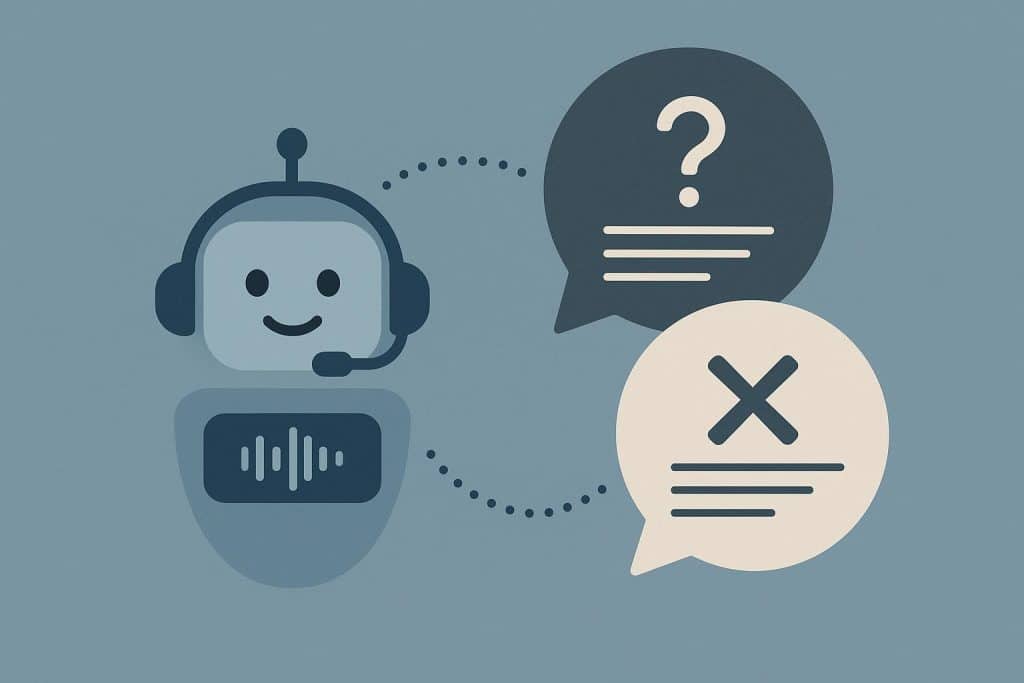
Automated support has grown well past scripted FAQs and hold-time reduction. Banks, insurers, SaaS companies, and online retailers now run millions of AI-handled calls every month. Yet most of that volume is still routine: balance checks, order tracking, appointment confirmations. The real test arrives when a customer calls angry, confused, or ready to cancel. These conversations carry emotion, history, and revenue risk, and they expose every weakness in a system trained primarily on cooperative interactions. An ai voice agent designed for these moments treats objections and tension as native cases rather than exceptions. This piece walks through what happens when the caller stops being polite, and why the design choices around those moments matter more than any metric on routine calls.
Routine Volume Was Never the Hard Problem
Password resets, shipping updates, and plan inquiries. A decade-old phone tree could limp through those. The calls that determine retention look different. A billing dispute on an account has already been mishandled twice. A cancellation from someone who waited forty minutes last time. A confused policyholder who cannot parse a coverage change mid-claim.
These interactions carry real stakes. Industry data consistently shows that roughly 75 percent of customers still prefer a human agent when the issue is complex or emotionally loaded. An ai voice agent that bulldozes past that preference does not save the call. It accelerates the churn.
Reading Frustration Before the Caller Spells It Out
Experienced support agents pick up signals before a caller explicitly states frustration. A shift in pace, a clipped phrase, an interruption that carries impatience rather than rudeness. A capable ai voice agent runs a structurally similar process by monitoring vocal cues in real time: volume changes, sentence fragments, rising pitch, and extended silences. When those signals cross a threshold, the system adjusts its own delivery. Shorter responses. Slower cadence. An explicit acknowledgment before any solution attempt.
The pattern that works is older than any software. Acknowledge first, solve second. Before quoting policy, a well-tuned agent reflects back what it heard. “The charge appeared twice, and a correction is needed today.” That single move changes the trajectory of the call because the caller registers that the system understood the problem before jumping to a workflow.
Patience plays an underrated role. Software carries no mood from the previous interaction. It does not rush through a vent or let the last call bleed into the current one. That steadiness used to require the most experienced person on the floor.
Mapping Objections to Underlying Needs
Most customer objections are not really about what they say on the surface. “This is too expensive” typically means the value case has not landed. “Let me speak to a real person” often signals that confidence in automation has collapsed for that specific issue.
A strong ai voice agent maps objections to root causes rather than scripted rebuttals.
| Common Objection | What Usually Sits Underneath | Effective Agent Response |
|---|---|---|
| “This costs too much” | Unclear value, or eroded trust | Reframes around the problem solved, surfaces a relevant option, never argues price |
| “I already called about this” | Effort fatigue, feeling invisible | Pulls full history instantly so nothing gets repeated |
| “I don’t believe this will work” | A prior bad experience talking | Sets one concrete, verifiable next step |
| “I want a real person” | Need for control, or the issue outgrew the script | Routes immediately with full context attached |
The last row is the one most deployments handle poorly. They treat the request for a human as an objection to overcome. It is not. It is a signal to respect. Looping a caller back into a menu after that request virtually guarantees a negative review by the end of the day.
The Handoff Is Where Trust Lives or Dies
Knowing when to step aside may be the single most important capability an ai voice agent can have. Grief, legal exposure, a high-value account on the edge of cancellation. These belong to a person, and they need one fast.
Speed alone is not enough. “Can you explain the issue again?” after a five-minute automated conversation is the fastest way to lose a customer permanently. The systems that get this right pass every piece of context forward. The human agent picks up knowing the account, the problem, and the emotional temperature. No repetition.
McKinsey found that support teams using generative AI assistance resolved 14 percent more issues per hour. Salesforce reported that AI managed approximately 30 percent of service cases in 2025, with projections toward 50 percent by 2027. The volume story is settled. What matters now is ensuring the judgment calls reach a person faster and better briefed.
What Separates Tolerated Agents From Resented Ones
After dozens of deployments across financial services, ecommerce, and SaaS, a consistent pattern emerges. The ai voice agent systems that customers do not resent share several design habits:
- They disclose what they are. Pretending to be human backfires the instant someone notices.
- They make reaching a person effortless. No layered menus, no “let me try to help first” after a clear escalation request.
- They speak in the brand’s actual voice rather than a generic support dialect.
- They stay inside their boundaries. No hallucinated answers, no over-promising to close a ticket.
A well-designed ai voice agent earns its position not by mimicking a person but by handling volume gracefully and knowing where its competence ends. The companies seeing results measure accordingly. Not deflection rate, but resolution rate, customer effort score, and whether a tense call ended better than it started.
Conclusion
An AI voice agent does not win difficult conversations by overpowering the objection. It wins by reading the moment, lowering the temperature, resolving what it can, and handing off cleanly what it cannot. The systems that frustrate callers treat every interaction as a script to finish. The ones that work treat the hard call as the entire point, because that is the conversation a customer remembers the next time a renewal or repurchase decision comes around.