

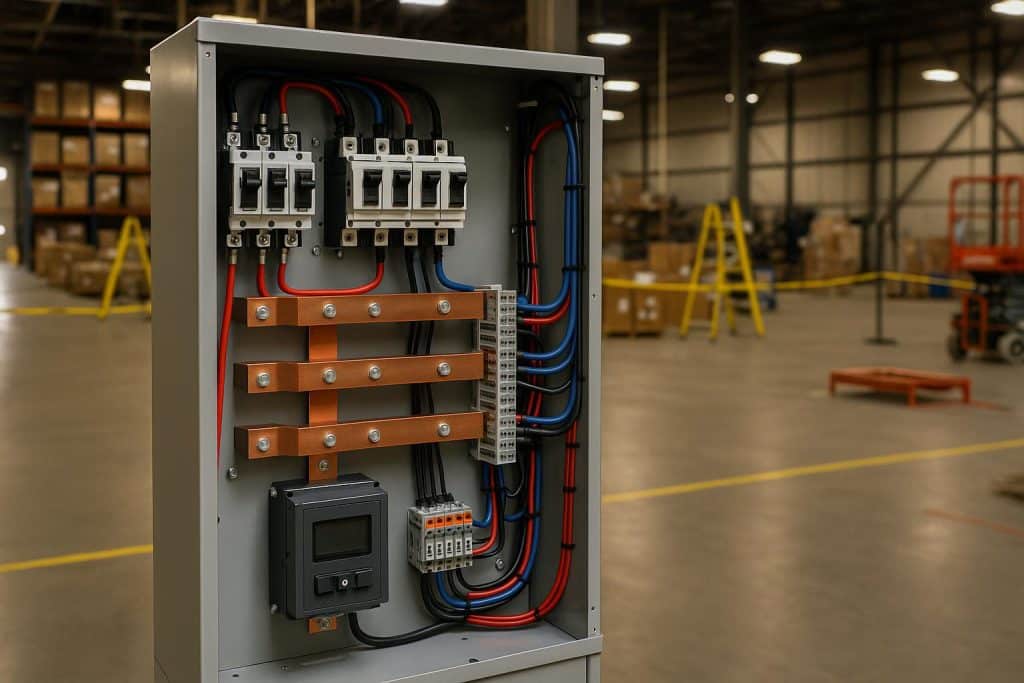
The shape of industrial electrical procurement has changed faster than most project schedules can absorb. Equipment lead times that once measured in weeks now measure in quarters, and in some categories, in years. Against that backdrop, the emergency switchboard build has shifted from a last-resort favour to a routine line item on the modern construction critical path.
Contractors, facilities teams, and data center owners are no longer treating rush fabrication as a premium upgrade. They are treating it as a hedge against a supply chain that no longer cooperates with the project schedule. The result is a quiet but significant restructuring of how the low-voltage and medium-voltage power distribution market actually clears.
The Lead-Time Crisis Reshaping Electrical Procurement
The numbers from across the supply chain explain why rush builds have moved from edge case to operating norm.
Barton Associates reports low-voltage draw-out switchgear lead times of 70 to 80 weeks, automatic transfer switches at 45 to 80 weeks, and pad-mount service transformers at 110 to 130 weeks. Generators above 100 kW currently sit at 36 to 48 weeks. CMIC Global puts the broader electrical scope for data center construction, including switchgear, transformers, generators, and cooling, at 12 to 18 months.
Those numbers are not a snapshot of a temporary disruption. They have stabilised at elevated levels through 2024 and 2026, driven by shared upstream component constraints across semiconductors, magnetics, capacitors, and core power-system parts. When one input slips, the entire assembly slips with it.
The practical consequence is that traditional OEM channels can no longer guarantee on-schedule delivery for any project where the energization date is fixed. A panelboard that needed to be on site in March 2026 had to be ordered in 2024. Most projects do not enjoy that kind of foresight, and the gap between order date and need date is what the emergency switchboard build market now fills.
Why Speed Has Become the Primary Specification
In any electrical specification document, voltage, amperage, configuration, and code compliance dominate the page. Lead time, when it appears at all, used to sit in the procurement appendix. That ordering has reversed for any project where energization is gating commissioning.
CMIC Global estimates a typical 60 MW data center can incur about $14.2 million per month in lost revenue and related impacts when commissioning is delayed. At that scale, even a modest fabrication premium becomes economically rational against the alternative of waiting. The arithmetic is simple, and it favours speed almost without exception.
For industrial manufacturers, mission-critical healthcare facilities, and large commercial operators, the calculus follows the same shape. Process plant downtime, surgical suite unavailability, and tenant occupancy delays carry their own per-day costs that often exceed the entire fabrication budget of the switchboard in question. The cheapest electrical assembly is the one that arrives in time to keep the schedule intact.
What Goes Into a Custom Switchboard Built in Days, Not Quarters
Compressing a 20-week OEM build into a 24 to 48 hour fabrication window is not a matter of working faster. It requires a structurally different operating model.
Design and Engineering Compression
Conventional switchboard design moves through multiple sequential approval cycles between the engineer of record, the OEM design team, and the contractor. Emergency builders compress this loop by working from the single-line diagram directly into shop drawings, with engineering approvals running parallel to fabrication rather than ahead of it. UL-891 compliance for low-voltage switchboards remains non-negotiable, but the path to that compliance bends to the schedule rather than the other way around.
Component Sourcing and Allocation
The single greatest constraint on speed is component availability. Builders running an emergency programme maintain stocking depth on the components most likely to gate a build: molded case, insulated case, air, and vacuum circuit breakers across the most common amp ratings, busbar in standard cross-sections, feeder sections, ground bars, and metering hardware. Holding inventory across multiple manufacturer brands, including Square D, Siemens, Eaton, GE, and ABB, is what allows a build to start on the day of order rather than the day the breakers arrive from allocation.
Fabrication, UL-891 Compliance, and Testing
The physical build of a low-voltage switchboard rated between 1600 and 4000 amps is mechanically straightforward when the components are on the floor. Enclosures get punched, busbar gets cut and torqued to specification, breakers get installed and labelled, and the assembly moves to factory acceptance testing. The compression comes from running these stations in parallel and from having the testing equipment and qualified personnel available the same day the unit clears assembly. UL-891 panel shop authorisation is what makes that compression compatible with code.
Where Emergency Switchboard Builds Show Up Most Often
Data Centers Racing for Speed-to-Power
The data center sector has emerged as the dominant demand driver for rush electrical fabrication. EnkiAI frames 2026 as a year where power availability, not IT hardware, is the main constraint on data center delivery, with interconnection queues delaying projects for years in some markets. When the utility connection finally clears, the project cannot afford to be waiting on internal distribution equipment. Modularised electrical assemblies, which CMIC notes can compress schedules by 30 to 50 percent, increasingly arrive in the form of pre-built emergency switchboards rather than OEM standard product.
Healthcare and Mission-Critical Facilities
Hospitals, dialysis centers, and biopharmaceutical facilities live under continuity obligations that do not bend to OEM calendars. When an existing switchboard fails or an expansion is energised, the replacement timeline is set by the operational reality, not the procurement market. Emergency builders fill this gap with custom panels designed around the existing enclosure footprint and the facility’s specific automatic transfer switch and standby generator arrangement.
Industrial Manufacturing and Process Plants
For manufacturers running continuous processes, a switchboard failure is a production failure. Replacement assemblies built to the exact configuration of the failed unit, including amp rating, voltage, and breaker schedule, allow a plant to return to service without redesigning the upstream or downstream distribution. The same logic applies to large commercial operators where retrofitting an existing service entrance is faster than rebuilding it.
The Manufacturers Behind the Components
The brand landscape of the components going into an emergency build still tracks the conventional electrical market closely. Square D QED-2 and similar Schneider Electric platforms remain the dominant choice for low-voltage switchboards in the United States, with Siemens, Eaton, GE, and ABB occupying the rest of the specification preferences depending on facility standard and engineer familiarity. The brand of breaker, busbar, and metering hardware in an emergency build is almost always identical to what would have shipped from the OEM channel. The compression comes from the fabrication and engineering side, not from substituting components.
That continuity matters for maintenance, parts replacement, and code compliance. A facility that has standardised on Eaton across its existing service does not need to make a brand exception to obtain an emergency build. Builders running multi-brand stocking programmes are able to match the existing standard while still delivering inside a 24 to 48 hour window. Verified Breakers, for example, operates a multi-location stocking model across Colorado, Texas, and California that supports nationwide emergency switchboard builds on Square D, Siemens, Eaton, GE, and ABB platforms with rush fabrication on amp ratings from 600 to 3000 amps.
The New Economics: Why Rush Fabrication Often Costs Less Than Waiting
The fabrication premium on an emergency build is real and visible. It shows up on the invoice as a line item, and procurement teams notice it. What does not show up on the invoice is the delta between the project energising in week 4 versus week 80. That delta is where the actual economics of the decision sit.
For a 60 MW data center, the CMIC figure of $14.2 million per month in delayed commissioning impact dwarfs any plausible fabrication premium. For a 200,000 square foot industrial plant, the per-day cost of an unenergised production line will, in most cases, exceed the entire switchboard budget within a week. The conversation is no longer about whether emergency fabrication is worth paying for. It is about whether the project can survive the alternative.
That reframing is changing how procurement teams write specifications. Lead time is moving from the appendix to the primary requirements section. Engineering specifications now include explicit fabrication windows. Manufacturers and builders who can meet those windows are winning the work, and the ones who cannot are losing it to faster competitors regardless of catalogue depth.
Local Fabrication as Supply-Chain Resilience
The broader strategic shift behind the emergency switchboard build market is that domestic and regional fabrication has become a resilience play, not a cost play. When upstream electrical supply chains behave like constrained industrial pipelines, the value of having a builder within driving distance who can fabricate, modify, test, and ship in days rises sharply. That value is independent of unit price.
For contractors planning into 2027 and beyond, the procurement question is no longer just which manufacturer to specify. It is increasingly which fabrication relationship will be available when the project hits the inevitable schedule compression event. The builders who have invested in multi-brand inventory, UL-891 panel shop authorisation, and in-house engineering capacity are the ones converting that question into orders.
The 20-week lead time is not going to disappear in 2026 or 2027. What is changing is how the industry routes around it. Emergency switchboard fabrication has become the standard workaround, and the projects that treat it as a routine procurement option rather than a panic measure are the ones that hit their energization dates intact.