

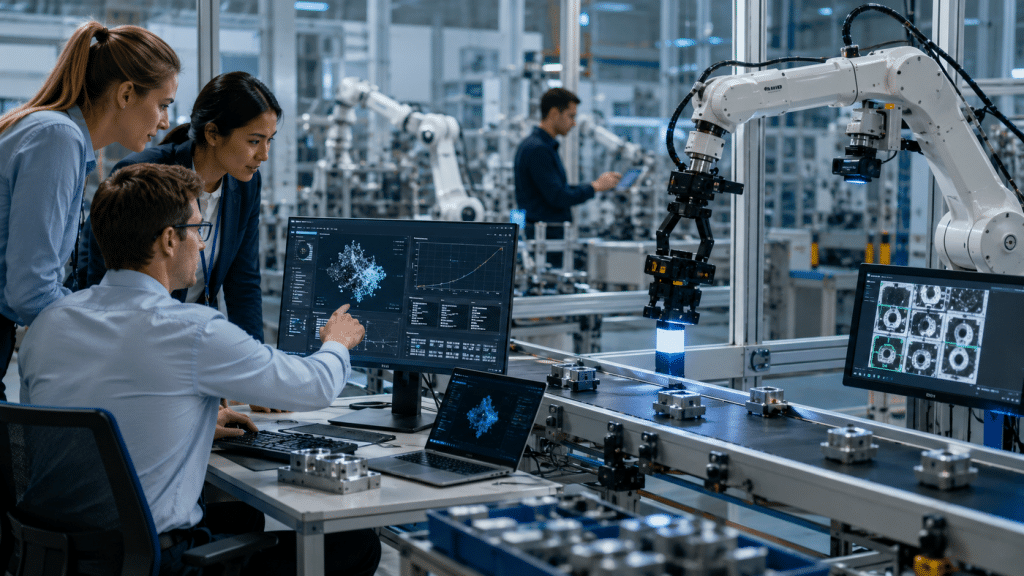
A factory floor does not look like the usual stage for AI. You think of machines, timing, parts moving from one point to another, and someone checking whether the process actually worked. But honestly, that is exactly why industrial AI competitions are starting to feel more useful than another polished demo video.
Factory problems are better than abstract prompts
For a long time, AI contests mostly felt like algorithm battles. Clean datasets. Clean rankings. Clean presentations. Useful, sure, but not always close to the messy situations where industrial tools have to survive.
The inaugural Shenzhi Cup Artificial Intelligence Innovation Competition, guided by the Organizing Committee Office of the World Artificial Intelligence Conference and co-hosted by Shanghai State-owned Capital Investment Co., Ltd. and the China Academy of Information and Communications Technology, is interesting because it moves the challenge closer to production reality.
The preliminary round drew 1,451 teams from more than 30 countries and regions, with 40 teams advancing to the final round in Shanghai from July 14 to 18, 2026.
Real data changes the tone
A model can look impressive in a test environment and still struggle when a robotic arm misses timing by half a second.
That gap matters. Factory problems involve vibration, delays, uneven materials, energy limits, and systems that cannot simply “try again later.” To be fair, competitions cannot fully copy a real plant, but they can make teams deal with more than slide-deck thinking.
The best ideas need a place to break
Industrial AI improves when it is forced to fail early. Dynamic sorting, material handling, component assembly, chip testing, and system verification are not glamorous phrases. Weirdly enough, that makes them more convincing.
A warehouse task tells you something a benchmark score cannot.
Why global teams make the contest more useful
International participation is not just a nice line in an event announcement. It changes the mix of ideas.
The Shenzhi Cup brings together teams from leading technology companies, universities, research institutes, startups, and independent developers. According to the competition’s preliminary data, overseas teams have shown strengths in algorithm originality and interdisciplinary innovation, while domestic teams have stood out in scenario understanding and engineering implementation.
Put those together and you get something more practical than either side working alone. Some projects have already entered joint verification with leading manufacturing enterprises, which is where an AI competition starts to become more than a contest.
Research meets the production line
The useful part is not just who wins. It is what happens when a project moves from lab logic into factory pressure.
At some point, AI has to answer boring questions. Can it run steadily? Can it save energy? Can workers understand it? Can a company test it without rebuilding the whole process?
Those questions are not exactly exciting, but they decide whether a system gets used.
Competitions are becoming filters
A good industrial AI competition now works like a filter. It separates ideas that only sound strong from ideas that can handle real checks.
That is where capital support, testing platforms, and industry partners matter. The Shenzhi Cup has a total prize pool of RMB 4 million, but the more important part may be what sits around the prize: investment and financing matchmaking, access to application scenarios, and technology-chain support.
Shanghai State-owned Capital Investment brings industrial capital and implementation resources, while CAICT adds technical evaluation, testing, and industry credibility. That combination makes the competition less about applause and more about whether a promising system can move closer to deployment.
The factory challenge is becoming the AI challenge
The most interesting shift is that industrial contests no longer treat factories as background. The factory itself becomes the challenge.
The Shenzhi Cup’s four tracks reflect that shift. AI computing power and architecture looks at system stability and energy efficiency through third-party testing. Embodied intelligence and robotics focuses on real-machine tasks such as dynamic sorting, material handling, and component assembly. AI4S scientific intelligence applications require on-site system verification. AI terminal and human-computer interaction uses a 48-hour development format built around real-scenario prototypes.
AI computing power, robotics, scientific applications, and human-computer interaction all sit inside the same industrial chain. That feels more grounded than treating each field as a separate trend.
Less theatre, more verification
A 48-hour prototype test says something different from a keynote.
So does a real-machine robotics task. So does third-party chip evaluation. The connection with WAIC also matters here, because the final results of the Shenzhi Cup will be showcased during the 2026 World Artificial Intelligence Conference, giving stronger projects a public stage while still tying them back to practical evaluation.
Why this matters for industrial AI
Factory AI will probably not advance through one dramatic breakthrough. It will move through repeated testing, smaller fixes, and better links between teams that build models and companies that know the problems.
And maybe that is the point. The future of industrial AI may look less like a big reveal and more like a machine finally doing the same task correctly, again and again, under pressure.
That does not sound flashy.
But it sounds real.