

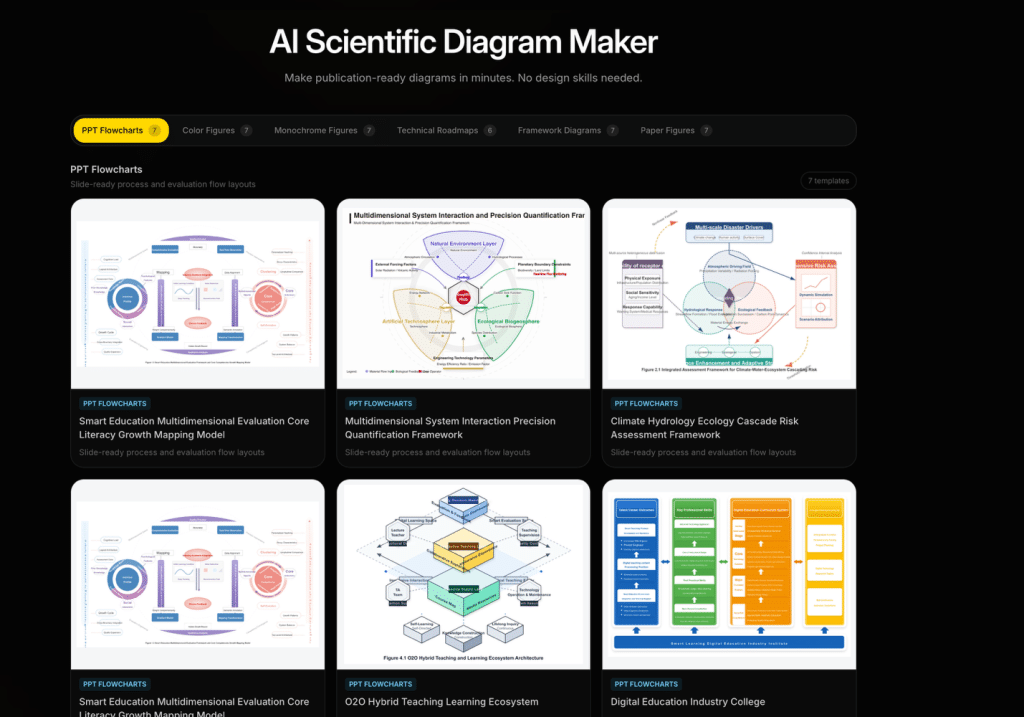
Creating scientific figures has always been one of the most time-consuming parts of academic work.
A researcher can finish an experiment, organize the data, and draft the paper, yet still spend hours trying to turn the main idea into a clear visual. A student may understand a method perfectly, but still struggle to explain it with boxes, arrows, labels, and layout. A professor may need clean diagrams for teaching, grant proposals, conference slides, or research posters, but may not have the time to design every figure from scratch.
That is why AI-assisted academic visualization is becoming an important part of the research productivity conversation.
In this hands-on style review, we look at how tools like Paper Banana fit into the growing need for faster, clearer, and more editable scientific figure creation.
First Impressions: Built Around Academic Visuals
Many AI image tools are designed for general creativity. They can generate portraits, product shots, social media graphics, fantasy art, and marketing visuals. These tools can be powerful, but scientific figure creation has a different set of requirements.
A scientific figure needs to communicate structure.
It must explain a method, show a workflow, represent a mechanism, summarize a pipeline, or make a complex idea easier to understand. The visual should be accurate, readable, and useful in a real academic context.
This is where paper banana takes a more focused approach. Instead of treating academic visuals as just another image generation task, it is positioned around research communication and scientific figure drafting.
The main value is simple: help users move from dense academic content to an initial visual structure faster.
The Problem: Researchers Start With Text, Not Design
Most research ideas begin as text.
A methods section describes steps. A biological mechanism explains relationships. A machine learning project includes data collection, preprocessing, training, validation, and interpretation. A research proposal may contain a clear logic, but that logic is buried across paragraphs.
The challenge comes when that text needs to become a visual.
Traditional tools usually start with a blank canvas. PowerPoint, Illustrator, Figma, Canva, and diagramming tools give users flexibility, but they still require manual work. The researcher has to decide the visual structure, create elements, write labels, align objects, and revise everything after feedback.
For people with design experience, this can be manageable. For many students and researchers, it creates friction.
The first draft is often the hardest part.
Once a draft exists, users can review it. They can move sections, shorten labels, adjust the flow, and improve the layout. But getting from academic text to a usable first version can take a long time.
How AI Can Reduce the Blank Canvas Problem
AI can help by turning the first stage of figure creation into a more structured workflow.
Instead of manually designing from zero, users can begin with research text, notes, or a short description. The AI can help identify key components and suggest a visual structure.
This does not mean the AI should make the final decision. Scientific figures still require human review. A figure that looks polished but misrepresents a method or concept can create confusion. In academic work, accuracy is just as important as readability.
A useful AI workflow looks more like this:
- Start with academic text or research notes.
- Generate an initial visual draft.
- Review the structure.
- Correct labels, steps, and relationships.
- Refine the figure for a paper, poster, or presentation.
This workflow keeps the researcher in control while reducing the time spent on manual layout.
Why Scientific Figures Are Different From General AI Images
General image generation is often judged by visual quality. Does the image look realistic? Is the style attractive? Does it match the prompt?
Scientific figures need a stricter standard.
They need to explain something clearly.
A workflow diagram needs the right sequence. A mechanism figure needs correct relationships. A data science pipeline needs accurate stages. A teaching diagram needs to simplify the idea without distorting it.
This makes academic visualization a practical use case for AI, but also a challenging one.
The most useful output is not always the prettiest image. It is the draft that helps the user understand what to revise next.
That is why tools focused on scientific figure generation need to support editing, review, and iteration. Academic visuals rarely stay unchanged after the first version.
Editable Drafts Matter
A figure may need to change many times.
A supervisor may ask for a label change. A collaborator may suggest a new section. A journal may require a specific format. A conference poster may need larger text. A slide deck may need a simplified version of the same visual.
This is why editable drafts are important.
A static image can be useful as a preview, but real academic work often needs revision. Researchers need to adjust labels, move elements, simplify the layout, and reuse the same concept across different formats.
AI can be most helpful when it creates a starting point that users can refine, rather than locking them into a final output.

Who Can Use This Kind of Tool?
AI-assisted scientific figure tools can support different types of users.
Graduate students can use them to prepare thesis figures, lab reports, research posters, or presentation visuals.
Researchers can use them to turn methods, mechanisms, workflows, and conceptual ideas into clearer visual drafts.
Educators can use them to create classroom diagrams and online learning materials.
Data scientists and technical teams can use them to explain pipelines, models, and systems.
Life science teams can use them to communicate experimental workflows, biological mechanisms, and research processes.
The shared need is clarity.
Complex information becomes easier to understand when it is organized visually.
A Better Workflow for Research Communication
Academic communication is changing.
Research is no longer shared only through journal papers. It appears in preprints, conference posters, slide decks, lab websites, online courses, social media posts, grant decks, and technical explainers.
This creates more pressure on researchers to communicate visually.
A strong figure can help a reviewer understand a method faster. It can help a student understand an abstract idea. It can help a collaborator identify missing steps. It can help a broader audience understand why a research topic matters.
Better scientific figures can make research easier to read, present, and share.
Final Verdict
Paper Banana represents a practical direction for AI in academic productivity.
Its value is not simply that it generates images. The stronger value is that it helps users move faster from research text to visual structure. That first draft can save time, reduce blank-canvas friction, and give researchers something concrete to review and improve.
AI will not replace scientific judgment. Researchers still need to check accuracy, correct labels, and make sure the final figure represents the real idea.
But for students, educators, and researchers who spend too much time turning complex ideas into clear visuals, AI-assisted figure drafting can be a meaningful improvement.
Scientific communication is becoming more visual. Tools that help researchers explain complex work clearly will become increasingly important.