

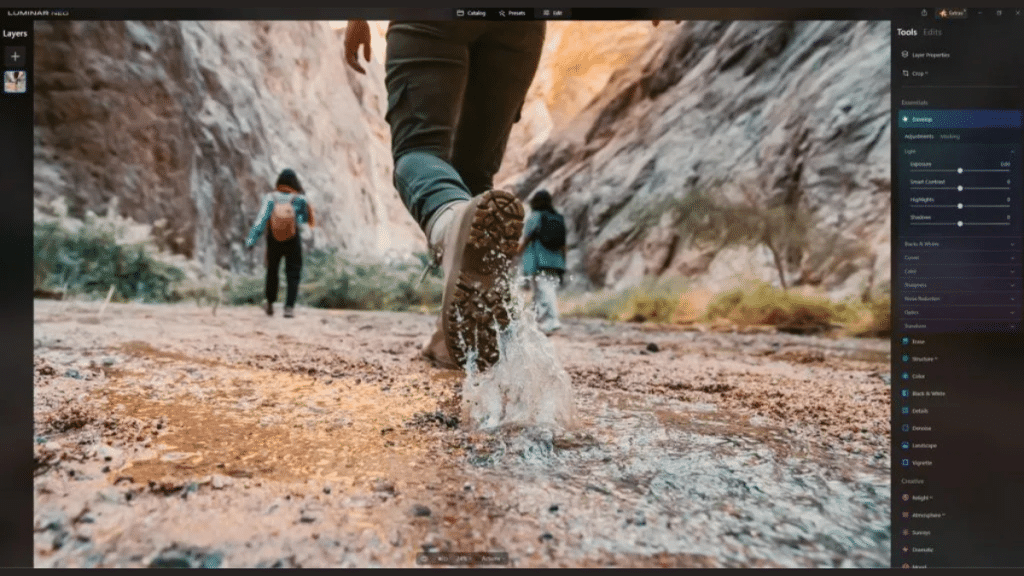
Looking for the best photo editing tool? Check out our comparison of Affinity vs Luminar Neo to see which one offers the best features and value.
When choosing the best photo editor, photographers and designers commonly compare Affinity Photo and Luminar Neo. Both these options are relatively budget-friendly and provide rich toolkits. However, they cater to different proficiency levels and creative needs.
Affinity Photo is Photoshop-like software. It includes high-end manual adjustment tools for professional-grade modifications. Meanwhile, Luminar Neo is a beginner-friendly AI photo editor. It aims to optimize and streamline your post-processing workflow.
This guide explains the main differences between the two software options. It helps photographers to make an informed decision to achieve flawless imagery.
Core Purpose & Target Audience
Affinity Photo was designed with professional photographers, designers, and retouchers in mind. The developers relied on Adobe Photoshop as the industry standard. Their main goal was to create a lower-price alternative without compromising the toolkit. The advanced layer system and detailed adjustments make this image editor perfect for sophisticated manual fine-tuning.
Luminar Neo, in turn, leverages artificial intelligence to simplify complex tasks. You can retouch skin, replace skies, or fix closed eyes in a photo without spending much time and effort. Automatization tools let photographers achieve visual perfection with just a few clicks. This approach does not overload newbies, and leaves experienced users more room for creative aspects of their work.
User Interface & Ease of Use
Affinity Photo has a Photoshop-like selection of tools. Its interface emulates the numerous panels and palettes available in more robust programs. Novices may find the cornucopia of brushes, masks, customizable layers, and parametric adjustment options daunting at first blush. Its feature-rich toolkit facilitates high-level image manipulation to suit an extensive gamut of photographic bents and visual genres. Users who are unaccustomed to applications like Adobe’s standard-bearer may initially feel lost.
On the other hand, Luminar Neo is a picture editing software that prioritizes user-friendliness and easy navigation. The layout is designed around automatic enhancement tools. Intuitive sliders and one-click adjustments let photographers achieve visual perfection regardless of their post-processing expertise.
Editing Features & Tools
Affinity Photo’s toolset ensures ultimate precision and creative control. Its layer-based editing system allows users to create detailed compositions. It includes non-destructive editing. You can edit photos multiple times. There is no risk of permanently altering the original file. This approach ensures your enhancements are reversible. It elevates confidence and allows endless creative experiments.
Luminar Neo offers a range of specialized tools. They were designed to simplify and enhance photo editing. These tools require minimal effort. Sky Replacement AI instantly swaps dull skies for vibrant, realistic ones. Relight AI addresses illumination imperfections without compromising the image’s overall appeal. Erase AI removes unwanted objects such as power lines or dust spots. Portrait Bokeh AI makes your portrait deep and dramatic with a background blur.
And it’s all backed up by AI Masking, which automatically detects and isolates subjects like people, animals, or buildings. Artificial intelligence modifies these elements selectively. The rest of the picture is unaffected.
Performance & System Requirements
Affinity Photo is optimized for detailed edits and runs efficiently on high-end PCs. Most features are manually applied, so the more complex the edits, the slower the performance.
Comparing Affinity Photo vs Luminar Neo, we see the latter relies on AI-based processing. This approach is usually more resource-intensive. A strong GPU is recommended for smooth performance.
Both programs are compatible with Mac and Windows (version 10 or later) and require multi-core processors and at least 8GB RAM.
Compatibility & Workflow
Affinity Photo supports various file formats, including RAW, TIFF, and JPEG. This versatility ensures smooth processing even for the highest resolutions. This independent software allows users to manage their creative process without relying on additional tools.
Luminar Neo, on the other hand, offers both standalone functionality and seamless integration into existing editing workflows. It supports RAW processing and non-destructive editing. This program also includes specific features to enhance your workflow efficiency. Batch processing and customizable presets are its main advantages.
Luminar Neo functions as a plugin for Photoshop and Lightroom. It can complement other editing software by adding advanced automation tools. Its workflow is designed for both quick adjustments and in-depth refinements.
Pricing & Licensing Model
Affinity Photo may be the better choice if you prefer a photo editor without ongoing costs. The software’s one-time purchase of $54.99 (~€53.20) makes it convenient for users seeking long-term post-processing solutions.
In contrast, Luminar Neo has a subscription model ($69 per year) (€66.79). It is preferable for users who want continuous updates and AI-driven enhancements. The lifetime purchase is available for $119 (€115.19), but additional fees may be required for updates or extra AI features for specific editing needs.
Who Should Use Which?
Choose Affinity Photo if…
- You need precise, layer-based manual control.
- You prefer a Photoshop-style workflow.
- You want a powerful image editor without a subscription.
Choose Luminar Neo if…
- You want quick, AI-assisted edits.
- You need AI photo editing with smart automation.
- You prefer easy-to-use tools for enhancing photos fast.
Ultimately, the best choice depends on your editing style and whether you prioritize AI automation or hands-on precision.