

Since the public debut of Generative AI in November 2022, this technology has rapidly permeated nearly every aspect of modern life.
So, why would the U.S. immigration process—especially the EB1A Extraordinary Ability petition—remain untouched by it? The answer: it hasn’t.
In U.S. immigration circles, the EB1A green card is often regarded as the “gold standard” for professionals with exceptional talent. Before the AI era, obtaining approval was a labor-intensive endeavor: applicants spent months tracking citations, drafting dense technical narratives, and attempting to prove their ‘major significance’ to USCIS officers who might not be experts in their field.
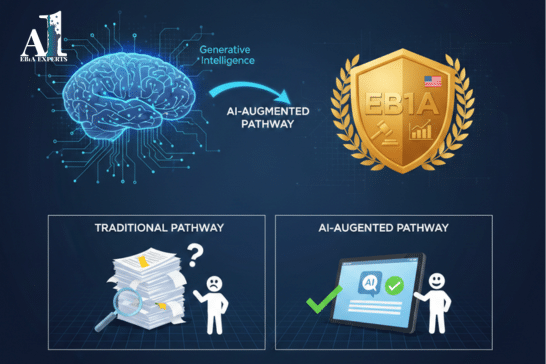
As 2025 draws to a close, a new approach has emerged: the AI-enhanced EB1A process. Generative AI has evolved beyond hype—it is now a practical tool that helps top-tier professionals, from biotech engineers to AI researchers, streamline preparation, reduce timelines, and improve approval outcomes.
How AI Supports EB1A Evidence Gathering
A major challenge for EB1A applicants is Evidence Mapping. Strengthening a petition requires carefully organizing materials to satisfy at least three of USCIS’s ten criteria. Traditionally, this has been a painstaking, time-consuming process.
When integrated strategically, Generative AI transforms this task from overwhelming to manageable. Here’s how it is applied in the EB1A journey:
1. Citation Analysis:
AI can scan global databases to identify citations where other researchers explicitly recognize your work as groundbreaking—rather than merely referenced as background. This data-driven approach replaces tedious manual review.
2. Gap Detection and Feedback:
Generative models can compare your profile to thousands of successful petitions, highlighting areas where criteria such as “Judging” or “Original Contribution” may be weak. This enables applicants to address gaps before submission.
3. Automated Exhibit Organization:
AI can categorize and cross-reference hundreds of pages of evidence—including awards, publications, and press mentions—ensuring a well-structured submission that aligns with legal requirements.
Translating Complex Work for USCIS Officers
A common cause of Requests for Evidence (RFEs) is that adjudicators often struggle to understand highly technical work. Many petitions are overloaded with jargon, which can obscure the true significance of an applicant’s contributions.
Generative AI acts as a “narrative bridge,” translating technical concepts into clear, persuasive language for non-experts. For example, a complex idea like “multi-modal neural architecture” can be reframed to demonstrate national importance in an accessible manner.