

Experimenting with AI has been a key process for companies over the past two years to understand the potential of this technology and how it can be applied to their businesses. But in 2026, the fundamental question will be moving from experimentation to execution, scaling, and real business impact.
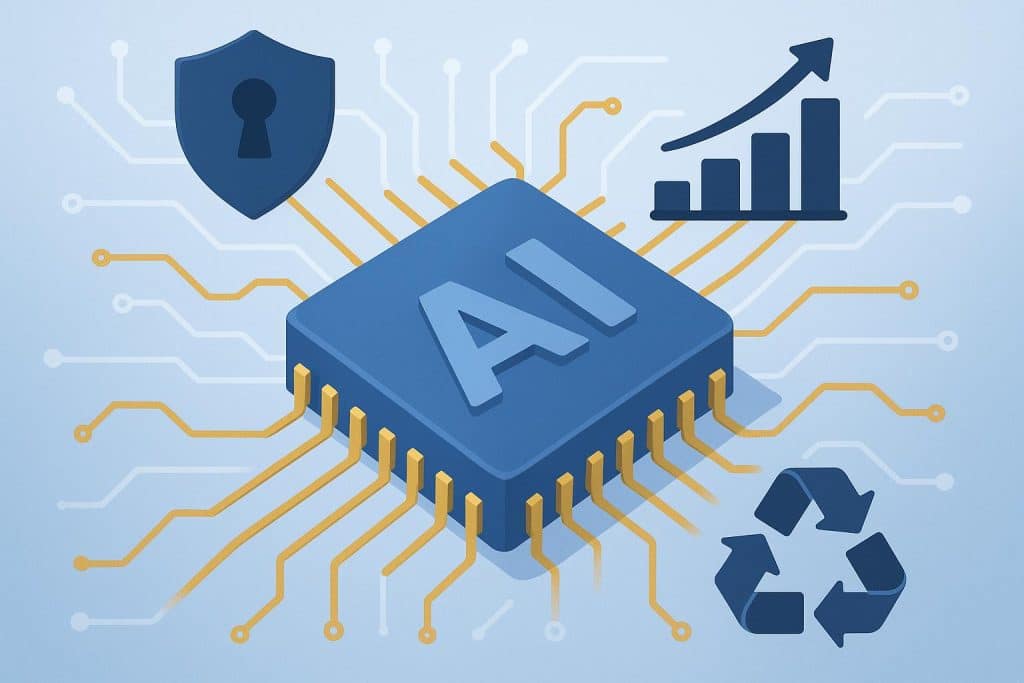
Organizations will no longer be asking whether to adopt AI, but rather how to do so securely, sustainably, and competitively.
That’s why we decided to create this blog, to share the main AI trends for 2026, supported by research from Microsoft, Google Cloud, IMD, Forbes, IDC, and Gartner, so your organization can start preparing for what’s to come.
AI Trends in 2026
AI Agents will continue to proliferate in companies
In 2026, AI agents will move beyond simple assistants and become active team members, capable of reasoning, executing complex tasks, and autonomously supporting decision-making, according to a Microsoft article on the topic.
AI agents will increasingly be seen as digital coworkers, making trust and security critical elements for companies to reinforce. It will be essential for each agent to have a clear identity, defined permissions, and data access control, similar to that of a human employee.
Companies will invest much more in AI training for their teams
It’s not just about implementing AI solutions; it’s also about ensuring teams are prepared and know how to get the most out of the tools.
That’s why Google Cloud predicts that 2026 will be the year companies invest not only in traditional training but also in continuous learning plans, so employees can keep pace with technology.
AI will no longer be exclusive to technical teams and will become a cross-functional skill, impacting areas such as marketing, operations, finance, human resources, and leadership.
Between 40% and 60% of operational work will be performed by AI in key areas
Another striking aspect of what’s coming in 2026 is the emergence of AI-native departments, where 40% to 60% of routine activities can be delegated to AI systems.
According to an article published by IMD, Human Resources, purchasing, and customer service operations will lead this evolution.
“In HR, the recruitment and onboarding process is already being automated from start to finish. Candidate selection, role assignment, interview scheduling, onboarding workflows, and training path design are all moving to agent-driven automation,” they commented in the publication.
GenAI copilots will be integrated into most enterprise applications
Generative AI is rapidly evolving from experimental pilots to large-scale operational adoption. By 2026, AI copilots will be deeply integrated into daily workflows.
These copilots are already:
- Generating code for software engineers
- Drafting contracts for legal teams
- Creating timelines and action plans for project managers
- Accelerating analysis and decision-making tasks
Physical AI: Artificial intelligence enters the physical world
Physical AI takes artificial intelligence beyond software, integrating it into robots, drones, autonomous vehicles, and smart devices that can perceive, decide, and act in the real world.
These systems combine sensors, actuators, and AI models to automate physical tasks in sectors such as logistics, manufacturing, and retail. Gartner estimates that by 2028, 80% of warehouses will use robotics or some level of advanced automation.
This trend will have a direct impact on operational efficiency, error reduction, workplace safety, and the scalability of physical operations.
AI-Native development platforms will change software engineering
AI-native development platforms are redefining how software is built. These platforms use generative AI to create applications faster and more affordably, from one-shot tools to approaches known as vibe coding, where deep technical knowledge is not required.
By 2030, 80% of organizations will downsize large engineering teams and transform them into smaller, AI-augmented teams.
Conclusion: 2026 will mark the difference between adopting AI and being an AI-Driven enterprise
AI trends toward 2026 make it clear that the focus is no longer on the technology itself, but on how it is securely, ethically, and strategically integrated into the business. Intelligent agents, copilots, AI-native platforms, and autonomous physical systems will redefine productivity and competitiveness.
Organizations that invest today in security, talent, governance, and technology architecture will be better positioned to capitalize on this new era. Those that don’t, risk falling behind in a market where AI will be a fundamental part of how work is done, decisions are made, and value is created.