

Alp De Waal is a UK-based healthcare manager and researcher whose work focuses on improving services for individuals with neurodevelopmental conditions. Since joining Berkeley Psychiatrists in 2022, Alp De Waal has progressed from practice manager to Care Quality Commission registered manager, overseeing regulatory compliance, service quality, and patient-centred care. His responsibilities include coordinating operational management, supporting collaborative clinical teams, and maintaining communication with the Care Quality Commission to ensure safety and effectiveness standards are met. Alp also contributes to research related to autism and attention-deficit hyperactivity disorder, including data compilation for a published study examining ADHD treatment practices in a large London clinic. Drawing on both operational leadership and research experience, he offers insight into how individuals navigate public and private pathways for autism assessment and diagnosis within the UK healthcare system.
Public and Private Pathways to Autism Assessments and Diagnosis
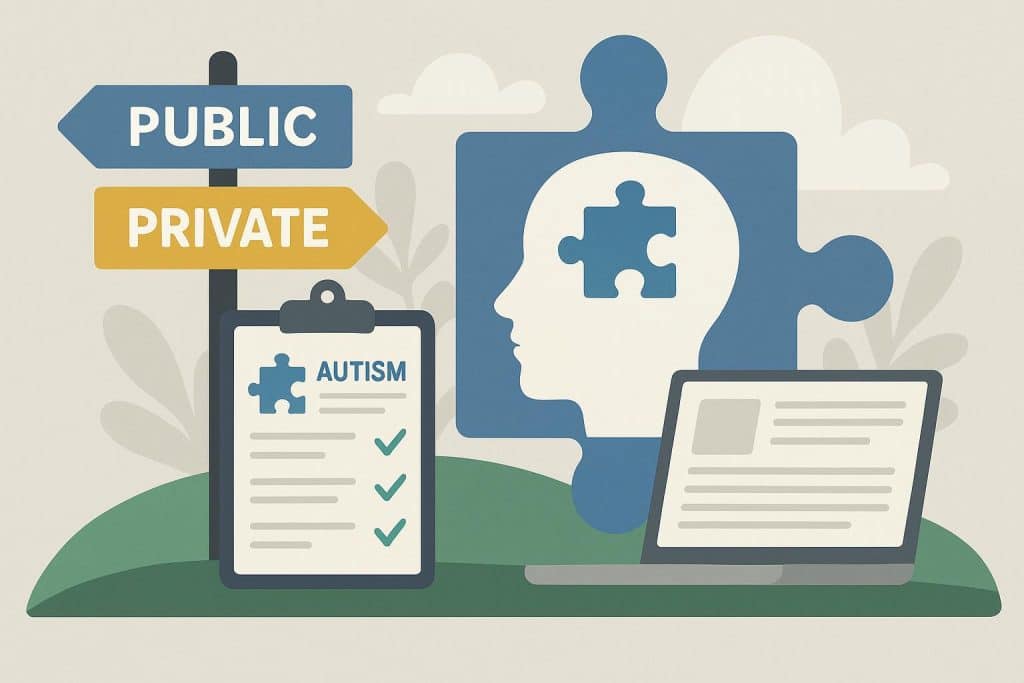
In the UK, residents have two routes for obtaining autism assessments. Individuals can access care through the private sector or the publicly funded National Health Service (NHS). Both options aim to characterize the patient’s presentation of a neurodevelopmental condition, often involving symptoms such as social communication difficulties, sensory and language challenges, restricted interests, and repetitive behaviors. After obtaining a diagnosis, individuals can explore the most effective therapeutic pathways and access appropriate support and services.
NICE (National Institute for Health and Care Excellence) standards inform the NHS pathway. They coordinate referrals through a general practitioner (GP), healthcare provider, or the Special Educational Needs Coordinator (SENCo) at school. Referrals pass through either adult neurodevelopmental services or Child and Adolescent Mental Health Services (CAMHS).
Whether private or public, the multidisciplinary diagnostic and assessment approach involves professionals such as psychologists, psychiatrists, and speech-language therapists. Initial assessments include interviews regarding developmental history and questionnaires completed by both the person with ASD and their caregivers. Clinicians often employ the Autism Diagnostic Interview-Revised (ADI-R) and Autism Diagnostic Observation Schedule (ADOS-2) as direct diagnostic resources.
The diagnosis provides a basis for work or school adjustments, self-support, and, in some cases, evidence used for the approval of financial support or social care. Medications or therapy interventions, if applicable, may follow. One major benefit of an autism diagnosis is the ability to obtain a legally admissible Education, Health and Care Plan, which defines the support patients receive.
Private and public autism assessments provide comparable quality and thoroughness, provided that one selects a trustworthy provider. In some cases, the NHS may refer patients to private providers and cover the cost of assessment and diagnosis. Just because an assessment is private doesn’t imply it’s unregulated, with the same NICE guidance followed by private practitioners. Holistic, flexible, and individualised assessments do come with a cost, often in the £1,000-£2,000 range.
Waiting times differ between the private and public systems. NHS assessments, while free, sometimes require two to five years to complete. Patients have less scheduling flexibility, and appointments may be shorter than those offered by private care providers due to high demand. Some sum up the difference as “time, access, and personalisation.”
A 2023 NHS report notes that an autism diagnosis requires expert clinical judgement based on a combination of observable behaviour and provided documentation of developmental history and behaviours. It reflects the fact that no diagnostic biomarkers for autism exist, and thus, biological tests or scans cannot objectively confirm or refute an autism diagnosis. In addition, medical experts do not universally agree on autistic traits, which often co-occur with other neurodevelopmental, communication, and mental health conditions (sole diagnosis is rarer than co-occurring diagnosis).
The diagnosis enables reasonable adjustments to the mental health or general physical health services one receives. For example, patients with anxiety or depression co-occurring with autism benefit from a unique treatment protocol. The same holds for those diagnosed with autism, alongside feeding and eating disorders. Therefore, patients must navigate the process as effectively as possible to receive appropriate care in a timely manner.
About Alp De Waal
Alp De Waal is the registered manager at Berkeley Psychiatrists in the United Kingdom, where he oversees service delivery, regulatory compliance, and operational management. After joining the organisation in 2022 as practice manager, he advanced to a Care Quality Commission registered manager role in 2025. He also contributed data to research on ADHD prescribing practices at a large London clinic. Alp holds a Master of Science degree from Queen Mary University of London and maintains professional interests in autism and ADHD research.