

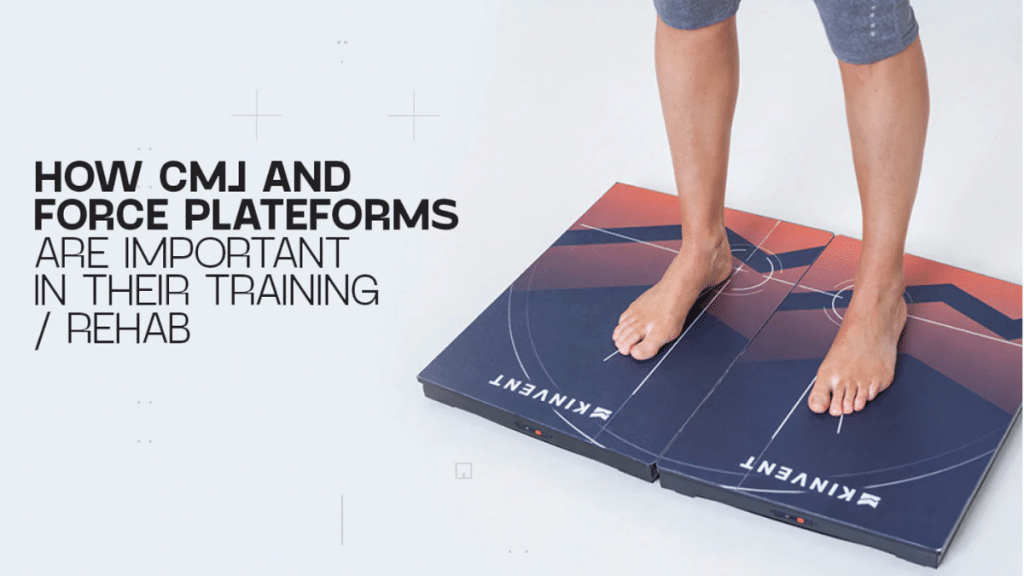
Countermovement jump (CMJ) tests have long been used by physical therapists and athletic coaches and trainers to measure patients’ and athletes’ vertical jump height. While the test can be performed without any tools, instruments – like accelerometers, contact mats, cameras and force plates – can be used to generate additional, highly valuable data. That data can be leveraged to help rehabilitate injuries and make return-to-sport determinations.
Among the tools that can be used to support testing, portable force plates deliver the most insight at the lowest cost and with the least complexity. While other set-ups require the precise configuration of multiple pieces of costly equipment, force plates can be used alone to instantly generate numerical data about explosive strength, lower body power, and landing symmetry.
Below are answers to frequently asked questions about CMJ tests – and how force plates can take testing to the next level.
How are CMJ Tests Traditionally Performed?
Before the advent of digital biofeedback devices and equipment, CMJ tests could only be performed using the subject’s body – and a piece of chalk. During an analog CMJ test, a PT or trainer has their patient or client jump to their maximum height. While they are in the air, they are directed to draw a chalk line on the wall when they reach that maximum height. This method roughly measures vertical height – but nothing else.
How Do You Use Force Plates to Conduct CMJ Tests?
It’s easy to conduct CMJ tests with digital force plates. While specific set-ups and protocols will vary from model to model, testing generally follows the same, general process:
- The subject warms, then stands upright on the plates
- The subject squats and then quickly jumps as high as possible
- The subject lands squarely back on the plates
- The test is repeated
High-quality force plates measure velocity and force during each phase of the jump: weighing, unweighting, braking, propulsion, flight, and landing. Depending on the type of force plates used, the data may be sent back to connected software via Bluetooth or displayed on an LCD screen.
What Do Force Plates Capture During a CMJ Test?
When force plates are used to conduct CMJ tests, they generate comprehensive data about:
- Jump height
- Concentric and eccentric peak power, peak force, duration, and impulse
- Total impulse
- Symmetry and asymmetry
What Are the Benefits of Using Force Plates in CMJ Testing?
Traditional CMJ testing forces PTs, trainers and coaches to rely on qualitative data, sight and feel to rehabilitate patients and train athletes. Further, the “data” they generate is limited in scope.
Force plates capture that limited scope of data – and expand on it. Like analog testing, force plates measure vertical height, but they also capture biofeedback data for a wide range of other metrics. Further, and perhaps most importantly, the data captured by force plates is numerical – so professionals don’t need to use eyeballing and guesswork to inform their rehab and training plans.
The result? PTs, coaches and trainers are empowered to make better-informed decisions – and patients and athletes experience better outcomes.