

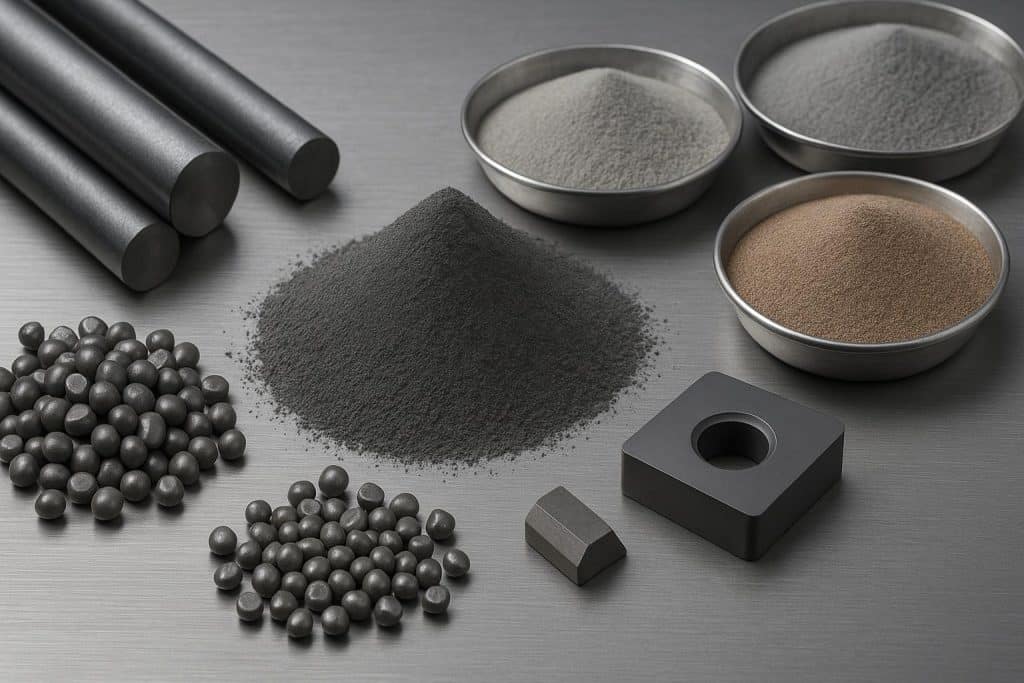
In the world of industrial materials, tungsten carbide occupies a unique space. It is the unsung workhorse behind almost every product we touch. From the ballpoint pen on a desk to the massive drill bits cutting through the ocean floor for oil, this material makes modern life possible. It is widely known for being incredibly hard and resistant to wear, often sitting right below diamond on the hardness scale. However, viewing tungsten carbide as a single, uniform material is a misconception. It is actually a composite, a complex recipe that metallurgists tweak and modify to suit specific environments.
For a business owner running a machining shop or a procurement manager at a mining company, the difference between a standard grade and a custom alloy can mean the difference between profit and loss. When a tool fails prematurely, production stops. When a wear part corrodes because the chemistry was wrong for the environment, costs skyrocket. This is where the subtle art of custom alloying comes into play. It turns a generic commodity into a specialized solution.
The Components of the Recipe
To understand customization, one must first understand the base ingredients. Tungsten carbide is a cemented carbide. It is not a metal alloy in the traditional sense, like steel or brass. Instead, it is a composite material made of hard ceramic particles (the tungsten carbide grains) glued together by a metal binder.
Think of it like concrete. The tungsten carbide grains are the gravel and rocks, providing the structural strength and wear resistance. The binder is the cement that holds everything together. In the vast majority of cases, cobalt is the binder of choice. It bonds exceptionally well with tungsten and offers a good balance of toughness and hardness.
However, standard mixtures of tungsten and cobalt are rarely enough for high-performance applications. If a manufacturer simply mixes a standard ratio of these two elements, the resulting material might be hard, but it might also be brittle. If they add too much binder, it becomes tough but wears down too quickly.
The goal of tungsten carbide manufacturing is to manipulate these variables. Engineers adjust the grain size, the percentage of the binder, and even the chemical makeup of the binder itself to create a material that behaves exactly how the end-user needs it to.
Hardness vs. Toughness
The central challenge in metallurgy is the trade off between hardness and toughness. In simple terms, hardness is the ability to resist scratching or wear. Toughness is the ability to absorb energy and resist breaking or chipping under impact.
Imagine a ceramic plate. It is very hard; you cannot scratch it easily with a knife. But if you drop it, it shatters. That is low toughness. Now imagine a car tire. It is very tough and can absorb the impact of potholes, but you can cut it easily. That is low hardness.
In industrial applications, engineers usually want both. They want a cutting tool that stays sharp for days (hardness) but will not snap if it hits a hard knot in a piece of wood (toughness). Achieving this requires custom alloying.
By creating a “graded” structure or adding small amounts of other carbides like titanium carbide or tantalum carbide, manufacturers can inhibit grain growth during the sintering process. This keeps the grain structure fine and uniform, which boosts hardness without a catastrophic loss of toughness. This level of micro-structural control is what separates high quality custom parts from generic imports.
Alternative Binders
While cobalt is the industry standard, it has limitations. It is susceptible to corrosion, particularly in acidic or saline environments. For industries like oil and gas, food processing, or marine engineering, a standard tungsten cobalt blend might fail rapidly. The salt water or acidic fluids eat away the cobalt binder, leaving the hard tungsten grains unsupported. The material essentially crumbles from the inside out, a process known as “leaching.”
To combat this, manufacturers create custom alloys using nickel or nickel chromium binders. Nickel offers superior corrosion resistance. It acts as a shield, protecting the integrity of the part even when submerged in harsh chemicals.
In the food production industry, this is not just about durability; it is about safety. Certain grades of binder must be FDA-compliant to ensure that no heavy metals leach into the product. A custom alloy designed for a tomato sauce canning line, which is highly acidic, will look very different chemically from an alloy designed for cutting dry lumber.
Grain Size
The size of the tungsten carbide particles plays a massive role in performance. These grains can range from submicron (extremely fine, like flour) to extra coarse (like sand).
Submicron grades are incredibly hard. They are used for micro-drills in the electronics industry, where precision is paramount and the tool needs to hold a razor sharp edge on a circuit board. There is very little impact involved, so the lower toughness of the fine grain is acceptable.
On the other opposite end of the spectrum, mining and road milling require coarse grains. When a road crew is tearing up asphalt, the teeth on the milling drum take a beating. A fine grain grade would shatter on impact. A coarse grain grade with a higher percentage of binder can absorb the shock of hitting rock and concrete without failing.
Customizing the grain size distribution allows manufacturers to tune the material. Some advanced grades even mix grain sizes, using small particles to fill the voids between larger ones, attempting to get the benefits of both worlds.
Industry Specific Customization
The true value of custom alloying becomes obvious when looking at specific industry challenges.
- Woodworking and Timber Cutting wood sounds easy, but it is actually chemically aggressive. Wood contains tannic acids that attack cobalt binders. Furthermore, modern engineered woods like MDF (Medium Density Fiberboard) contain glues and resins that are extremely abrasive. A standard grade saw tip will dull quickly. Custom grades for woodworking often use a specialized binder that resists acid corrosion while maintaining a fine grain for a sharp cutting edge.
- Oil and Gas Downhole tools operate in some of the most hostile environments on Earth. High pressure, high temperature, and the presence of corrosive hydrogen sulfide gas create a metallurgical nightmare. Components like valve trim, seal rings, and nozzles must survive these conditions for thousands of hours. Here, manufacturers often use complex binders involving nickel, chromium, and molybdenum to resist corrosion and thermal cracking.
- Metal Forming In can making or wire drawing, tools are under constant compressive stress. They need to be polished to a mirror finish to prevent the metal from sticking to the tool (galling). Custom grades for this sector focus on minimizing porosity. Any tiny pore on the surface of the tool can cause a scratch on the final product. Metallurgists use Hot Isostatic Pressing (HIP) alongside specific alloy recipes to ensure a theoretically dense material with zero porosity.
The Future of Alloying
As technology advances, so do the demands on materials. We are seeing a rise in additive manufacturing (3D printing) for cemented carbides. This changes the game entirely. It allows for complex geometries that were previously impossible to mold or machine.
The alloying requirements for 3D printing are distinct. The powders must flow differently, and the binder distribution must be precise to prevent warping during the sintering phase. This is the new frontier for metallurgists: designing alloys not just for performance, but for printability.
We are also seeing research into binder-less carbides and alternative hard phases that reduce reliance on cobalt, driven by both health regulations and supply stability. The recipe continues to evolve.
In Conclusion
Tungsten carbide is far more than a simple hard metal. It is a canvas for metallurgical innovation. The ability to tweak carbon levels, swap binders, and control grain sizes allows this material to adapt to the specific needs of forestry, energy, medicine, and manufacturing.
For decision makers in these industries, the takeaway is clear: do not settle for the default option. Understanding the specific stresses your machinery faces and demanding a material composition designed for those conditions is a competitive advantage. It turns a consumable expense into a long term asset. Whether cutting through steel or pumping corrosive sludge, there is a specific alloy recipe that does it better, longer, and more efficiently.