

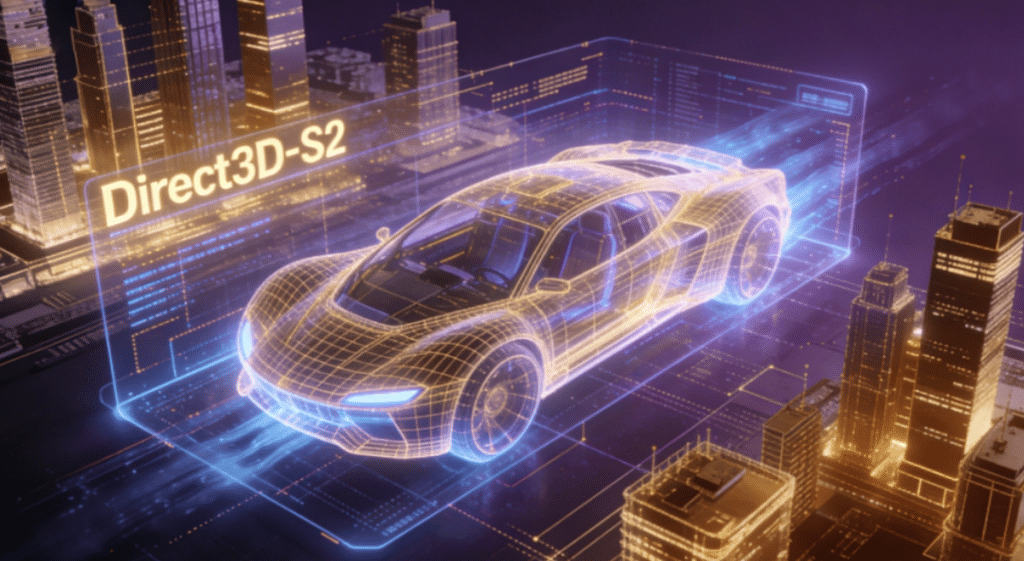
The promise of a truly “Open Metaverse” has long been delayed by a singular, physical reality: 3D assets are remarkably difficult and expensive to create. While the hardware, led by the Apple Vision Pro and Meta Quest 4, has leaped into the era of spatial computing, the content ecosystem remains trapped in a 2D-centric production model. To power the next generation of digital twins and interactive environments, a robust spatial computing engine is required to bridge the gap between creative vision and engine-ready reality.
Neural4D (N4D) is positioning its Direct3D-S2 architecture as the foundational logic for this new era. By moving beyond simple “image-to-mesh” estimation and toward native volumetric reasoning, N4D is turning the 3D asset bottleneck into a high-speed automated pipeline.
1. Direct3D-S2: The Architecture of Immersive Fidelity
In spatial computing, “good enough” geometry no longer exists. On a flat 2D screen, a slightly distorted mesh can be hidden with clever lighting; in a 1:1 scale VR environment, those same artifacts break the immersion instantly. Direct3D-S2 was designed to solve this by prioritizing volumetric integrity over mere visual resemblance.
⚡ 2048³ Native Resolution: Most generative models struggle beyond 1024-voxel density. N4D’s native logic allows for 2048³ resolution, delivering the sharp edges and intricate details necessary for industrial digital twins and luxury retail assets.
🎹 Spatial Sparse Attention (SSA): The breakthrough of the SSA mechanism lies in its efficiency. By focusing compute only on the physical surfaces of an object, it achieves an inference speed 12 times faster than current industry standards.
The emergence of spatial intelligence for production-ready 3D AI marks a turning point where AI-generated meshes no longer require hours of manual retopology to be usable in professional environments.
2. Interoperability: The Key to an Open Metaverse
The vision of the Open Metaverse depends on interoperability—the ability for a digital asset to retain its physical and visual properties whether it is inside Unreal Engine 5, Unity, or a WebXR browser.
N4D ensures this portability by adhering to strict industrial standards during the generation process:
✅ Watertight Geometry: Every asset generated is mathematically closed (manifold). This is critical for physical simulations where “leaky” meshes cause collision detection to fail or 3D prints to collapse.
✅ PBR Texturing Pipeline: Rather than “baking” light into the texture, N4D outputs full Physically Based Rendering (PBR) maps, including Albedo, Roughness, and Metallic layers. This ensures the asset reacts naturally to the lighting conditions of any virtual world it enters.
3. Neural4D-2.5: Scaling the Human-AI Collaboration
As we look toward the 2026-2027 roadmap, the role of the creator is shifting from “builder” to “director.” Neural4D-2.5 introduces a conversational multi-modal layer that allows for rapid scene iteration.
Through Natural Language Instructions, developers can refine spatial assets in real-time. Whether it’s adjusting the scale of a structural beam or the fabric weave of a virtual garment, the Direct3D-S2 engine handles the underlying math, allowing the creator to focus on the experience. This “deterministic output” is what makes N4D a strategic asset for enterprises scaling their spatial presence.
4. Conclusion: Architecting the Future of Reality
Spatial computing is not just a new way to see the world; it is a new way to build it. By reducing the computational overhead and maximizing mesh fidelity, Neural4D is providing the infrastructure needed for an era where the digital and physical are indistinguishable.
For developers and brands architecting the future of the metaverse, integrating a high-performance spatial computing engine is the first step toward creating a reality that is truly immersive, interoperable, and ready for the world to step inside.