

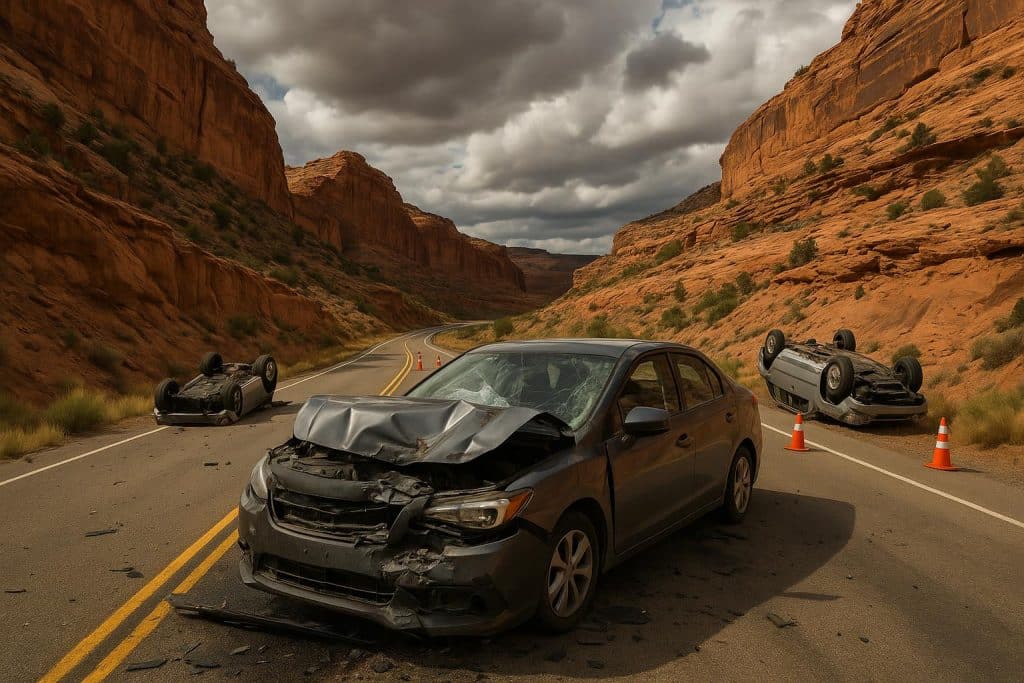
You know the drill. You’re cruising down I-15, maybe heading into Salt Lake for work or making that weekend drive down to St. George. The mountains are on your left, the radio is playing something decent, and traffic is actually moving for once. Then, out of nowhere, brake lights flash red. Tires screech. That sickening crunch of metal on metal follows, and suddenly, your perfectly average Tuesday has turned into a nightmare.
It happens fast. Too fast. One minute you are thinking about what to grab for lunch, and the next you are sitting on the shoulder of the highway, heart pounding against your ribs, wondering if that smoke coming from your hood is going to turn into a fire.
Most of us think we are good drivers. We think we are prepared. But when the dust settles and the adrenaline starts to fade, the reality of the situation hits you like a freight train. It’s not just about the damaged bumper or the insurance call. It is the dizzying maze of questions that follows. Whose fault was it? Why does my neck hurt? Who is going to pay for this rental car?
The Immediate Aftermath and the Legal Maze
Once the police have come and gone and you are left staring at a crumpled piece of metal that used to be your car, the phone calls start. Insurance adjusters are quick. They call you before you’ve even had a chance to process what happened. They sound nice, sure. They ask how you are feeling. They tell you they want to “take care of things” quickly. It sounds great, doesn’t it?
But here is the thing, they don’t tell you. They aren’t working for you. They work for a massive corporation that makes money by paying you as little as possible. That “quick settlement” they are offering? It often doesn’t even cover the ambulance ride, let alone the months of physical therapy you might need down the line.
This is usually the moment when people realize they might be in over their heads. You try to read through the policy documents, but it looks like it was written in another language. You realize that to get fair treatment, you need someone who speaks that language fluently. You might need to bring in a Utah car accident lawyer to level the playing field. Having someone who understands the specific tactics insurance companies use in our state can be the difference between getting your medical bills paid and drowning in debt.
It is not about being litigious or greedy. It is about protection. When you are injured and vulnerable, the last thing you need is a professional negotiator trying to talk you into signing away your rights for a few hundred bucks.
Understanding Utah’s “No-Fault” System
One of the most confusing parts of crashing in Utah is the “no-fault” status. If you are from out of state, or if you have just never had a wreck here, this can trip you up.
Basically, it means that no matter who caused the crash, your own car insurance pays for your initial medical bills. This coverage is called Personal Injury Protection, or PIP. It sounds convenient, right? It means you don’t have to wait for the other driver’s insurance to admit fault before you can go to the doctor. You just go, and your PIP kicks in.
But there is a catch. PIP usually has a limit, often around $3,000 for medical expenses. In today’s healthcare world, $3,000 gets you an ambulance ride and maybe a Tylenol at the ER. Once you burn through that PIP coverage, things get complicated. You can only step outside of the no-fault system and pursue a claim against the at-fault driver if you meet certain thresholds.
This is where the law gets sticky. You generally need to have incurred more than $3,000 in medical bills, or have suffered a “permanent” injury, to file a liability claim for pain and suffering. Determining what counts as “permanent” or proving that your bills were “necessary” is where the fight usually happens. The insurance company will argue that you didn’t need that MRI or that your back pain is from an old sports injury, not the crash.
The Comparative Negligence Trap
Let’s say you get past the no-fault hurdle. Now you have to deal with the fault. Utah follows a “modified comparative negligence” rule. This is a fancy way of saying that you can still get paid even if the accident was partly your fault, but only up to a point.
Here is the kicker: that point is 50 percent.
If a judge or jury decides you were 49 percent at fault, you can recover damages (though your payout gets reduced by that 49 percent). But if you are found to be 50 percent at fault? You get nothing. Zero.
Imagine you are in a crash at an intersection. The other guy ran a red light, but you were speeding slightly. The insurance adjuster might try to argue that your speed contributed 50 percent to the crash. If they succeed, they walk away without paying a dime. This 50 percent bar is a strict cutoff. It makes the investigation phase absolutely critical. You can’t just assume the police report will save you. You need photos, witness statements, and sometimes even accident reconstruction experts to prove that you were not the primary cause.
Financial Preparedness and the Unexpected Costs
Beyond the legal battles and the insurance limitations, there is the immediate financial shock. Even with good insurance, the out-of-pocket costs pile up fast. You have deductibles to pay. You might have to pay for a rental car upfront and wait for reimbursement. You have copays for medication.
It is moments like this where general financial health becomes a safety net. We often talk about saving for vacations or houses, but building a traveler’s emergency fund isn’t just for missed flights or lost luggage. It is for those moments when you are stranded in a mechanic’s waiting room in Nephi or recovering in a hospital in Provo, needing cash flow while the insurance companies bicker over liability.
Having that financial cushion allows you to make calm decisions rather than desperate ones. When you are broke and injured, you are more likely to accept that lowball offer just to keep the lights on. Financial stability gives you the patience to fight for what you actually deserve.
The Long-Term Impact of “Minor” Injuries
A lot of people walk away from a crash feeling “fine.” The adrenaline is masking the pain, or maybe it just feels like a stiff neck. So they tell the police they aren’t hurt. They tell the insurance company they are okay.
Then, two weeks later, they wake up and can’t turn their head.
Whiplash, soft tissue injuries, and even concussions can have delayed symptoms. The problem is, if you have already given a recorded statement saying you were “fine,” the insurance company will use that against you. They will say this new pain must be from something else.
This is why you never, ever sign a release immediately after a crash. You do not know what your body is going to do in a month. You do not know if that tingling in your fingers is temporary or if it is a sign of nerve damage that will require surgery.
Utah’s statute of limitations generally gives you four years to file a lawsuit for a car accident. That sounds like a long time, but it flies by. And if the vehicle that hit you was a government vehicle—like a city bus or a police car—that timeline shrinks drastically. You might only have a year, or even less, to file a “notice of claim.” Miss that deadline, and your case is dead in the water.
Protecting Yourself on Utah Roads
So, what can you do? You can’t control the other drivers. You can’t stop the person in the lane next to you from texting while driving. But you can control your response.
Get a dashcam. It is the single best investment you can make for your car. In a “he-said, she-said” situation, video footage is the ultimate tiebreaker. It stops the arguments about who had the green light before they even start.
Be careful with what you post on social media. It sounds paranoid, but insurance investigators look at your Facebook and Instagram. If you are claiming a serious back injury but you post a photo of yourself hiking Angels Landing the next weekend, your case is toast.
And finally, don’t face the system alone if you don’t have to. The laws here are designed to be fair, but they are also complex. The insurance companies have teams of experts working to protect their profits. You deserve to have someone protecting your future.
Driving in Utah is beautiful. The scenery is unmatched. But the risks are real. When the unexpected happens, knowledge is your best defense. Stay safe out there, and watch out for those red lights.