

Imagine you arrive at your desk on Monday morning and, instead of opening a chat window, you brief your AI on the week’s priorities. It reads your codebase, pulls your latest project notes, coordinates three specialist subagents, and 20 minutes later drops a finished pull request, a competitive brief, and a drafted client email into your project folder. You review. You ship.
That is the promise both Claude Cowork and Eigent are selling in 2026. Both platforms let you hand a complex goal to an AI agent and walk away while it executes. Where they diverge is in how that execution happens, who owns the infrastructure running it, and how deeply you can customize and extend it for your specific workflows.
This is a round-by-round comparison of both platforms across the dimensions that actually affect daily use.
Round 1: Getting Started
Claude Cowork is designed to minimize time between install and first productive task. Existing Claude Pro or Max subscribers open the desktop app, point it at a project folder, and are running agentic workflows within a few minutes. The interface is polished and approachable for non-technical users. Progress panels surface what the agent is doing at each step. Steering controls let you redirect or pause mid-task without starting over. There is nothing to configure beyond your existing Anthropic subscription.
Eigent is straightforward to get running. The desktop app downloads directly from eigent.ai, and the local backend starts up with a handful of commands. For most developers the entire process takes under 15 minutes. The platform runs a local stack of FastAPI, PostgreSQL, and an orchestration layer in Docker, which means you own and control the infrastructure from day one. Your data stays on your machine without any additional configuration required.
Verdict: Both platforms are accessible within a short window of deciding to try them. Cowork suits non-technical users who want zero configuration and are already on a Claude subscription. Eigent suits developers and technical teams who want a quick local setup plus full ownership of the stack. The gap in onboarding effort is smaller than it looks, and Eigent’s payoff in data control and extensibility starts immediately.
Round 2: How the Agents Execute Work
This is the most architecturally significant difference between the two platforms.
Claude Cowork operates as a single agent with access to a set of tools. It plans a workflow, executes steps sequentially, and can spawn sub-agents when the task demands it. For everyday workloads such as drafting documents, refactoring a module, or summarizing a research topic, this model is fast, reliable, and benefits from tight integration with Anthropic’s latest Claude capabilities. The single-agent model is also easier to reason about when something goes wrong.
Eigent is built around a workforce model. A root coordinator agent receives your goal, decomposes it into parallel subtasks, and dispatches those subtasks to a pool of specialized worker agents running simultaneously. Developer agents, browser agents, document agents, and multimodal agents operate concurrently rather than waiting in sequence. For workflows with independent branches, the throughput difference is real. The architecture originates from the CAMEL-AI research framework, so the orchestration logic draws on academic work on multi-agent communication and fault tolerance rather than being a product-team convenience.
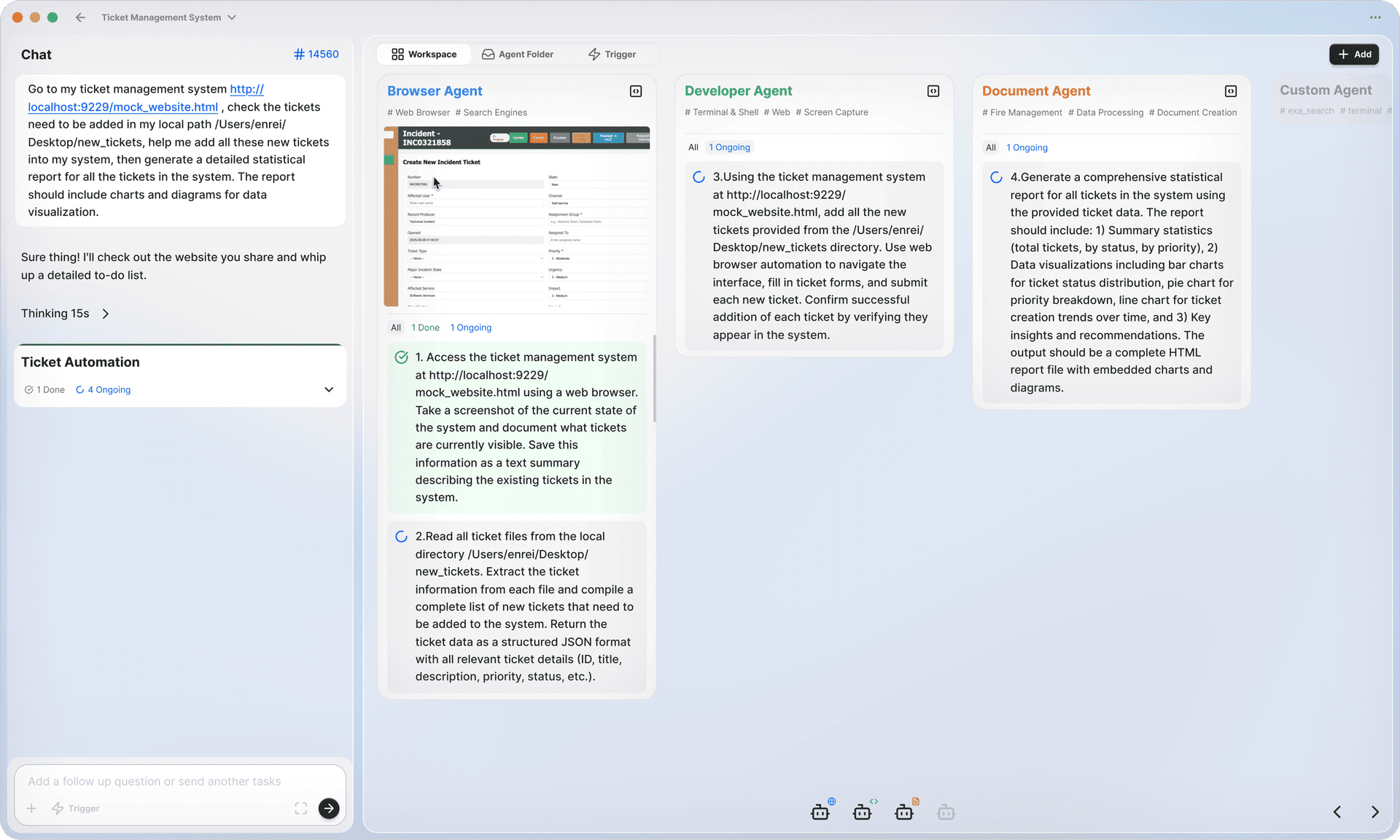
Verdict: For simple to moderate tasks, both platforms produce good results. For complex workflows that can be decomposed into parallel branches, Eigent’s workforce architecture produces faster results and handles partial failures more gracefully. If your day-to-day workload is primarily sequential tasks, Cowork’s simpler model is entirely sufficient.
Round 3: Skills and Triggers vs Plugins and Scheduled Tasks
How you extend an AI coworker platform and automate recurring workflows matters as much as what it can do out of the box.
Claude Cowork extends through Plugins, which are MCP-based tool servers that expose new capabilities to the agent. Time-based automation is covered by Scheduled Tasks, which fire a workflow at a specified time. Both systems work reliably for standard use cases. The ecosystem is managed within Anthropic’s distribution model, and there is no community-driven mechanism for packaging and sharing reusable workflows between teams.
Eigent approaches extensibility through two systems that work together: Skills and Triggers.
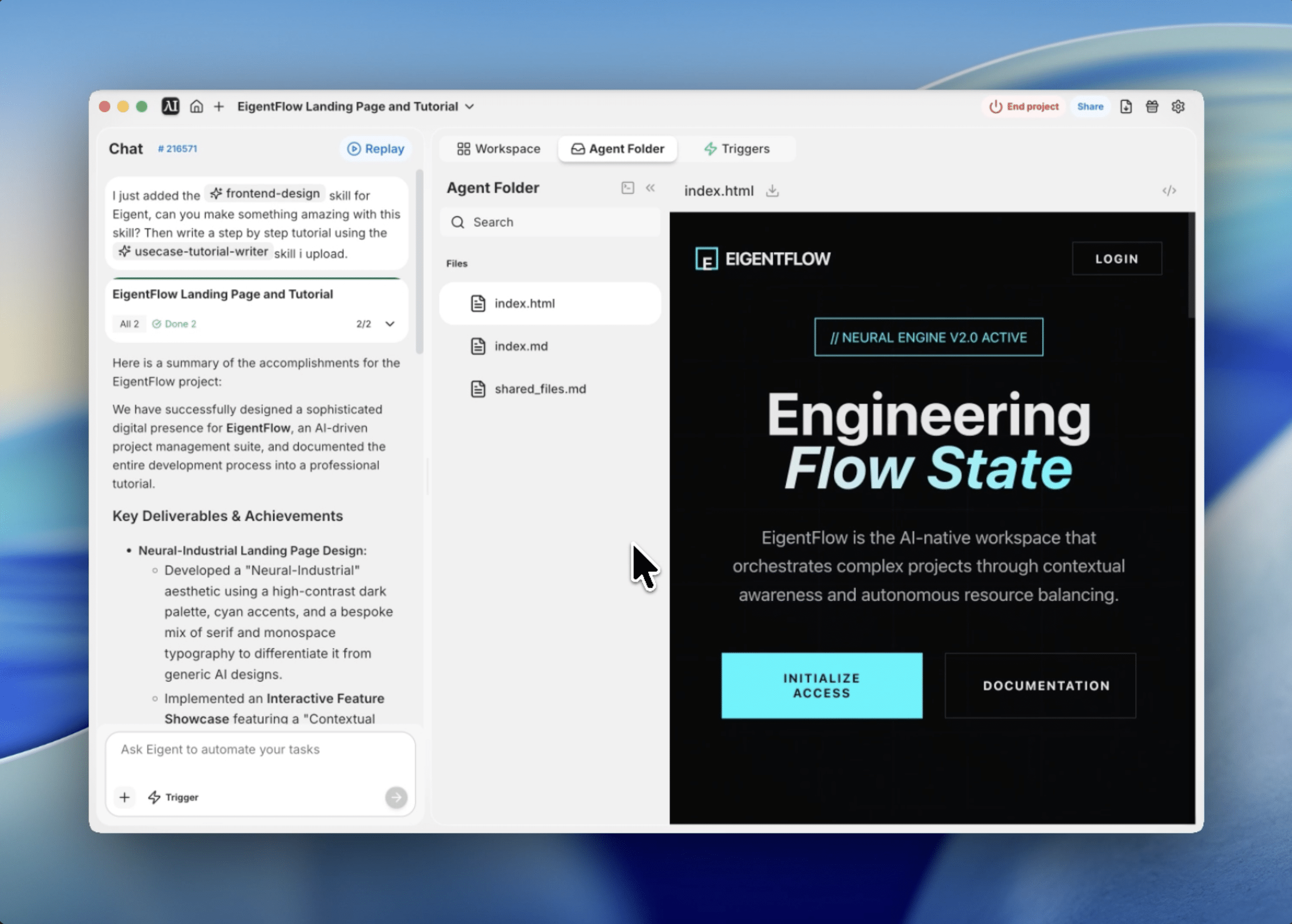
Skills are packaged, reusable workflow definitions. Instead of describing a multi-step process every time it is needed, you encode it into a Skill file that any agent in the workforce can invoke consistently. Eigent ships with a growing library of built-in Skills covering common professional tasks: document generation with the DOCX and PDF skills, spreadsheet creation with the XLSX skill, presentation building with the PPTX skill, and recurring automation with the Schedule skill. Skills are composable, so a workflow that generates a report, converts it to PDF, and sends a summary can become a single invokable unit rather than a manual sequence of prompts.
Triggers expand on this by activating Skills and agent workflows automatically. A Trigger can be time-based via cron schedule, event-based such as a file appearing in a folder or an incoming API webhook, or on-demand via a single click from your IDE. Where Cowork’s Scheduled Tasks address the time-based case, Eigent’s Trigger system is broader and integrates directly with the workforce architecture, so a triggered workflow distributes work across multiple parallel agents rather than queuing behind a single one.
A practical example: weekly reporting. With Cowork, a scheduled task runs a prompt at the designated time. With Eigent, a Trigger fires a Skill that dispatches a Developer agent to pull the latest metrics, a Document agent to draft the narrative section, and a Browser agent to fetch any external benchmarks, all simultaneously, with the root coordinator assembling the final output.
Verdict: Eigent’s Skills plus Triggers system offers meaningfully deeper extensibility than Cowork’s Plugins plus Scheduled Tasks, particularly for teams with recurring structured workflows that benefit from packaging and reuse. For users who need only occasional tool access and basic time-based reminders, Cowork’s simpler model is perfectly functional.
Round 4: Privacy, Data Residency, and Model Choice
Claude Cowork accesses your local file system directly, which is a genuine step forward from cloud-only AI tools. Your files stay on your machine. Every inference call and every task prompt, however, travels through Anthropic’s model infrastructure. For the majority of consumers and many businesses, this is a reasonable trade-off. For teams with regulated data, proprietary IP, or air-gapped network requirements, the cloud inference component creates compliance complexity that needs to be addressed before deployment.
Cowork also runs exclusively on Claude models. There is no way to route specific subtasks to a different provider, use a locally hosted open-weight model for cost-sensitive steps, or switch providers based on organizational preference or performance requirements.
Eigent keeps the entire stack local by default. The FastAPI backend, the orchestration logic, task history, and all intermediate data live in Docker containers on your machine. Inference calls go to whichever providers you configure, including locally hosted models via Ollama, which enables fully offline workflows with no external network traffic. Teams using Gemini, MiniMax, OpenAI-compatible APIs, or any combination can configure the agent workforce to match their existing infrastructure rather than the other way around.
Verdict: For data-sensitive teams, Eigent’s local architecture is a structural advantage that Cowork cannot replicate regardless of future feature additions. For individuals and small teams without strict compliance requirements, Cowork’s approach is practical and safe. On model flexibility, Eigent is the clear winner.
Round 5: Cost and Long-Term Value
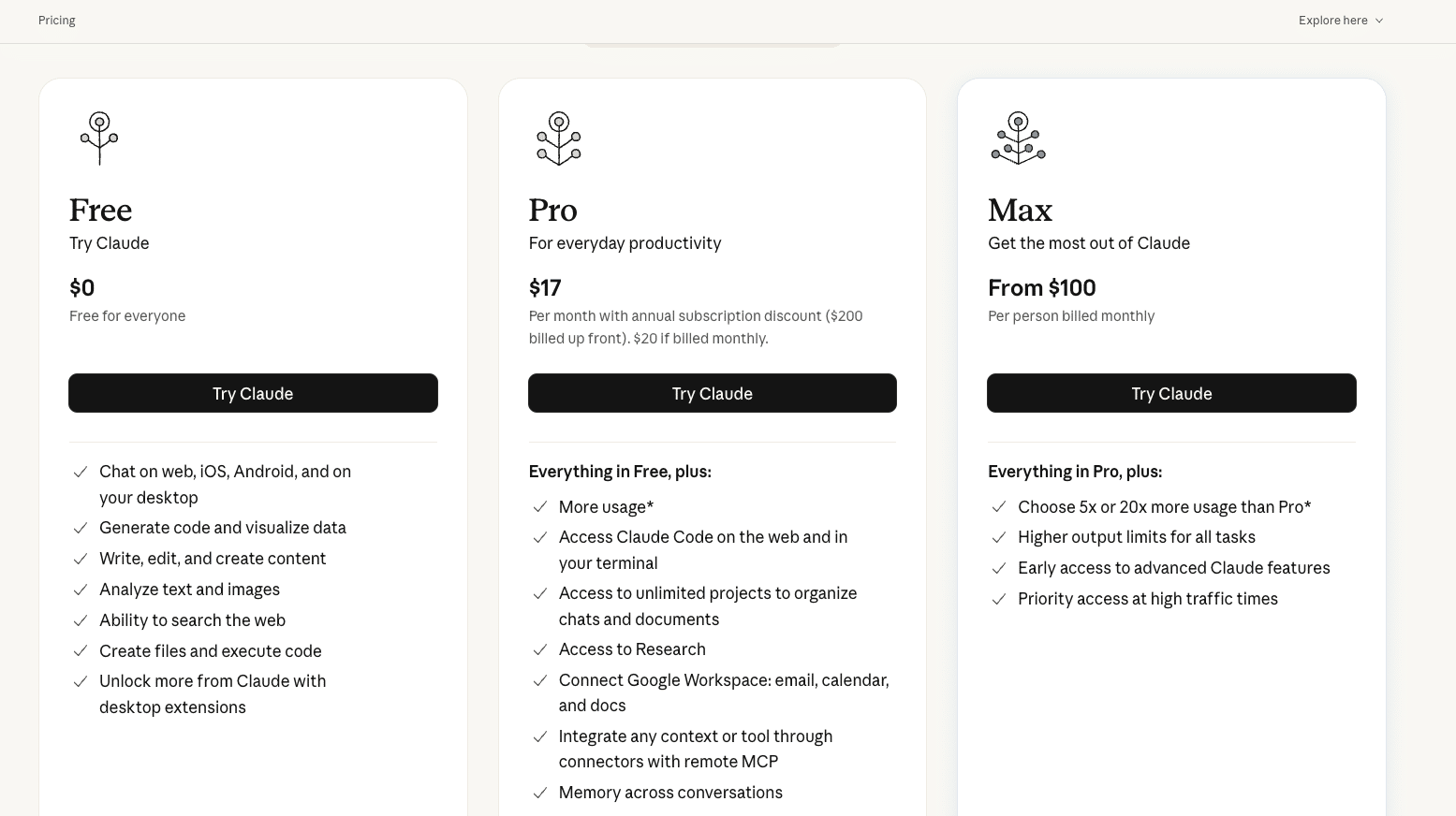
Claude Cowork is included in Claude’s Pro and Max subscription tiers. For existing subscribers, there is no incremental cost to start using the agentic desktop features. The pricing model is simple and the value is clear for light to moderate individual usage. At team scale, per-seat subscription costs compound in a way that does not reflect actual usage intensity, and there is limited ability to optimize costs per task type.
Eigent has no platform cost. The Apache 2.0 licensed software is free to download, deploy, and modify. All costs come from LLM API usage, and you control those by choosing providers, selecting cost-efficient models for lower-stakes tasks, and routing premium model calls only where the quality difference is worth the price. Organizations running Eigent with locally hosted models via Ollama pay essentially zero variable cost for the agentic platform layer itself.
Verdict: For an individual already on a Claude subscription, Cowork’s bundled pricing adds clear convenience. For teams scaling beyond a handful of seats, or any organization that wants cost transparency and per-task optimization, Eigent’s BYOK economics are more efficient over time.
Feature Comparison Table
| Feature | Claude Cowork | Eigent |
|---|---|---|
| Agent model | Single agent with tools | Multi-agent workforce |
| Parallel execution | Limited | Native, built-in |
| Extensibility system | Plugins (MCP) | Skills plus MCP servers |
| Automation and scheduling | Scheduled Tasks | Triggers: cron, event, webhook |
| Built-in tool library | Limited | 200+ MCP tools |
| Skill sharing and reuse | Not available | Community skill library |
| Model support | Claude only | BYOK, any provider |
| Offline capability | No | Yes via Ollama |
| Data residency | Local files, cloud inference | Fully local stack |
| Open source | No | Apache 2.0 |
| Enterprise features | Not announced | SSO, RBAC, audit logs |
| Platform cost | Claude Pro/Max subscription | Free |
Who Each Platform Is Built For
Both platforms solve a real problem. The question is which constraints each solves better for your specific situation.
Claude Cowork is the stronger fit if:
You want to be productive within minutes of installing. Your team includes non-technical members who need a clean, guided interface with no configuration overhead. You are already on a Claude subscription and want native access to Anthropic’s latest model capabilities. Your workflows are primarily ad-hoc and do not require recurring automation or reusable workflow packaging.
Eigent is the stronger fit if:
Your data cannot leave your infrastructure due to compliance, contractual, or security requirements. You need genuine parallel multi-agent execution for complex, multi-branch tasks. You want to build recurring workflows as reusable Skills and trigger them automatically rather than re-prompting every time. You want model flexibility and cost control through BYOK. You are building AI agent infrastructure that will scale across a team and need an open, auditable, extensible foundation. You have enterprise governance requirements such as SSO, RBAC, or auditable execution logs.
A hybrid approach works well for many teams:
Cowork handles fast, lightweight, Claude-optimized tasks where native model quality and minimal setup are worth the subscription cost. Eigent handles sensitive, recurring, or complex workflows where the full workforce architecture, local data residency, and Skills ecosystem justify the setup investment. The two platforms are not mutually exclusive.
The Bigger Picture
Claude Cowork validated a new interaction model for AI at work. Giving an agent direct, persistent access to your local environment produces results that chat-based interfaces simply cannot replicate. That contribution to how this category is evolving is genuine.
Eigent rebuilt that interaction model on an open, extensible foundation with a workforce architecture that goes further on parallel execution, model flexibility, and extensibility. The Skills and Triggers system represents a more mature answer to how teams standardize and scale AI workflows, packaging institutional knowledge into reusable units that any agent in the workforce can invoke and triggering those units through a broader set of activation mechanisms than time-based scheduling alone.
For a broader look at how Eigent compares to other open source Claude Cowork alternatives including OpenClaw, Open Cowork, and OpenWork, the Eigent team has published a comprehensive guide to the top five options in 2026.
Both platforms are worth running against your actual workflows before committing. The practical difference is that one of them is free to evaluate without a time limit.