

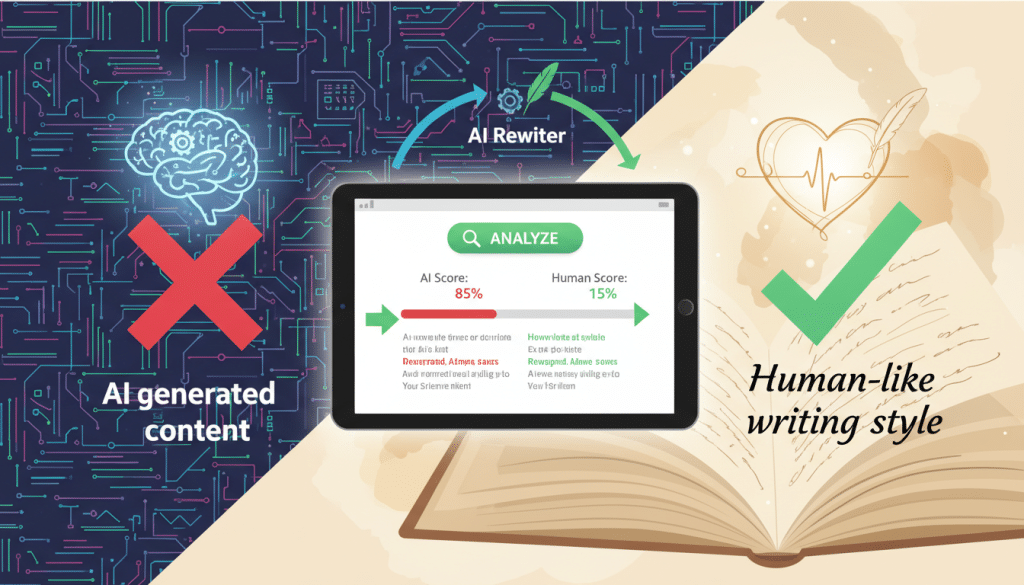
AI has made writing faster, but it has also made evaluation harsher. Content is no longer judged only on clarity or correctness. It is judged on whether it feels authored. In classrooms, content teams, and professional settings, writing that looks automated faces friction. Dechecker is built for that reality, helping writers keep control when AI is part of the workflow.
Where AI-assisted writing starts to fail
When drafts arrive before decisions
AI produces usable drafts almost instantly. That speed changes behavior. Writers spend less time deciding what they want to argue and more time reacting to what already exists. The result is content that moves forward without clear commitment.
An AI Checker exposes this problem quickly. It doesn’t accuse the text of being artificial. It shows where the writing stops reflecting clear human choice. Those are the sections that typically raise concern later, even if no rule is broken.
Smooth text can still raise doubt
Writing can be fluent and still feel wrong. Many AI-assisted drafts read evenly from start to finish, with no pressure points or shifts in emphasis. Readers notice this. They may not call it “AI,” but they slow down, reread, or disengage.
Dechecker helps writers spot these uniform stretches early, when structural adjustments still make sense. Fixing this at the sentence level rarely works. The issue is momentum, not grammar.
Risk shows up before feedback arrives
By the time an editor, reviewer, or instructor flags content, the damage is already done. The writing has been framed as questionable.
Dechecker is designed to surface risk before that moment. It allows writers to see how their content might be received, not just how it was generated.
Using detection to guide decisions, not panic
Scores are not the objective
Detection tools often tempt writers into chasing numbers. They rewrite until a score drops, even if the text becomes weaker in the process. This is how content loses clarity.
Dechecker avoids that trap by positioning AI Checker feedback as directional. It highlights patterns worth reviewing, not outcomes to satisfy. Writers decide what matters and what doesn’t.
Structural signals matter most
Credibility problems rarely come from isolated sentences. They come from repeated patterns: similar paragraph lengths, predictable transitions, and balanced phrasing that never breaks rhythm.
Dechecker draws attention to these signals. That encourages writers to intervene at the structural level, where changes actually affect how the text reads.
Feedback changes drafting behavior
Writers who use AI Checker regularly stop waiting until the final draft to make decisions. They vary structure earlier. They commit to positions sooner. Over time, fewer sections trigger concern.
That shift is practical. It saves time and reduces unnecessary revision.
Turning AI drafts into publishable writing
When revision becomes erosion
One common mistake is revising blindly. Writers respond to feedback without understanding why it appeared. Over several passes, the original point softens. The text becomes safer and less useful.
Dechecker helps prevent this by tying feedback to readability and intent. Writers are pushed to clarify what a section is doing before they change how it sounds.
Controlled humanization, not decoration
Some drafts need rhythm restored. Others need sharper emphasis. Very few need more words.
For AI-heavy drafts, targeted use of the AI Humanizer can reintroduce natural variation without altering meaning. It works best when writers already know their position and want the language to reflect it more clearly.
Humanization here is corrective, not cosmetic.
Knowing when to stop editing
Not every flagged pattern deserves removal. Some repetition supports clarity. Some neutrality is intentional.
Dechecker helps writers recognize when a draft is strong enough to stand. That restraint is often what separates confident writing from overworked text.
Real-world pressure points
Academic work under scrutiny
Students now operate in an environment where suspicion comes easily. Even original work can be questioned if it reads too clean or too generic.
Dechecker allows students to review drafts before submission and identify where reasoning becomes indistinct. AI Checker feedback points to sections that need stronger ownership, not fabricated complexity.
Marketing content that must convert
In marketing, automated tone kills engagement. Readers disengage the moment messaging feels templated.
Dechecker supports content teams by identifying where copy loses specificity. That gives marketers a chance to reassert perspective and intent before performance drops.
Professional documents that carry weight
Reports and proposals are judged on accountability. Writing that feels assembled rather than authored weakens authority, regardless of accuracy.
Using AI Checker during drafting helps professionals maintain control over tone and progression. The document reads as considered, not compiled.
Confidence comes from control, not concealment
Faster revision through understanding
Writers revise faster when they know what they are fixing. Guesswork slows everything down.
Dechecker shortens revision cycles by making feedback legible. Writers learn which patterns matter and respond directly.
Authority shows in selective emphasis
Strong writing doesn’t emphasize everything. It chooses where to push and where to step back. That balance is difficult for AI to produce without guidance.
Dechecker helps writers reintroduce that balance by exposing over-even pacing and cautious phrasing. The fix is often subtraction, not addition.
Tools should reinforce judgment
The most effective tools don’t compete with the writer’s role. They support it.
Dechecker works because it keeps decision-making with the writer. AI Checker feedback informs judgment instead of replacing it.
Writing with AI, without losing credibility
AI is part of the baseline now
For many workflows, AI is unavoidable. The question is not whether it is used, but whether its use is visible in the wrong way.
Dechecker helps ensure it isn’t. It focuses on how writing reads under scrutiny, not how it was produced.
Results matter more than process
Readers care about clarity, intent, and responsibility. They don’t audit workflows. They respond to what’s on the page.
Writing that shows clear decisions earns trust. Dechecker exists to protect that outcome when AI accelerates everything else.