

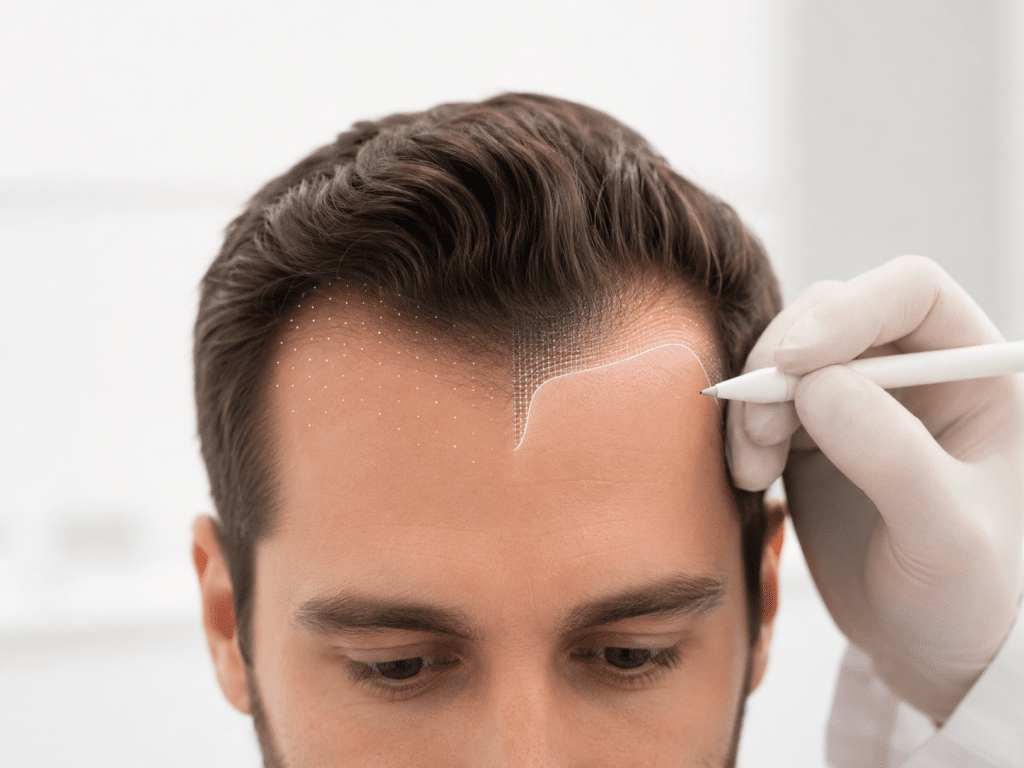
When looking into hair loss solutions, many people first turn to an online graft calculator. These tools seem straightforward: you select your hair loss pattern, typically using the Norwood scale, and in return, you get an estimated number of grafts needed.
The number feels solid, giving a preliminary sense of scope to a problem that was, until that moment, just something seen in the mirror.
This number is a starting point. Its job is to turn a flat picture into a number, but the reality of surgery is three-dimensional and depends entirely on the individual. The gap between that online estimate and a real clinical plan is filled by details that a basic calculator usually cannot assess fully.
Why the Basic Calculator’s Math Is Often Incomplete
The biggest limitation of a basic automated calculator is its inability to see your specific hair and scalp characteristics. It has to work on the assumption that everyone’s hair and donor area are the same; this is a basic problem.
For instance, someone with thick, coarse hair might get the visual density they want with 1,800 grafts in a specific area. To cover that exact same spot with a similar look, a person with very fine hair could require 2,700 grafts. A basic calculator has no reliable way to measure hair shaft thickness from a simple form. It mainly estimates the visible area that may need coverage.
And it assumes the donor area at the back of your head is a perfect, endless resource.
In practice, donor density (the number of hair groupings per square centimeter) is different for everyone. A surgeon might find a rich density of 90 follicular units per square centimeter in one spot but a lower count of 65 near the sides. This difference directly changes the surgical plan.
The calculator is also blind to the surgeon’s transection rate—the small percentage of hair follicles that might be damaged during extraction. With a 2,500-graft procedure, a 3% transection rate versus a 15% rate creates a difference of 300 usable follicular units. This is a massive variable that comes down to the surgeon’s skill, not a piece of code.
Other factors are difficult for basic calculators to measure accurately:
- Hair Type: Wavy or curly hair gives much better coverage than straight hair. Because of the way it bends and takes up space, a surgeon can often achieve the desired look with fewer grafts. This volume advantage is something a two-dimensional calculator can never account for.
- Color Contrast: The greater the contrast between your hair color and skin tone (e.g., black hair on fair skin), the more density is needed to create an illusion of fullness.
- Scalp Flexibility: How loose or tight the scalp is can affect the surgical method, particularly for FUT procedures.
What Does a Surgeon See That the Calculator Can’t?
The most important information is gathered during an in-person examination. A surgeon needs to look at the “miniaturization halo,” which is the transition zone around the obviously bald spot where native hairs are thinning but not yet gone.
A tough call has to be made: should new grafts be placed aggressively between these weaker hairs (which can sometimes cause temporary shedding of nearby hairs) or should the plan be more conservative? An online tool just sees this whole area as a bald spot needing total coverage, which can inflate the graft count.
The calculator’s true function is to give a rough reference point. For a prospective patient, the number it provides is best used to understand the general scale of the issue before a real consultation. It sets a baseline for a more meaningful conversation.
It is a tool for estimating magnitude. It can show whether you are likely looking at a 1,500-graft procedure or one that is closer to 4,500 grafts. That number, however, is not a treatment plan. The real, workable number only comes after a professional has assessed your donor density, hair caliber, and the specific pattern of your scalp and donor area.
Where Better Online Tools Can Still Help
A useful example is HairCostCalculator.com, an AI-supported hair transplant graft calculator that analyzes uploaded photos to estimate graft needs, compare average costs by destination country, and review donor-area suitability. For users who want to go further, the platform can also provide a free doctor-reviewed report based on their submitted information.