

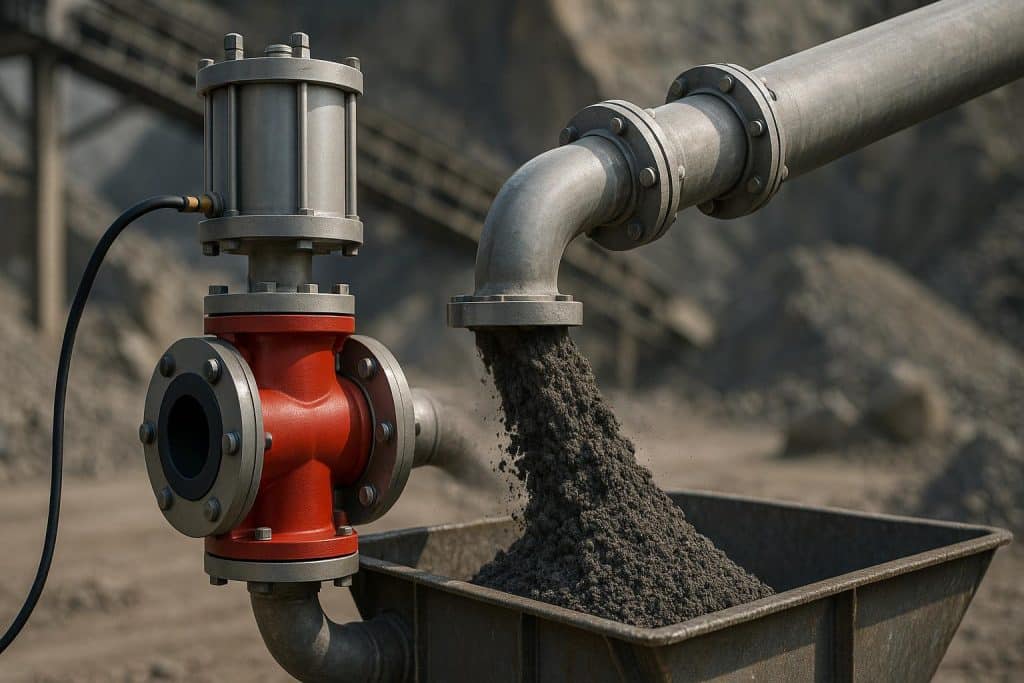
Industrial systems that handle abrasive slurries, powders, pellets, granulates, and viscous or solids-laden media place high demands on valves. In these services, conventional valve types often experience wear, plugging, buildup, and sealing problems that increase maintenance costs and reduce overall process reliability. That is why many engineers turn to pinch valve technology when evaluating severe-duty applications. Among the available options, pneumatic pinch valves are widely recognized for their combination of automation, simplicity, and process suitability.
The main difference with a pinch valve is how it controls flow. Rather than positioning a rigid closure component directly in the process stream, the valve shuts off by compressing a flexible sleeve. This reduces the number of internal parts exposed to abrasive or contamination-prone media. For difficult applications, that design difference can have a meaningful impact on performance and service life.
Abrasive wear is one of the biggest reasons these valves are selected. In slurry systems, suspended solids can erode conventional seating surfaces and internal trim, especially when flow is continuous or cycling is frequent. In powder and dry bulk systems, fine particles can enter mechanical areas and interfere with sealing or movement. By simplifying the shutoff mechanism, pinch valves often provide a more durable alternative in these harsh environments.
Automation adds another layer of value. Pneumatic actuation makes it possible to integrate the valve into broader process control systems, which is especially important in plants that rely on remote operation, rapid cycling, or coordinated valve sequencing. This is useful in conveying systems, batching operations, wastewater systems, and chemical processes where repeatable actuation is essential.
Pinch valves also perform well in applications where buildup is a concern. Difficult media does not always move smoothly through restrictive valve internals. Products may settle, compact, or cling to surfaces, eventually affecting reliability. Because the flow path is generally cleaner and less obstructed when open, pinch valves are often able to reduce those issues and support more consistent operation.
Shutoff performance is another practical advantage. Many valve styles seal well in clean service but become less reliable when fine particles or suspended solids are present. A pinch valve closes by pinching the sleeve, which can improve isolation in process conditions that are challenging for rigid seat designs. This makes the technology especially relevant where leakage or incomplete closure creates operational or housekeeping problems.
Industries such as mining, cement, ceramics, wastewater treatment, food processing, and bulk solids handling often rely on pinch valves because they align well with the realities of difficult media service. Instead of forcing abrasive or solids-heavy material through a valve designed primarily for cleaner fluids, these systems benefit from a valve concept built around simpler shutoff and reduced internal exposure.
Proper application review is still important. Pressure, temperature, media chemistry, sleeve material, and operating cycle requirements should all be matched carefully to the service. But when engineers need automation along with strong performance in severe-duty conditions, pneumatic pinch valves are often one of the most reliable options to evaluate.